
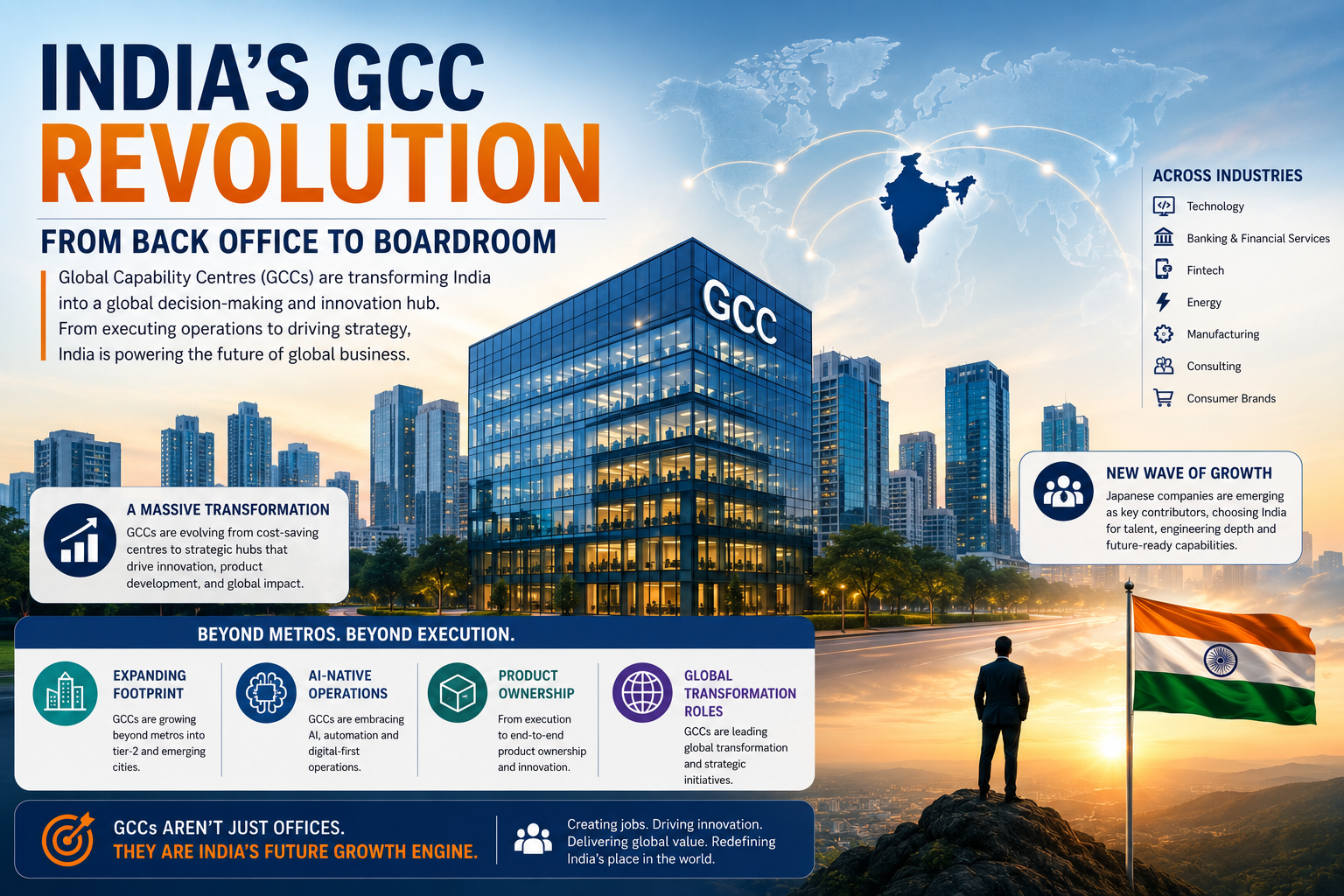
For a long time, India was identified with cheap IT services and software exports. While that remains an important pillar of Indian economy, focusing only on these sectors overlooked one of the biggest transformations currently underway in India- the rapid rise of Global Capability Centres (GCCs).
India is no longer just the world’s back office. It is increasingly becoming the place where multinational corporations make strategic decisions, develop products, drive innovation, and lead global digital transformation.
According to the latest Nasscom-Zinnov report, India is now home to 2,117 Global Capability Centres (GCCs), employing over 20 lakh professionals. These centres have evolved from cost-saving units into strategic hubs that play a critical role in the global operations of some of the world’s largest companies.
From back office to strategic headquarters
The GCC story began when multinational companies started setting up operations in India primarily for repetitive support functions. These centres handled customer support, finance operations, and other back-office activities that helped companies reduce operational costs.
Over time, however, India’s talent pool started to change the equation.
Today, GCCs in India handle high-value functions such as financial analysis, advanced analytics, product engineering, cybersecurity, artificial intelligence (AI), and research & development (R&D). Instead of merely executing instructions from headquarters abroad, Indian teams are increasingly designing products, developing technologies, and influencing business strategy.
This shift has transformed GCCs from simple cost centres into indispensable components of enterprise strategy.
Western companies led the way
Initially, most GCC investments came from companies based in the United States and Europe. Businesses across sectors—including software, banking, financial services, fintech, energy, manufacturing, consulting, and consumer goods—established large operations in India to tap into its growing talent ecosystem.
These centres gradually expanded in both scale and responsibility, laying the foundation for India’s emergence as a global knowledge and innovation hub.
Japanese companies are driving the next wave
The next phase of India’s GCC story is now unfolding. Japanese companies are rapidly emerging as one of the fastest-growing sources of new GCC investments. Recent industry reports indicate that Japan has become the largest contributor among Asia-Pacific-origin GCCs.
Unlike earlier outsourcing models focused primarily on reducing costs, Japanese firms are increasingly choosing India for its engineering expertise, highly skilled workforce, digital capabilities, and long-term innovation potential.
This marks a significant evolution in how global companies perceive India’s role in their international operations.
A massive growth opportunity
The financial outlook reflects this transformation. According to the Nasscom-Zinnov report, India’s GCC ecosystem is expected to generate $98.4 billion in revenue by FY26. Industry projections cited by the Financial Express estimate that this figure could rise to between $155 billion and $199 billion by FY30.
These numbers demonstrate that the GCC sector is not only expanding rapidly but also becoming increasingly mature and sophisticated.
Strengthening India’s Services Economy
The rise of GCCs is also contributing significantly to India’s broader services-led growth story.
According to data released by the Reserve Bank of India (RBI), India’s services exports reached a record $421.3 billion in FY26, while the country’s total exports touched an all-time high of $863.1 billion.
Although services exports are driven by multiple sectors, GCCs have emerged as one of the key contributors by creating high-value intellectual output and supporting global business operations from India.
Beyond Bengaluru and Hyderabad
Another notable trend is the geographical expansion of GCCs.
While Bengaluru, Hyderabad, and the National Capital Region (NCR) continue to dominate as major hubs, companies are increasingly exploring Tier-2 cities and emerging locations. Improvements in digital infrastructure, availability of skilled professionals, and lower operating costs are making these cities attractive destinations for future expansion.
At the same time, the nature of work is changing. GCCs are increasingly taking ownership of AI-native operations, end-to-end product development, and global transformation initiatives.
This reflects a broader shift in India’s role—from executing global projects to leading innovation and creating intellectual property.
The future growth engine
Global Capability Centres have become much more than office campuses employing thousands of professionals. They represent a structural transformation in India’s economy.
They are creating high-quality jobs, generating global value, attracting long-term foreign investment, and reshaping India’s identity in international business.
Understanding GCCs is no longer just about understanding one industry. It is about understanding where the Indian economy is headed. As multinational companies continue to place greater trust in India’s talent and innovation ecosystem, GCCs are set to become one of the country’s most important engines of growth in the coming decade.

