
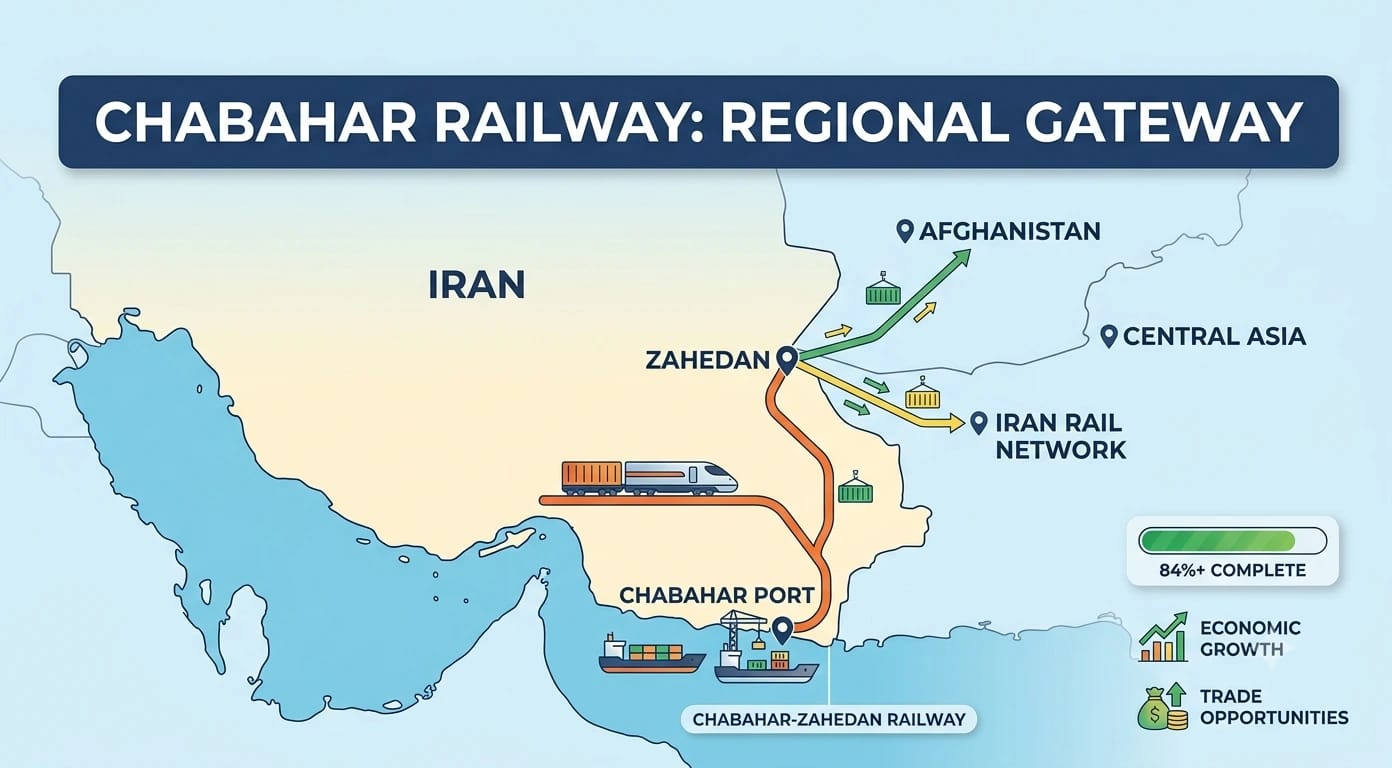
The Chabahar rail project in Iran is one of the most closely watched transport projects in the region because it connects a major ocean port with inland rail networks and opens a faster route for trade and movement.
The Chabahar–Zahedan railway has shown strong progress, with one source putting the project at more than 84% completion and another saying track-laying and station work are nearing the final stage. The line is being built to improve access from the port city of Chabahar to inland areas and to support wider economic and transport goals across the region.
To understand why this project matters, it helps to think about how goods move. When a port is linked to rail, cargo can travel more smoothly from ships to trains and then to cities, and inland markets.
This saves time, reduces pressure on roads, and can lower transport costs. In the case of Chabahar, the railway is expected to support trade with neighboring countries and landlocked regions by giving them a shorter and more practical route to the sea.
The project has also become important because it is tied to long-term regional planning. It has been described as a strategic link that can strengthen commercial movement and connect remote areas to the main rail system.
India’s push to fast-track the Chabahar rail link is tied to its broader strategic and economic interests in the region. the government has long viewed Chabahar Port in Iran as a critical gateway to Afghanistan and Central Asia, allowing India to bypass Pakistan for trade access. India is accelerating engagement now through renewed diplomatic coordination, operational support at the port, and potential technical or financial facilitation.
India aims to strengthen this alternative trade corridor, improve connectivity for Indian exports, and counterbalance China’s growing presence in nearby Gwadar Port under the China-Pakistan Economic Corridor (CPEC). The recent easing of regional tensions has created space for India to re-energize its involvement and ensure the project aligns with its long-term connectivity and trade strategy.
The railway line is about 634 kilometers long and has faced delays over the years, but work has continued and construction now appears much closer to completion. Many observers see it not just as a railway line, but as a development corridor with economic value beyond transport alone.
The financial side of the project has drawn attention as well. Earlier it was mentioned that there will be an estimated cost of around $1.5 billion to $1.6 billion, with funding linked to national development plans and infrastructure investment. In the early stages, there were discussions about outside participation, but later reporting said Iran pushed ahead with its own resources and engineering capacity.
That shift matters because it shows how major infrastructure can continue even when political or financial conditions become difficult.
For local communities, the value of the railway is easy to understand. A new rail link can bring work during construction, support businesses after opening, and make travel and transport more efficient. Farmers, traders, exporters, and importers may all benefit when goods move faster and more reliably. If you imagine a shipment that once needed multiple slow transfers, the railway can act like a straight bridge between the port and the inland network, making the whole process simpler and more predictable.
The project also carries wider regional importance because the port is seen as a gateway for trade beyond one country’s borders. It has been noted that the route can help movement toward Afghanistan and other Central Asian markets, which makes it attractive for long-distance commerce.
That is why the railway is often described as a missing link in the transport system: Once fully operational, it can change how people and goods move across a larger area.
In simple terms, the Chabahar rail project is about connection, speed, and opportunity. It links a sea port to inland rail lines, supports trade, and may improve access for businesses and communities that depend on smooth transport. As the project nears completion, its real test will be how well it helps everyday movement and regional commerce in practice.

