
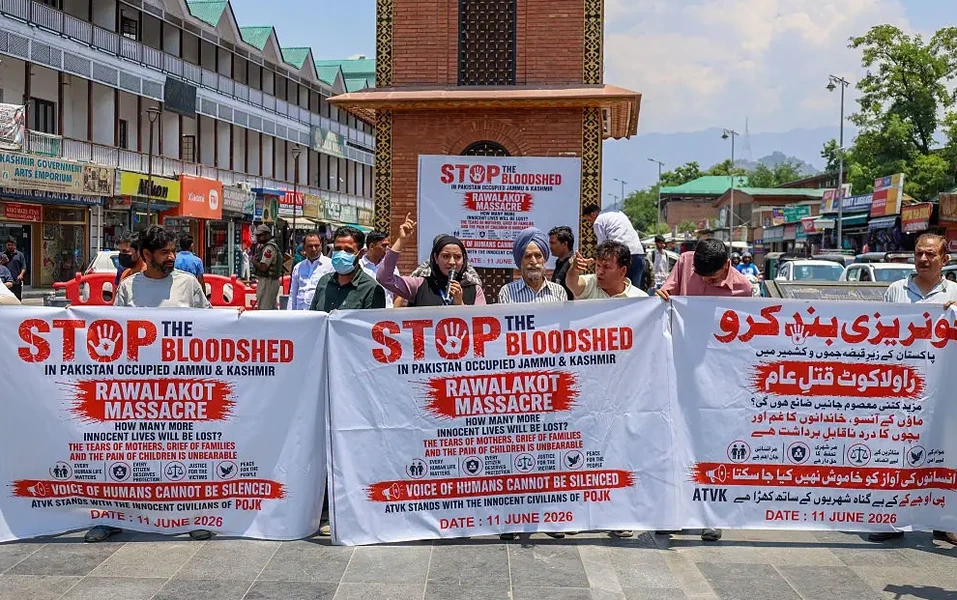
The protests in Pakistan-occupied-Kashmir show no signs of slowing down even though Pakistan government is resorting to collective punishment to break the protesters’ spirit. As per reports, supply of medicines and food essentials to the Pakistani occupied Indian territory has been disrupted as Pakistan establishment seeks to punish the protesters.
Now, thousands of people have gathered in Rawalakot in Pakistan-occupied Jammu & Kashmir (PoJK) to assert that the region is not a constitutional part of Pakistan, renewing calls for greater political rights and self-determination. The rally was attended by activists, civil society members, and local residents. This rally once again highlights growing dissatisfaction among people in PoJK with Islamabad’s governance of the Indian territory illegally occupied by Pakistan.
New : 🚨“Declaration at Rawalakot: ‘PoJK Is Not Part of Pakistan.”
Thousands of demonstrators at Rawalakot’s Eidgah Ground reiterated that PoJK is not part of Pakistan, delivering another major challenge to Islamabad’s control over the region.
Since 9 June, another group of… pic.twitter.com/DMnNLwgSTp— Shivank Mishra (@shivank_8mishra) June 30, 2026
The demonstration saw participants carrying banners and raising slogans that emphasized PoJK’s distinct political identity. Speakers at the rally argued that the region has never been formally integrated into Pakistan under its Constitution and therefore cannot be treated as one of the country’s provinces. They accused Islamabad of exercising control over the territory without granting its people full constitutional rights or genuine political autonomy.
The rally also focused on long-standing grievances related to governance, economic development, and administrative control. Protesters alleged that key decisions affecting the region are often taken by Pakistani authorities rather than elected local representatives. They claimed that the existing governance structure limits the powers of the local administration while placing critical matters under the influence of Pakistan’s federal institutions.
Several speakers criticized what they described as restrictions on political expression and demanded greater democratic freedoms. They called for transparent governance, increased accountability, and the protection of civil liberties. Organizers stressed that the movement was aimed at securing political rights and ensuring that the voices of PoJK residents are heard.
The Rawalakot gathering comes amid a series of protests across PoJK in recent years over rising inflation, electricity tariffs, shortages of essential commodities, and demands for better public services. Public demonstrations have frequently drawn attention to economic hardships and concerns over the allocation of local resources. The latest rally broadened those concerns by placing renewed emphasis on the constitutional and political status of the region.
The status of the former princely state of Jammu and Kashmir remains a subject of dispute between India and Pakistan. India maintains that the entire region of Jammu and Kashmir, including areas under Pakistani control, is an integral part of India, while Pakistan administers parts of the territory under separate governance arrangements. The differing claims have remained at the heart of bilateral tensions for decades.
The Rawalakot rally reflects continuing political discontent within PoJK and underscores demands from sections of the local population for greater autonomy, constitutional clarity, and expanded democratic rights. Whether these demands will translate into policy changes remains uncertain, but the demonstration has once again brought attention to the political aspirations and governance-related concerns of residents in the region.

