
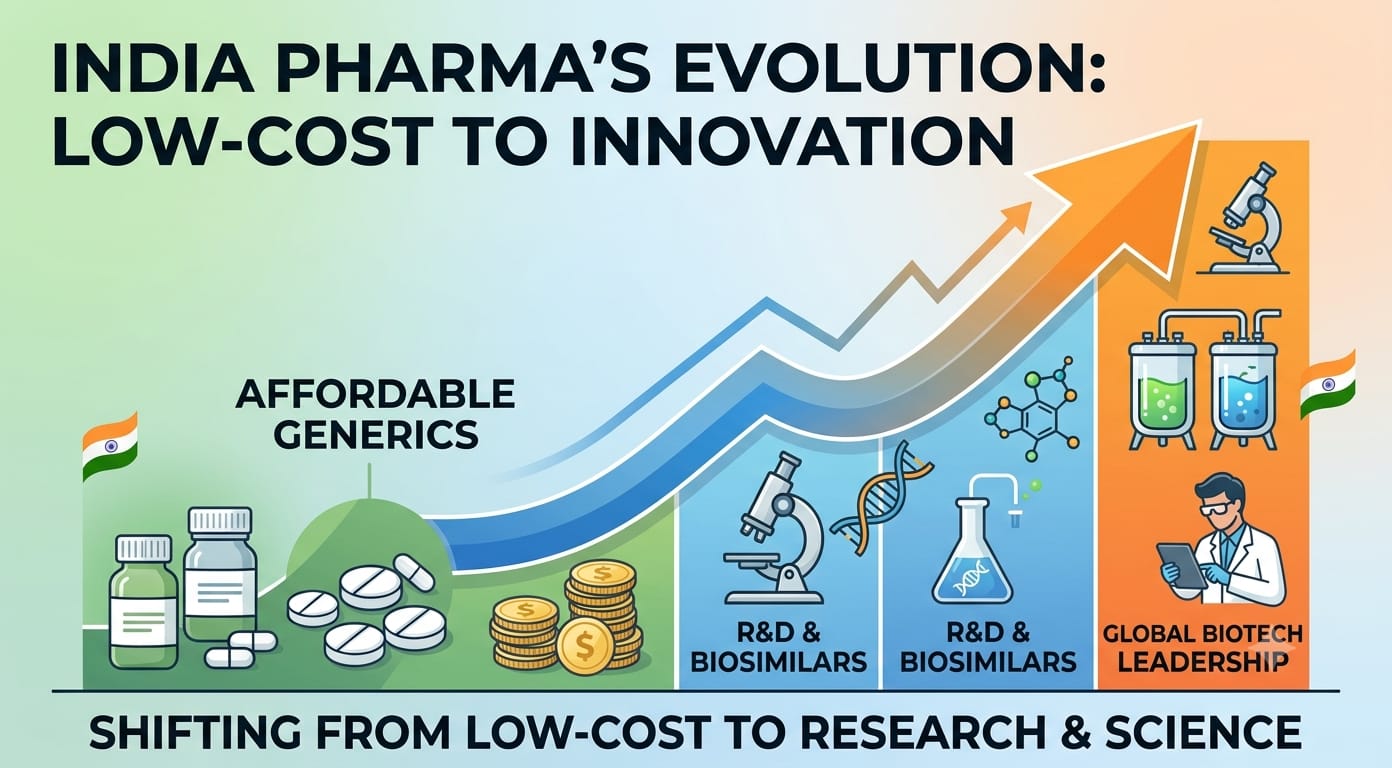
The Indian pharmaceutical sector has long been known for making affordable medicines, especially generic drugs that helped many people access treatment at lower cost. That role remains important, but a new direction is now becoming clearer.
The business is slowly moving toward higher-value work such as biosimilars, complex formulations, research-based products, and innovation-led medicine development. This change is not happening overnight. It is emerging because the market is changing, competition is rising, and companies are looking for better margins and stronger global presence.
For a long time, the strength of this sector came from scale, efficiency, and low-cost production. That model created a strong export base and gave a major push to affordable healthcare in many countries. Still, simple generic manufacturing has become more crowded, and profit pressure has increased. In such a situation, a shift toward innovation becomes more than a choice.
It becomes a path for survival and growth. Companies that once focused mainly on copying known molecules are now trying to build research capacity, work on biologics, and enter categories where knowledge and technical skill matter more than volume alone.
A major part of this shift is the rise of biosimilars. These are advanced medicines that are similar to already known biologic drugs, but they are usually harder to make than ordinary tablets or capsules. They need deeper scientific ability, tighter quality control, and stronger investment.
This is important because biosimilars can open the door to more valuable markets and better long-term business opportunities. In simple terms, the sector is no longer only about making more medicines. It is also about making more complex medicines that can compete in higher-end global markets.
This transition also matters for jobs and skills. As companies move toward innovation and biologics, the demand for scientific talent, laboratory expertise, regulatory knowledge, and advanced manufacturing skills goes up. That means the sector may create a different kind of employment compared with the older model.
Instead of only large-scale production roles, there may be more need for researchers, quality specialists, data experts, clinical support teams, and technology-focused workers. For students and young professionals, this shift signals that future growth may depend more on learning and specialization than on routine production alone.
There is also a wider business angle. If companies succeed in developing stronger innovation capabilities, the sector could improve its position in international markets. Buyers across the world are increasingly looking for quality, reliability, and advanced therapies.
A move toward high-value products can help the sector stand out in a crowded market. It may also reduce dependence on price competition, which often cuts into profits. In that sense, innovation is not only about science. It is also about building a stronger business story for the long term.
At the same time, the shift brings challenges. Research takes time, money, and patience. Results are not always quick. Regulatory approval can be demanding, and global competition in biologics is tough. Smaller firms may find it difficult to move into this space without strong partnerships or support.
Even so, the direction seems clear. The sector is trying to rise above the image of being only a low-cost supplier and is aiming to be seen as a more advanced and trusted player in healthcare.
Every major industry must evolve when markets change. The pharma sector is now stepping into that stage. The future may still include generics, but it will likely be shaped more and more by biosimilars, research-based products, and innovation-driven growth.
That makes this shift not just a business story, but a sign of how industrial ambition grows over time. A sector that once built strength through affordability is now trying to build strength through intelligence, science, and value.

