
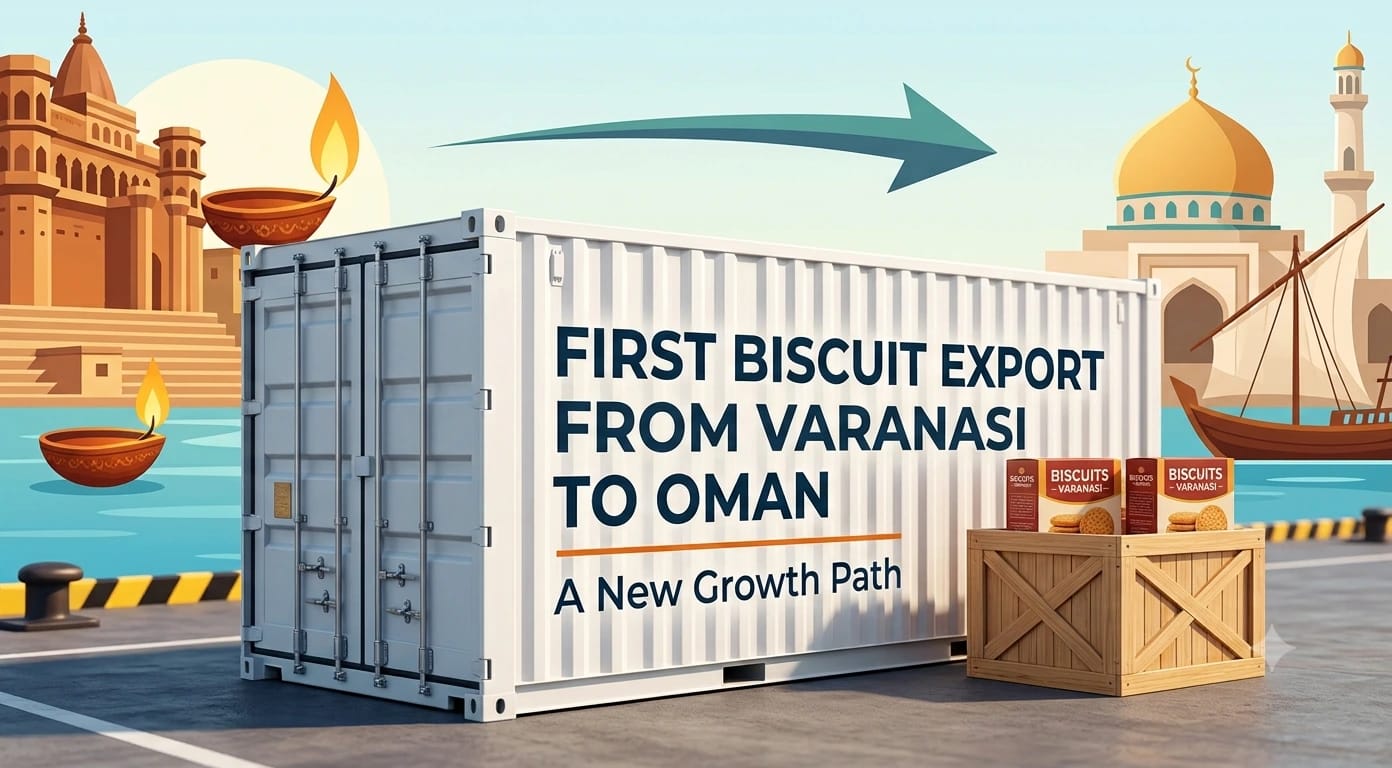
A fresh export story from Varanasi is now drawing attention far beyond the city’s borders. For the first time, a large biscuit shipment has moved from this historic centre to Oman, showing how local production, better logistics, and growing trade links can turn an ordinary food item into a symbol of progress and possibility.
A first shipment of 40 metric tonnes of biscuits has moved from Varanasi to Oman, and this has become an important sign of how a once landlocked region can slowly turn into a trade-linked business centre.
The shipment was supported by the Agricultural and Processed Food Products Export Development Authority, and it came after the India-Oman economic partnership made cross-border trade easier for processed food products. In simple words, this is not only about biscuits leaving one city for another country; it is also about local industry finding a wider stage and gaining confidence to grow further.
The biscuits were made by a Varanasi-based company, and the consignment was reported to be sent through an inland container route for customs clearance before moving onward for shipment.
This shows how a product can travel through a planned logistics chain when roads, depots, ports, and paperwork work in a smoother way. Such movement may look ordinary from outside, but for a local producer it can mean steady orders, larger production runs, better plant use, and a stronger reason to hire workers and suppliers nearby.
This development matters because Varanasi has already been building a place for itself in agri-export activity over the past few years. Earlier initiatives helped the region send vegetables, mangoes, rice, and other farm products to foreign markets, and the area saw repeated first-time export achievements in a short span .
That history makes the biscuit shipment more meaningful, because it shows a shift from only raw farm goods to processed food products with added value . When a region begins exporting more finished products, the benefit usually spreads farther than the factory gate, reaching packaging units, transport workers, local traders, and farmers who supply ingredients or supporting materials .
The larger picture also shows how **better infrastructure** can change the local economy in practical ways. When airport support, customs clearance, container movement, and exporter services become easier, small and medium businesses can think beyond nearby markets and start serving distant ones .
That wider reach can improve income stability, reduce waste, and raise demand for local production, which is often how a regional economy becomes stronger step by step . In this case, the growth is not sudden or flashy; it is built through connection, planning, and repeated opportunities that make business activity more reliable.
This export also reflects a bigger market opportunity for processed foods from the region. Biscuit shipments may seem simple, but they represent branding, product quality, shelf-life management, and customer trust in overseas markets.
If more such orders continue, local manufacturers may increase output, improve standards, and create more jobs in handling, operations, quality control, and distribution. The effect can travel beyond one factory, because every successful shipment encourages other businesses to consider export as a practical path rather than a distant dream.
The most encouraging part is that this event sends a message of possibility. A region that once faced limited export activity now has a growing name in food processing and trade, and each successful shipment adds more weight to that identity . If such progress continues for the next 4-5 years, the area may see more factories, more export-ready products, and more local employment linked to packaging, storage, transport, and supply work.
In that sense, the biscuit export is not only a shipment but also a sign of confidence, showing how local strength can turn into wider opportunity when the right support system is in place.

