
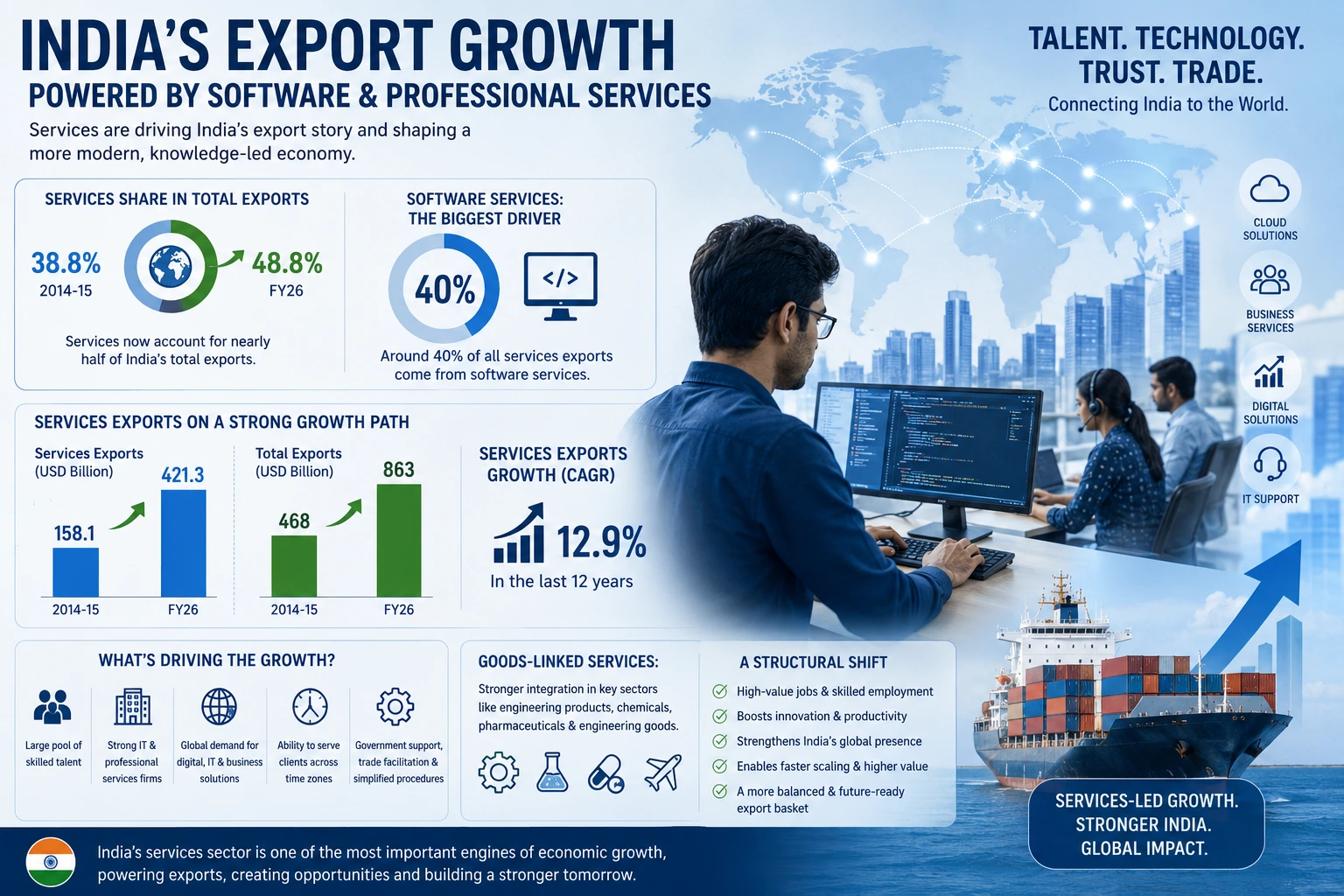
The services export story in FY26 shows a clear shift in the country’s trade pattern, where digital and knowledge-based services are becoming stronger than many traditional export categories.
The overall share of services in India’s exports has risen to 48.8% in FY26 from 38.8% in 2014-15, showing how important this segment has become in the national economy.
This change is not sudden; it has grown steadily over several years as global demand for Indian services has increased and more businesses have depended on remote, online, and technology-based solutions.
Software services remain the biggest driver in this growth. They account for around 40% of all services exports, which means nearly two-fifths of India’s services earnings come from this single category.
The role of software is important because it connects Indian talent with world markets without depending on physical movement of goods. In simple terms, code, digital support, and online business solutions have become a major source of foreign exchange for the country.
The rise in services exports is also linked to the broader transformation of global business. Many international companies now rely on Indian firms for IT support, software development, business process services, and professional consulting. This has helped India move from a mainly goods-focused export base to a more balanced export structure where services now carry nearly half the weight.
India’s services exports rose from $158.1 billion in 2014-15 to $421.3 billion in FY26, while total exports increased from $468 billion to $863 billion during the same period.
Another important part of this growth is the strong performance of software services themselves, which have remained the key export driver for years.
This strength comes from India’s large pool of trained professionals, established IT firms, and the ability to serve clients across time zones. The report says services exports have grown with a compound annual growth rate of 12.9% in the last 12 years, which reflects steady and sustained momentum rather than a one-time jump.
Trade patterns are also changing in goods-linked services, especially in areas like engineering products, chemicals, pharmaceuticals, and engineering goods, where imported components and export-linked services are becoming more tightly connected.
The report mentions that engineering exports were among the top movers and that certain sectors have benefited from better trade flows and improved global demand .At the same time, the government’s trade facilitation measures, simplification of import procedures, and support for exporters have helped reduce friction in the system.
There is also a deeper economic message in this rise. Services exports usually create high-value jobs, support urban and semi-urban skilled employment, and improve India’s presence in the global economy.
Unlike many goods sectors, services can scale quickly when talent, technology, and market access come together. That is why this growth is being seen as a sign of structural change, not just temporary trade strength.
Overall, the report shows that India’s export basket is becoming more modern and more services-led. Software, digital delivery, consulting, and professional services are shaping the next phase of export growth, while the share of services in total exports continues to climb. This makes the services sector one of the most important engines of India’s economic story today.

