
There are moments in a nation’s energy journey that don’t make headlines with explosions or crises; they arrive quietly, in the form of numbers. And the numbers that came out of the first three months of 2026 are the kind that quietly change everything.
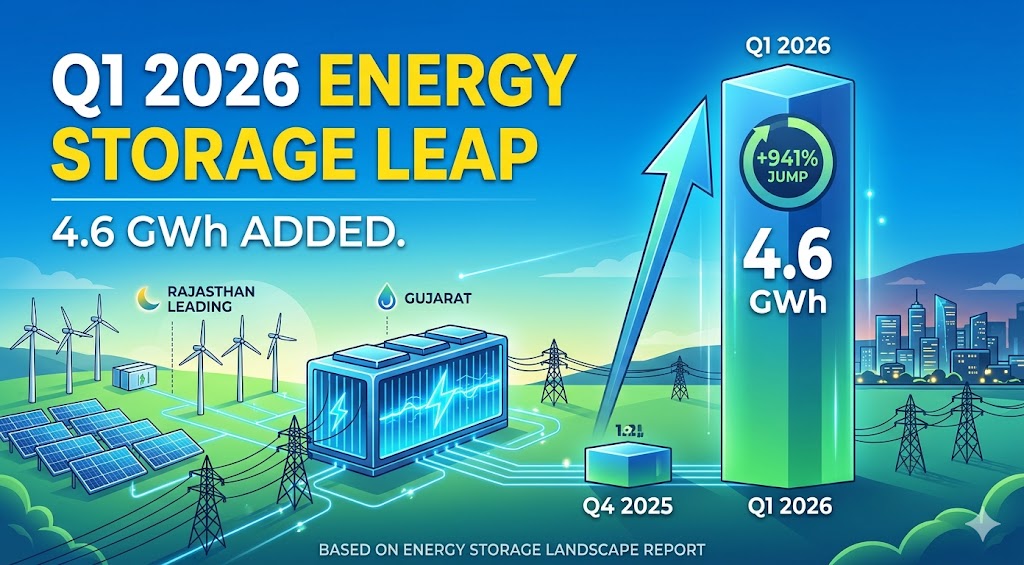
According to the latest India’s Energy Storage Landscape Report published by Mercom India Research, the country added 4.6 gigawatt-hours (GWh) of battery energy storage capacity in just the first quarter of 2026 that is January, February, and March. To put that in perspective, the quarter before this October to December 2025 saw only 442.7 megawatt-hours (MWh) of capacity added.
The jump between those two periods? A staggering 941 per cent. That is not a typo. That is not a rounding error. That is the real, verified figure sitting at the heart of one of the most significant clean energy milestones in recent memory.
So what exactly is battery energy storage, and why should the average person care? Think of it the way a household thinks about a power bank for a phone. The sun shines and the wind blows but not always when electricity is needed most. Battery storage systems act like enormous power banks for the grid, capturing surplus electricity generated from solar and wind sources and releasing it when the sun sets or the air goes still.
Without storage, renewable energy remains unreliable. With it, the lights stay on cleanly, consistently, and without burning coal. That is the revolution that is quietly underway.
As of March 2026, the country’s cumulative installed battery energy storage capacity reached 5.9 GWh.
Of that total, standalone energy storage systems account for 73 per cent of the capacity meaning these are dedicated storage projects, not attached to any single energy source.
Solar-plus-wind projects with storage capabilities, often called round-the-clock projects, contribute 15 per cent, and solar-plus-battery energy storage projects make up 11 per cent. This mix tells an important story: the storage infrastructure being built is versatile, spread across multiple models, and designed to support a cleaner grid over the long term.
Geographically, Rajasthan leads the country in cumulative installed energy storage capacity, holding a 42 per cent share. Gujarat follows at 25 per cent, and Maharashtra accounts for 9 per cent. Rajasthan’s dominance comes as no surprise the state has long been at the centre of large-scale solar development and has been a frontrunner in renewable energy auctions. That leadership is now extending into storage as well, a natural and necessary progression.
Beyond what has already been installed, the pipeline ahead is equally compelling. As of the end of Q1 2026, the country’s energy storage development pipeline stood at 69 GWh comprising 41 GWh of standalone storage, 11 GWh of solar-plus-wind with storage, and 9 GWh of solar-plus-energy storage projects.
Gujarat holds the largest pipeline of standalone battery storage capacity. This pipeline signals that the growth seen in Q1 is not a one-time burst, it is the beginning of a much larger wave.
Raj Prabhu, CEO of Mercom Capital Group, captured the moment precisely: “The strong growth in Q1 2026, coupled with a rapidly expanding project pipeline, reflects how quickly energy storage is becoming a core part of India’s power infrastructure.”
This is a turning point that has been building for years. The India Energy Storage Alliance had forecast a near tenfold jump in battery storage capacity additions for 2026, and the Q1 data suggests that trajectory is very much on track.
A nation that began its energy storage journey with small pilot projects as recently as 2013 has, in one quarter alone, come closer than ever to making reliable, round-the-clock clean power a grid-wide reality. The quiet revolution, it seems, is picking up speed.

