
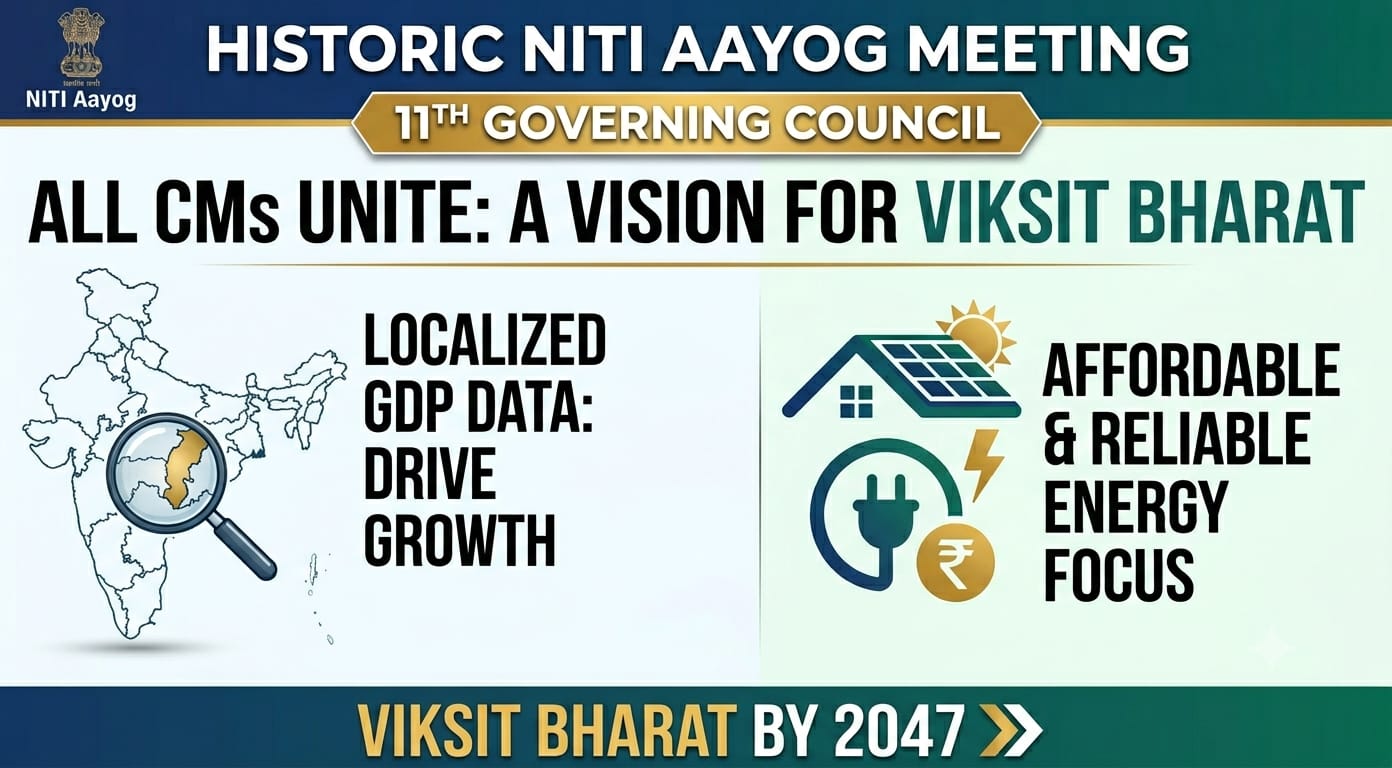
A landmark gathering took place on June 11, 2026, when the 11th Governing Council Meeting of NITI Aayog was convened at Rashtrapati Bhavan Cultural Centre in New Delhi under the chairmanship of Prime Minister Narendra Modi.
This meeting marked a historic moment as chief ministers from all 28 states participated together, something that had never happened before in the council’s history. The discussions centered on a theme called Inclusive Human Development for Viksit Bharat at 2047, which focuses on ensuring every citizen benefits from national development regardless of where they live or their background.
The most significant announcement came when the Prime Minister instructed state governments to create district-level gross domestic product estimates. This move means economic performance will now be measured not just at the state or national level, but for each individual district across the country.
Having reliable data at this local level helps identify which areas are growing quickly and which need more support, allowing policies to be designed based on actual evidence rather than assumptions.
Currently, 26 states and union territories already compile district domestic product estimates, and the Ministry of Statistics has released official guidelines using 2022-23 as the base year. The district-level data is expected to become available within a few months, enabling decentralized planning and better regional development analysis.
Affordable energy emerged as another major concern during the meeting, with chief ministers from various states emphasizing the need for competitive electricity prices and reliable power supply for both households and industries.
Several leaders highlighted that energy availability directly impacts manufacturing growth and economic expansion, making it essential to keep prices manageable while ensuring consistent supply.
The discussions also covered expanding renewable energy infrastructure, with particular attention on spreading solar energy systems on rooftops in residential buildings, schools, hospitals, and government facilities.
This approach would reduce household dependence on grid electricity and make subsidy management more manageable for state governments.
Beyond these two primary focuses, the meeting addressed multiple development areas including human capital development, future-ready skilling initiatives, manufacturing expansion, and women-led economic initiatives.
The Vice Chairperson of NITI Aayog, Ashok Kumar Lahiri, noted that energy security and making power prices competitive were heavily discussed, along with strategies for making reliable energy available across the country.
Participants also talked about defense manufacturing and infrastructure demands from specific regions including Telangana, Jammu and Kashmir, and Jharkhand. The Prime Minister urged states to attract investments from partner nations by resolving investor concerns quickly and creating better business environments.
The gathering reflected a strong commitment to cooperative federalism, where the center and states work together as a team toward the vision of a developed country by 2047. This approach treats development not as any single party’s agenda but as the aspiration of all citizens, requiring every state, city, and village to progress.
The meeting concluded with constructive discussions that reflected the aspirations, hopes, experiences, best practices, and challenges faced by different states. NITI Aayog will now study all suggestions made during the meeting to help translate the vision into concrete, measurable outcomes for every citizen across the country.
This historic meeting demonstrates how localized economic data combined with affordable energy access can strengthen grassroots economies and support long-term national development goals, making the journey toward a developed nation more inclusive and data-driven for communities at every level.

