
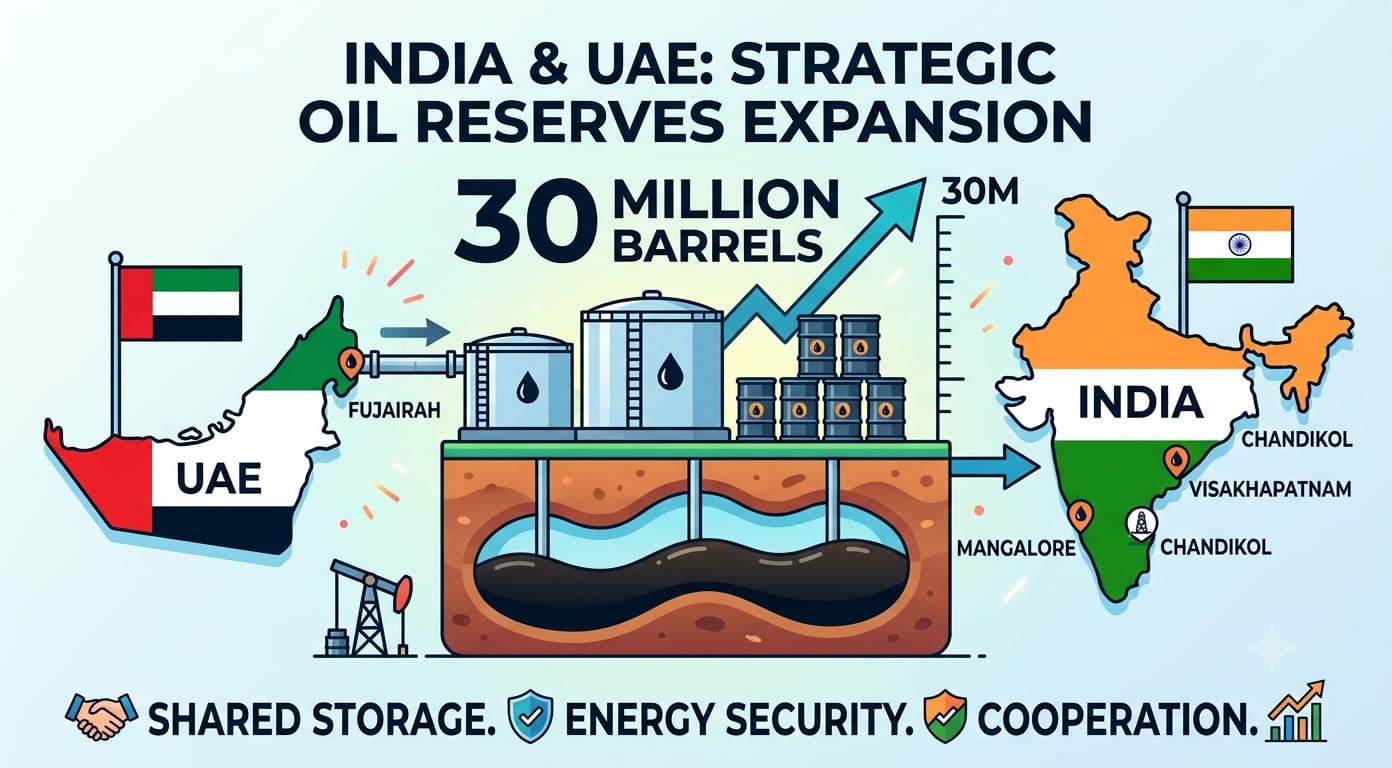
A quiet but powerful shift is taking place in how energy security is being built for the future. Two longtime partners in the energy world are moving forward with a plan that could change how oil is stored and protected across the region. The goal is simple yet significant: to increase the amount of crude oil kept in strategic reserves from just under 6 million barrels to a much larger 30 million barrels.
This expansion is part of a deeper cooperation between the nation on the eastern coast of the Arabian Peninsula and its large Asian neighbor, one of the world’s biggest oil consumers.
The heart of this plan lies in underground storage caverns and new infrastructure at key coastal locations. Currently, the Abu Dhabi-based oil company holds about 5.86 million barrels at a storage facility near Mangalore on India’s southwest coast. That number is expected to grow dramatically.
New sites under consideration include Visakhapatnam and Chandikol, both located along the Bay of Bengal on the eastern seaboard. These locations offer strategic advantages, being closer to major consumption centers and away from some of the geopolitical risks that affect other routes.
The expansion will use a mix of existing underground caves and newly built storage units, a method that has proven effective in previous projects.
What makes this move especially meaningful is that it’s not just about storing more oil. It’s about creating a shared safety net. When global oil supplies face disruptions due to conflict, natural disasters, or market shocks, having large reserves ready can prevent sudden price spikes and keep energy flowing smoothly.
For the large Asian country, which depends heavily on imported oil, this partnership offers greater flexibility and stability. For the Gulf nation, it provides a secure place to store part of its energy wealth outside its own borders, far from the Strait of Hormuz a critical but vulnerable shipping route.
The two sides are also looking beyond oil. A framework for strategic gas reserves is being developed alongside the oil plan. This could include liquid natural gas and liquid petroleum gas storage, adding another layer to the energy cooperation.
In addition, there’s talk of possibly storing some of the Asian nation’s crude oil in Fujairah, a major oil hub in the Gulf partner’s territory. Fujairah lies outside the Strait of Hormuz, making it a safer alternative in times of crisis. These ideas show that the partnership is evolving into a broader, more flexible energy alliance.
Timeline-wise, the approach is “as soon as possible,” though experts note that new construction projects can take a couple of years. Site identification, technical checks, and implementation will all play a role in how quickly the full 30 million barrels can be stored.
Still, the message from both governments is clear: this is a priority, and progress is expected swiftly. The agreement was formalized during a high-level visit last year, when memorandums of understanding were signed between the Indian Strategic Petroleum Reserves Limited and the Abu Dhabi National Oil Company.
This kind of cooperation reflects a growing trend in how countries are thinking about energy. It’s no longer just about buying and selling oil. It’s about building trust, sharing risks, and creating systems that can withstand uncertainty.
For every common person, the impact may not be visible right away, but it shows up in stable fuel prices, reliable power supply, and a stronger economy. Energy security is the foundation that lets schools stay open, hospitals run smoothly, and businesses keep growing.
In a world where energy markets can change overnight, having a plan like this gives both nations a sense of control. It’s a reminder that even small steps in cooperation can lead to big results. And as more countries look to build similar partnerships, this one could become a model for how energy security is managed in the future.

