
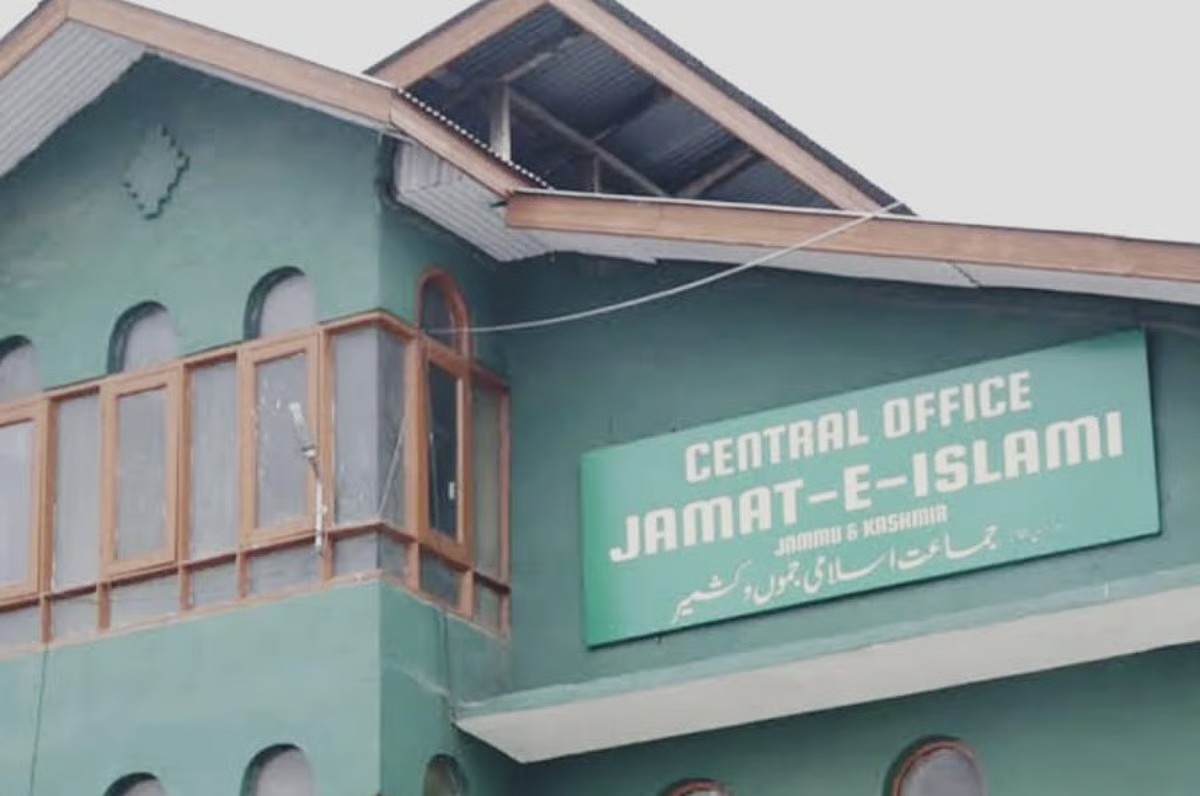
On May 25, 2026, the National Investigation Agency (NIA) conducted searches at three locations in the Srinagar and Shopian districts of Jammu and Kashmir (J&K), in connection with a terrorism funding case linked to the banned Jamaat-e-Islami Jammu and Kashmir (JeI-J&K) under the Unlawful Activities (Prevention) Act (UAPA).
The raids resulted in the recovery of incriminating financial documents and electronic gadgets. The searched premises included properties in the Lal Bazar area of Srinagar, specifically Jamiat ul Banaat (a girls’ religious school); Jamia Siraj-ul-Uloom in the Imam Sahib area of Shopian, an educational institution declared illegal on April 24, 2026; and the residence of Shahzada Aurangzeb, a former senior functionary of JeI-J&K, in the Molu Chitragam area of Shopian.
On May 15, 2026, the J&K Police, in coordination with Central Security Forces, carried out extensive search operations at over 15 locations across Bomai, Warpora, Sopore, and Tarzoo in Baramulla district. During the operation, officials recovered incriminating literature, documents, digital devices, and other materials linked to a banned organisation, which were subsequently seized for further investigation and analysis.
On February 3, 2026, NIA conducted searches at six locations across three districts – Srinagar, Baramulla, and Bandipora. The raids targeted a residence at Hazari Bazar in the Rainawari area of Srinagar, along with other sites in Bomai, Rafiabad, Sopore, Bandipora, and Parimpora.
The searches were carried out at the homes of former JeI leader Ghulam Ahmad Sheikh, former militant Iqbal Sheikh in Bomai, ex-government employees Mohammad Munwar Mir (Rafiabad) and Farooq Ahmad Peer (Model Town, Sopore), retired teacher Mohammad Maqbool Mir in Bandipora, and Zahoor-ur-Raheem in Parimpora, Srinagar.
On January 1, 2026, Police conducted a raid at the residence of a JeI-J&K member at Dadsara in the Awantipora tehsil (revenue unit) of Pulwama District. During the operation, Police recovered incriminating material and digital devices. Several persons were questioned, and investigations into the case are ongoing.
Since the ban on JeI-J&K was extended in February 2024, security agencies have intensified action to curb its suspected separatist and militant links, including accusations of terrorist funding, radicalisation, and support to groups like Hizbul Mujahideen (HM) and Lashkar-e-Toiba (LeT). JeI-J&K was originally banned in 2019, with earlier bans in 1990 and 1975, and has a long history as an Islamist socio-political movement in J&K.
It is rooted in the broader JeI founded by Maulana Abul A’la Maududi in 1941, formally emerging in Kashmir in the mid-1940s, separating from JeI-Hind in the early 1950s, and focusing on Islamic revivalism and advocacy on Kashmir’s political status, including support for separatism. JeI-J&K has historically operated through a network of educational trusts and institutions imparting both modern and Islamic education.
After its ban in February 2019, former members of the JeI-J&K launched a new political party called Justice and Development Front (JDF). The party was formally floated in 2024–2025 as a breakaway faction, with its public launch announced on April 27, 2025. In the 2024 J&K Assembly elections, several ex-members or sympathisers (including key JDF figures) contested as independents, though none of the JDF-linked candidates won a seat. The Election Commission of India (ECI) later granted recognition to JDF as a political party on January 30, 2026, allowing it to function openly within the constitutional framework.
Significantly, several educational institutions and trusts linked to JeI-J&K have faced intensified action, including declarations as unlawful entities, arrests, and the framing of charges against operatives. On April 18, 2026, the J&K Government took control of 58 private schools affiliated with JeI-J&K and its educational trust, the Falah-e-Aam Trust (FAT). Earlier, in August 2024, the Government had ordered the takeover of over 200 private schools across the Kashmir Valley. It was later decided that principals of nearby government schools would administer these schools. On April 24, 2026, Darul Uloom Jamia Siraj-ul-Uloom at Imam Sahib in Shopian was declared an unlawful association under UAPA, with authorities citing the case of former student Sajjad Bhat, who owned the vehicle used in the February 14, 2019, Pulwama terrorist attack that killed 40 CRPF personnel.
In 2025 as well, police launched large-scale crackdowns on JeI-J&K-linked madrassas and mosques. On November 27, 2025, Police carried out raids across eight districts – Srinagar, Anantnag, Budgam, Shopian, Pulwama, Awantipora, Kulgam, and Handwara – targeting residences, business establishments, and institutions linked to JeI-J&K. Searches were conducted at the houses of former JeI-J&K Amirs Abdullah Wani and Ghulam Mohammad Bhat, along with several other JeI-J&K-linked individuals. Police also raided multiple JeI-J&K-associated institutions, including Jamiat-ul-Banaat, Rahat Manzil, Chinar Publication Trust, and Jamia Islamia Institute. On August 5, 2025, an NIA court framed charges against three alleged JeI-J&K operatives – Amir Mohammad Shamsi, Abdul Hamid Ganai alias Abdul Hamid Fayaz, and Mushtaq Ahmad Mir alias Mushtaq Ahmaq Zargar– along with the Al-Huda Educational Trust (AHET) – for suspected illegal transactions, for terrorist funding. Earlier, on October 11, 2022, NIA had conducted searches at 18 locations across J&K and arrested one person in connection with the investigation into AHET’s funding activities.
The reported measures reflect a sustained shift in the Indian state’s approach toward JeI-J&K, moving from earlier intermittent actions to a more systematic effort aimed at dismantling its alleged revival networks. The emergence of JDF is seen as a key indicator of whether this cadre can integrate into mainstream democratic politics or continues operating through informal and subversive structures. However, the long-term outcome will depend not only on enforcement, but also on the rehabilitation of institutions, procedural transparency, and the provision of credible political avenues to address underlying grievances. The state’s actions have constrained JeI-J&K networks, but the situation remains a continuing contest between sustained enforcement and the resilience of its ideological structures.
Author: Ruchika Kakkar – Research Assistant, Institute for Conflict Management

