
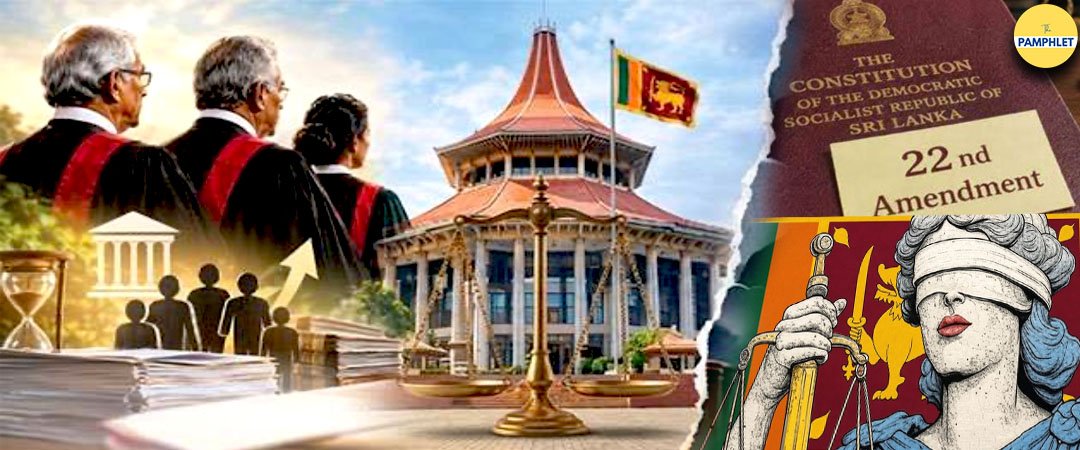
September 24, 2026, Sri Lanka’s proposed Twenty-Second Amendment to the Constitution that is scheduled to be debated in Parliament amid an intensifying confrontation between the Government, the Opposition, the legal profession and civil society.
While the Anura Kumara Dissanayake Government presents the measure as a judicial-efficiency reform intended to address delays and case backlogs, opponents have argued that it could extend the tenure of serving judges and create scope for executive influence over the superior judiciary.
The controversy has acquired wider political significance because the proposed amendment comes at a time when the Government commands a two-thirds majority in Parliament and is pursuing an ambitious programme of institutional restructuring.
The proposed amendment is narrowly framed around the judiciary. It seeks to raise the mandatory retirement age of Supreme Court judges from 65 to 67 years and that of Court of Appeal judges from 63 to 65 years. It further provides that the Chief Justice would retire upon reaching 67 years of age or completing six years in office, whichever occurs first. A separate Judicature (Amendment) Bill proposes changes to the retirement age of judges serving in the High Court, District Courts and Magistrates’ Courts. Parliament has scheduled the constitutional amendment for debate on September 24, 2026, and the Judicature Bill for September 25, 2026.
The Government argues that the measure is necessary to retain experienced judges, increase the capacity of the courts and accelerate the disposal of pending cases. The proposal has also been advanced alongside the stated objective of strengthening judicial independence and improving the effectiveness of the justice system. However, critics have questioned whether increasing the retirement age of a limited number of judges, by itself, would address structural problems such as vacancies, inadequate court infrastructure, procedural delays and the large case backlog. This gap between the stated objective and the proposed instrument has prompted questions about the broader rationale behind the amendment.
Sri Lanka’s constitutional history has been marked by repeated alterations in the balance between the Executive, Parliament and the Judiciary. The 1972 Constitution abolished the previous constitutional framework and established a republican system. The 1978 Constitution introduced the executive presidency and substantially strengthened presidential authority. Subsequent amendments frequently reflected the political priorities of the Government in office rather than a settled national consensus on constitutional design. Several other amendments have taken place over the period of time.
The principal concern relates to the possible impact on judicial independence. Judicial independence depends not only on the formal protection of judges from dismissal, but also on secure tenure, predictable conditions of service and freedom from political pressure or inducement. A decision to extend the retirement age while particular judges are in office can create a perception that the amendment has been designed to benefit, retain or influence specific individuals. Even where no direct interference is proved, the appearance of political intervention can weaken public confidence in the courts.
The Bar Association of Sri Lanka (BASL) has argued that changing the retirement age of superior court judges affects the constitutionally protected independence of the Judiciary. It has referred to Articles 3 and 4(c) of the Constitution, under which sovereignty is vested in the People and judicial power forms part of that sovereignty. BASL has also relied on the Supreme Court’s 2022 determination in the Inland Revenue Case, arguing that an amendment affecting the retirement age or period of office of incumbent judges could affect judicial independence and therefore requires approval at a referendum. The constitutional question has now moved beyond political debate. Sixty-seven petitions were reportedly filed before the Supreme Court challenging or supporting the Bill. The petitions were heard by a five-member bench headed by Chief Justice Preethi Padman Surasena. The Court completed the hearings, with its determination to be communicated to the Speaker in accordance with the constitutional procedure.
There are certainly some key Grounds of Opposition. First Judicial Independence: The BASL argues that changing the retirement conditions of superior court judges could affect judicial independence. It has invoked Articles 3 and 4(c) of the Constitution, under which sovereignty is vested in the People and judicial power forms part of that sovereignty. Secondly, effect on Incumbent Judges: Petitioners have questioned the absence of a clear transitional provision excluding judges already in office. They argue that the proposed amendment could alter the tenure conditions of incumbent judges after their appointment.
Third comes Referendum Requirement. BASL has relied on the Supreme Court’s 2022 determination in the Inland Revenue Case to argue that a change affecting the retirement age or tenure of incumbent judges could require approval by the People through a referendum, in addition to the required parliamentary majority.
Fourth is the Question over Judicial Efficiency. Critics have questioned whether extending the retirement age by two years would, by itself, address the structural causes of judicial delays and case backlogs, including vacancies, inadequate infrastructure and limited judicial capacity.
Moreover, Precedent for Future Governments is also a concern., Opponents are concerned that allowing a government to alter the retirement conditions of serving judges through constitutional amendment could establish a precedent for future governments to modify judicial tenure according to changing administrative or political circumstances.
Lastly, timing and the Chief Justice: The timing of the proposal has attracted scrutiny because the incumbent Chief Justice, Preethi Padman Surasena, could potentially be affected by the proposed extension. BASL has referred to speculation that the amendment could facilitate an extension of his tenure. Such claims concerning Government motive, however, remain contested and have not been established as fact.
The question before the Court is not simply whether judges should retire at 65, 67 or another age. It is whether a change affecting the superior Judiciary can be enacted by a two-thirds majority in Parliament alone, or whether it also requires approval through a national referendum. If a referendum is required, the Government would have to place the issue before the electorate. If parliamentary approval is sufficient, the Government’s parliamentary majority could enable passage without a direct popular vote.
Opposition parties, particularly the Samagi Jana Balawegaya (SJB), have described the proposal as part of a wider attempt to undermine the separation of powers. Opposition Leader Sajith Premadasa has accused the Government of attempting to establish one-party rule and has announced a mass mobilisation in Colombo on September 24, 2026, coinciding with the parliamentary debate. The political messaging is likely to portray the amendment not as an administrative reform but as a test of whether the Government intends to respect institutional checks after securing a dominant parliamentary mandate.
The opposition to the Bill, however, extends beyond political parties. BASL and around 40 professional organisations and trade unions have warned that the proposal could undermine judicial independence and the rule of law. Religious authorities, including the Chief Prelates of the three principal Buddhist chapters, have also expressed reservations.
The Government has scheduled the Bill for parliamentary debate on September 24, 2026, while the Judicature (Amendment) Bill is scheduled for a vote on September 25, 2026. The Government has maintained that retaining experienced judges is necessary to address delays and improve the capacity and effectiveness of the judicial system. The parliamentary debate and the planned mobilisation against it will bring the constitutional dispute into both institutional and public arenas. The immediate trajectory of the controversy will depend on the Supreme Court’s determination, the Government’s response to it, and the positions adopted by the Opposition, the legal profession and other civil-society groups.
In the longer term, the amendment could become an important indicator of the Dissanayake administration’s approach to institutional restraint. If enacted without wider consultation or a referendum despite sustained objections, it could deepen mistrust between the Government on the one hand, and the legal, political and wider community, on the other, and establish a dubious precedent for future governments. Sri Lanka’s recent constitutional history demonstrates that changes presented as institutional or administrative reforms can have wider consequences for the balance between the Executive, Legislature and Judiciary. The Twenty-Second Amendment will test whether the country has moved beyond that cycle, or whether constitutional change remains vulnerable to the priorities of the government in power……(The author is Deepak Kumar Nayak, Research Associate, Institute for Conflict Management)

