
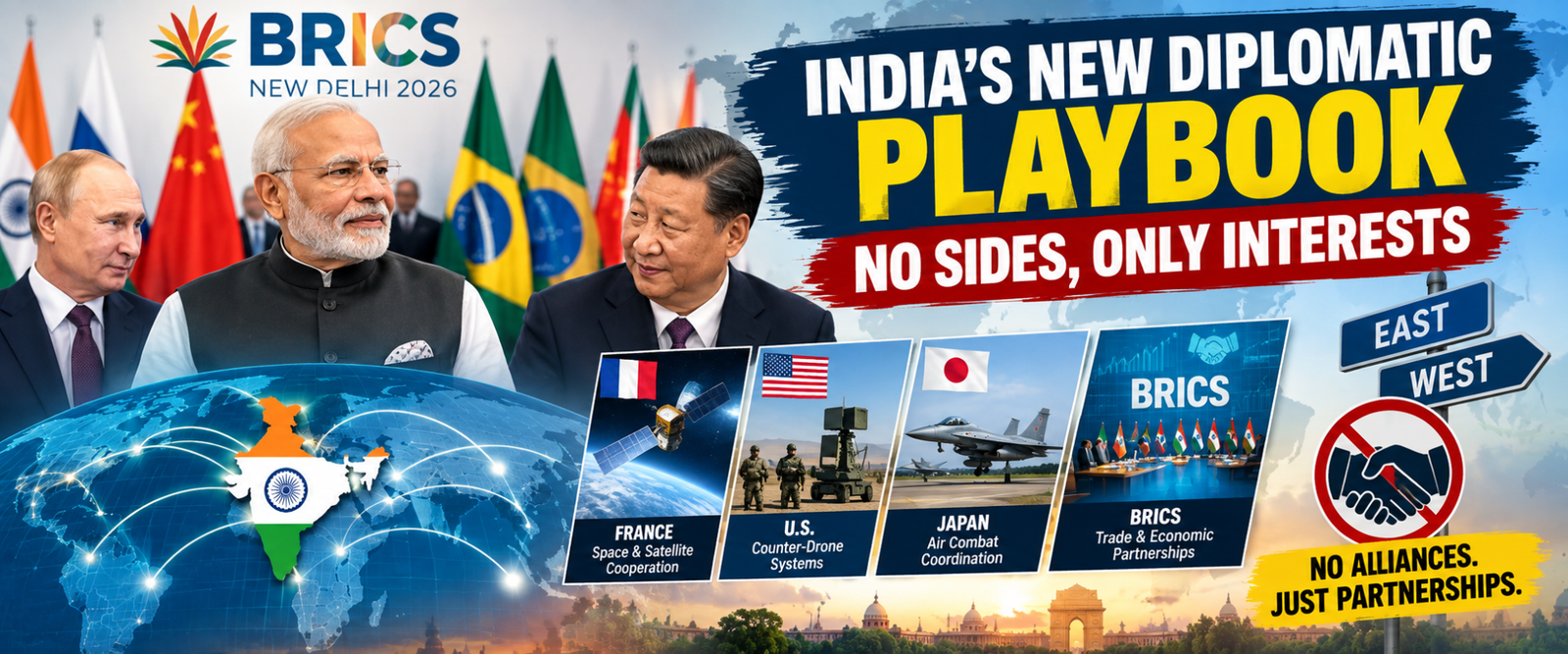
When New Delhi hosted the 18th BRICS Summit in September 2026, foreign policy experts again described India’s foreign policy in a way they have often used before. To Western analysts, Prime Minister Narendra Modi sharing a stage with Russian President Vladimir Putin and Chinese President Xi Jinping looked like a move toward an anti-Western group. To supporters of a world with many power centres, it signalled a big step toward a world no longer led by the United States.
Both views miss a point. In the exact same week that BRICS leaders agreed on the New Delhi Declaration, India signed a major satellite monitoring deal with France, added American counter-drone systems to joint army drills, and hosted Japanese F-2 fighter jets on its soil for the first time.
This was not a nation struggling to balance competing pressures. It was the deliberate execution of a main plan designed for an era without fixed alliances. The real lesson from India’s busy week of diplomacy is not that New Delhi is playing both sides, but that the very idea of “picking a side” no longer works for major middle powers.
The Rise of Practical Partnerships
For decades, global experts insisted that countries must eventually join one main power center to keep their people safe and grow their economy. Cold War history built this belief. You were either inside a defense group or left out in the cold. Today, global power is too divided, and national needs are too specific, for rigid groups to work.
India has turned this division into a clear advantage. Instead of looking for safety through a single big alliance, New Delhi builds targeted partnerships made for specific needs.
Look at the agreements signed during that single week. Where India needed advanced space monitoring and small commercial satellite tech, it turned to France’s Safran Space and local companies. Where it needed high-altitude counter-drone capability, it trained alongside the United States military in Rajasthan and Uttarakhand. Where it wanted air-combat coordination in the Indo-Pacific, it brought Japan’s Air Self-Defense Force to Jodhpur.
At the exact same time, India used the BRICS meeting to advance its economic and regional goals. It secured agreement on local-currency trade, called for reforms in global organisations, and finalised a proposed $11.5 billion industrial deal with the United Arab Emirates.
Dividing Relationships by Purpose
Notice the pattern. India does not ask its Western partners to support its trade with Russia, nor does it ask its BRICS partners to protect its sea routes in the Indian Ocean. Each relationship is kept separate. Each serves a distinct purpose.
This approach—often wrongly called double-dealing or fence-sitting—is better understood as practical teamwork. In a world where global institutions are blocked by deep rivalries, progress no longer happens through big global treaties. It happens through smaller groups working on specific tasks.
Misreading New Delhi’s Pragmatism
This shift creates a challenge for traditional Western thinking. Leaders in Washington and European capitals often treat India’s refusal to pick a side as a temporary phase—a problem to solve before New Delhi eventually joins a Western defense alliance.
That expectation misunderstands Indian strategy. India’s policy of making its own choices is not an old habit from the past century. It is a smart calculation for today’s world. By refusing to join a binding military group, India keeps the freedom to trade, cooperate, and negotiate with anyone, anywhere, whenever it helps its national interest.
Furthermore, India is not alone in this strategy. Across the Global South, middle powers like Indonesia, Saudi Arabia, Brazil, and the UAE are following a similar path. They refuse to treat global diplomacy as an all-or-nothing game. They trade with China, buy equipment from Europe, keep security ties with the United States, and work on energy with Russia. India is simply using this approach on a larger scale and with greater skill than most.
The Realities of a Divided World
The true test for this strategy lies ahead. Working with everyone is easy when global tensions are low. It becomes much harder when major powers demand total loyalty during sudden global crises. Managing close ties with Washington while growing trade with Moscow and keeping an uneasy peace on the border with Beijing takes great skill. One wrong move can upset multiple partners at once.
Yet, the events of September 2026 prove that this approach works under pressure. India hosted competing world leaders, upgraded its military capabilities, and built influence across many areas without hurting its standing with any major country.
The lesson for world leaders is clear. The future of diplomacy will not be defined by a grand contest between two tidy groups. It will belong to nations that can manage a web of flexible, purpose-built partnerships.
Instead of asking which side India will finally choose, Western and Eastern capitals should start asking a more useful question: how can they make their own specific offers to New Delhi more attractive than the alternatives. In today’s world, real power belongs to those who keep their options open.

