
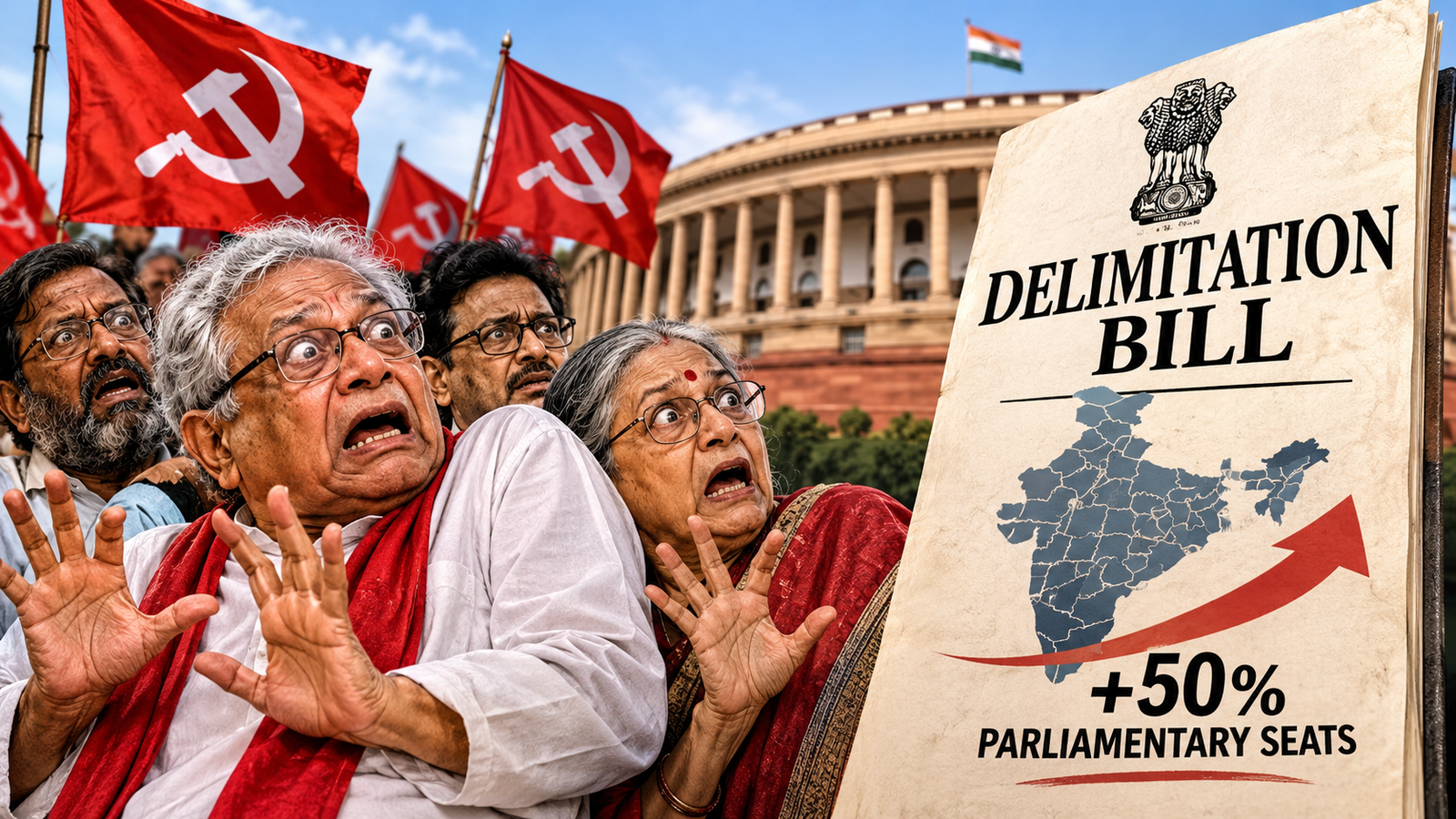
The Indian Left seems to have found yet another existential crisis to worry about. No, it is not inflation, unemployment, national security or the economy. It is the Delimitation Bill. Bhai, worry about your own existence, don’t worry about bills that may or may not pass in the Parliament.
Why the panic? Delimitation is a constitutional exercise aimed at reorganising electoral constituencies and ensuring fair representation as the country’s population changes. Population patterns change, demographics shift, and democratic representation must keep pace, after all, our constiution is a living instrument and is designed to adapt to the times. Yet, for India’s Left, every major reform seems to come with an imaginary obituary for democracy. Democracy dies every day for them.
The irony is simply delicious. A political movement that once ruled West Bengal for 34 uninterrupted years and held considerable influence in Tripura is now struggling to remain relevant in national politics. West Bengal has long moved on from the Left’s political experiment, while its presence in Parliament has become increasingly marginal.
And yet, the same political establishment behaves as though the country cannot take a single constitutional step forward without seeking its permission! And after watching Left’s decline, for some reason, Rahul Gandhi led the Congress Party down the same path. Why? We can never figure out.
Of course, questions about the delimitation formula, representation of states and the impact on federalism are legitimate. Any exercise of this magnitude must be transparent and equitable. But there is a difference between asking difficult questions and treating every reform as an impending catastrophe.
The proposed expansion of parliamentary seats by 50 per cent, along with safeguards intended to preserve the existing proportional representation of states until 2051, deserves serious discussion. The proposed move is also linked to the implementation of 33 per cent reservation for women.
Perhaps the real problem for the Indian Left is that Indian politics is moving beyond its familiar slogans, outdated ideological battles and diminishing electoral footprint.
Democracy is not a permanent political rehabilitation programme for parties that have lost public support. If the Left wants to remain relevant, it might want to spend less time predicting the death of democracy and more time figuring out why voters have stopped listening to it.
After all, political relevance is earned at the ballot box, not through the loudest protests in Parliament, but who will explain it to the Left, which includes Congress now.

