
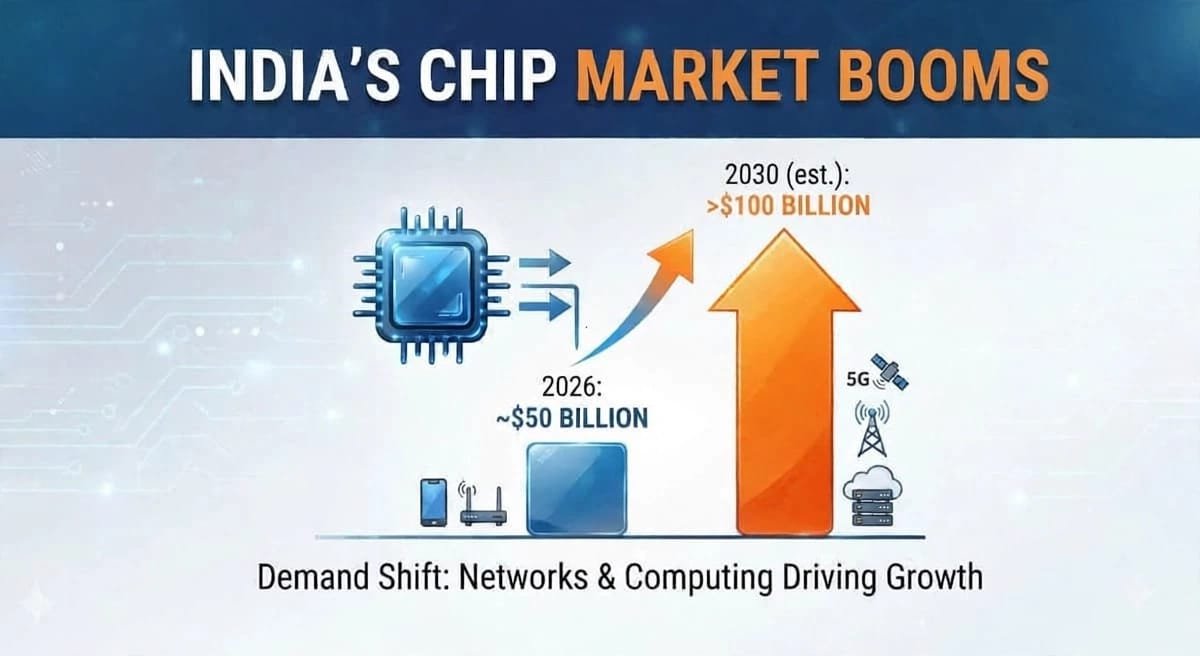
Tiny chips sit inside almost every device in daily life, including phones, routers, laptops and cars. India’s appetite for them is growing fast. A report by CareEdge Advisory, cited by ANI and published by The Economic Times on November 26, 2026, projects that the country’s semiconductor market will more than double. It is estimated at USD 45-50 billion in 2026 and could reach USD 100-110 billion by 2030.
The type of demand is changing along with its size. Semiconductor use is slowly moving away from traditional consumer electronics and toward connectivity and computing. Networking and communications is expected to become the largest segment by 2030. Its share of semiconductor revenue is projected to rise from 26.1 per cent in 2020 to 33.3 per cent in 2030. The segment is expected to grow at a compound annual rate of 17.8 per cent. The report ties this to 5G rollout, network upgrades, fibre expansion and the steady rise in data traffic.
Computing and data storage is also gaining ground. Its share is expected to climb from 12.8 per cent to 15.1 per cent over the same period, at a growth rate of 11.9 per cent a year. Together, these two segments are estimated to account for over half of all semiconductor revenue by 2030. Consumer electronics is moving the other way. Its share is projected to fall from 29.1 per cent to 22.2 per cent. That does not mean fewer gadgets. It means digital infrastructure, cloud computing and artificial intelligence are growing faster and taking a larger slice of the market.
The less comfortable part of the story is supply. India makes only a small share of the chips it uses, so imports fill almost all of the demand. Semiconductor imports more than tripled, from USD 11.9 billion in FY21 to USD 36.5 billion in FY26. Imports now meet 90-95 per cent of domestic demand for chip devices and components. In simple terms, almost every chip used in the country’s phones, networks and data centres is still made abroad. That leaves the country exposed to global supply disruptions and price swings.
The government is trying to change this through the India Semiconductor Mission. So far, 12 projects have been approved across six states, with combined investments above Rs 1.64 lakh crore. Five of them had started commercial production by October 2026. That is a real milestone, because it shows plans turning into factories and output. The next phase of the mission is expected to focus on research and development, materials, equipment and talent.
The report also points to the work still ahead. India already has strong skills in chip design and related services. Wafer fabrication, however, is at an early stage. Capacity in semiconductor materials and manufacturing equipment is limited. A chip industry depends on a whole chain of suppliers, so building one factory is not enough. The report names several things that will matter most: timely project execution, good manufacturing yields, technology partnerships, specialised talent and supplier development. These would raise domestic value addition and make supply chains more resilient.
The numbers show a clear direction. Demand is rising quickly and shifting toward the technologies that will run the next decade, including faster networks, cloud services and AI. Domestic production has begun but covers only a sliver of what is needed. The next few years will show whether new plants can scale up and whether the surrounding ecosystem can keep pace. If they can, a market worth over USD 100 billion could become an opportunity for Indian manufacturing, jobs and technology security, and not only a bigger import bill.

