
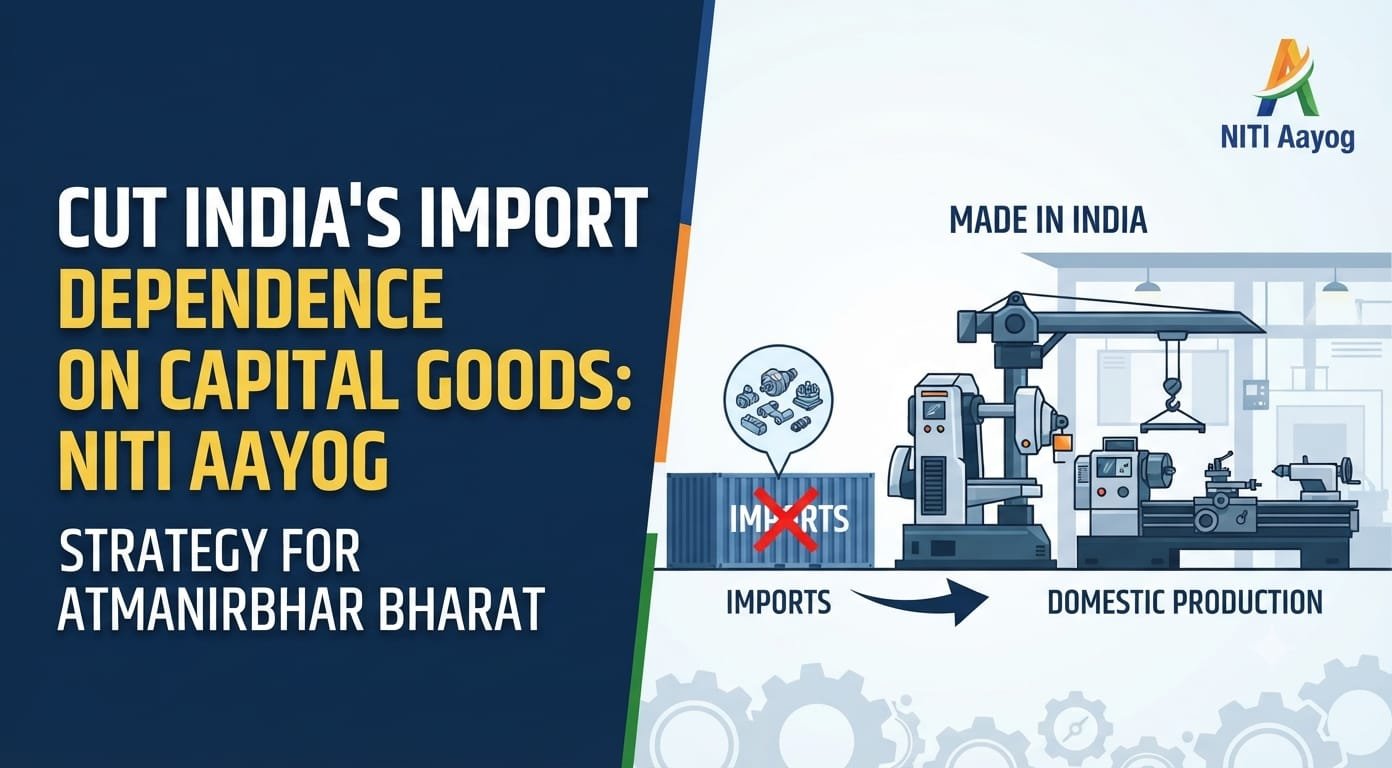
Every factory needs machines, and every road, textile mill and plastic unit depends on tools that someone had to build first. These items are called capital goods. India still buys a large share of them from other countries, and NITI Aayog, the government’s policy think tank, has started examining how to change that.
The numbers explain the concern. India relies on imports for 38 per cent or more of its needs in seven of ten capital goods sub-sectors. Dependence is especially high in plastic processing machinery, machine tools and textile machinery. These are the machines behind everyday products such as packaging, clothing and metal parts, so a disruption in their supply can slow many industries at once.
The worry has grown because countries are increasingly using trade restrictions as a pressure tool. China has put export curbs on certain critical components, and that has exposed weak spots in supply chains around the world. When one country controls an important part, it can tighten or loosen supply as it likes. Buyers elsewhere then face delays, higher prices or stalled production.
NITI Aayog is therefore assessing how deep India’s import dependence runs. It is also preparing policy recommendations to reduce that dependence and raise India’s share in global supply chains. People familiar with the matter say the suggestions will lean mainly towards regulatory and institutional measures rather than only new spending. Officials have already asked for inputs on bottlenecks that, if removed, could encourage companies to make more capital goods at home.
An official described two kinds of dependence. First, India depends almost completely on other countries for a machine. Second, most of the manufacturing happens in India, but key components still come from China. China knows exactly where each critical component it exports sits in the global supply chain, and it can use export controls as leverage. NITI Aayog is looking at both situations, because each one carries a different risk and needs a different fix.
Some steps have already been taken. On Wednesday, the Cabinet announced an ₹11,000 crore scheme to support domestic manufacturing of heavy construction equipment. The scheme also aims to build an ecosystem around that part of the capital goods industry. Heavy construction machinery matters because large infrastructure projects, from highways to ports, depend on it.
The shift is also part of a wider push to make more in India. Capital goods sit at the base of the manufacturing pyramid. A country that can produce its own machines can set up factories faster, control costs better and recover more quickly from global shocks. A country that cannot be exposed to decisions made elsewhere.
Regulatory and institutional reforms may sound dull, but they can have real effects. Simpler approvals, clearer standards, better testing facilities and stronger research support can make local production cheaper and more reliable. Small and mid-sized firms often struggle with such hurdles more than with a lack of ideas. Removing them could help Indian makers compete with established foreign suppliers on price and quality.
There is also a link to jobs. Machine-making units employ engineers, technicians and skilled workers, and they support many smaller suppliers around them. If more of these machines and their components are made in India, the benefit spreads beyond a single factory floor and into local economies.
Building capability will take time. Producing advanced machine tools or specialised components needs technology, skilled people and steady demand, and none of these appears overnight. Still, the direction is clear. Policymakers want fewer weak links, and they want India to be a supplier in global supply chains rather than only a buyer.
For ordinary citizens, the story may seem distant, but it touches daily life. Cheaper and more dependable local machinery can lower production costs, which can keep prices of goods steadier and open up better jobs. The final recommendations from NITI Aayog will show how far and how fast India can move on this.

