
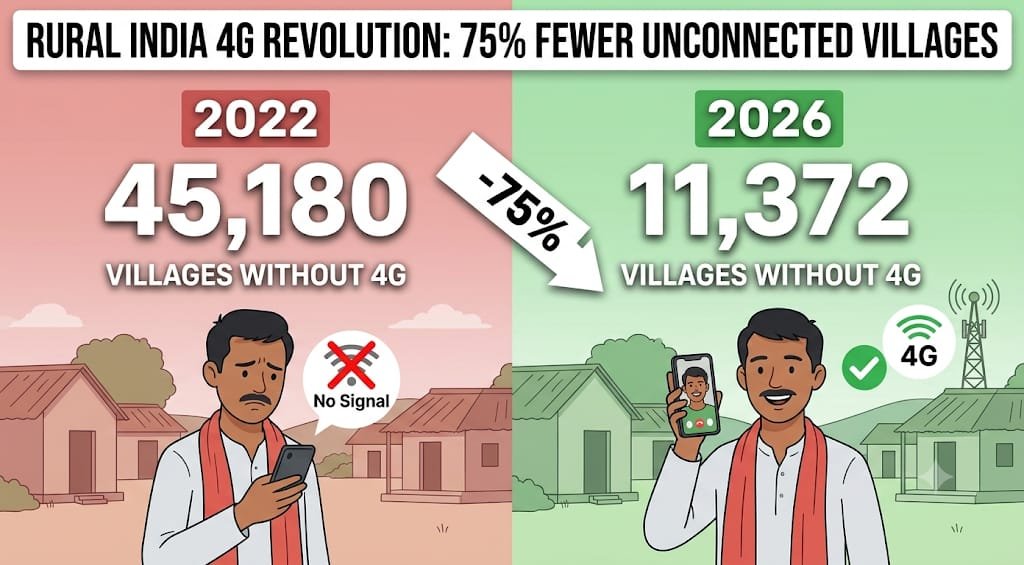
India has made a major advance in expanding mobile internet access in rural areas. According to Department of Telecommunications data obtained by The Hindu under the Right to Information Act, the number of villages without 4G connectivity fell from 45,180 in 2022 to 11,372 by 2026. This means the gap has reduced by nearly three-fourths, or about 75 percent, in just four years.
For millions of people living in remote villages, a mobile network is not only about making calls or watching videos. It affects access to online education, telemedicine, banking, government services, market information, and communication with family members working in other places.
When a village gets reliable 4G service, daily life becomes easier and digital opportunities become more reachable. The latest figures therefore point to an important step in reducing the digital divide between cities and villages.
The improvement has been driven largely by BSNL’s 4G saturation project, which was designed to bring mobile services to uncovered and difficult-to-reach villages. The project had initially aimed to cover 24,680 villages, but the overall reduction in villages without 4G has been much larger. This suggests that private telecom operators also expanded their networks and contributed to the wider coverage gains.
Government records show that as on 31 May 2026, 6,32,875 villages across India had 4G mobile services out of a total of 6,44,131 villages listed by the Registrar General of India. In other words, about 98 percent of villages now have 4G coverage. The remaining 11,256 villages, according to this official count, still lack 4G connectivity.
The progress is significant, but the task is not complete. Many of the villages still outside the 4G network are located in remote, hilly, forested, or border areas, where laying towers, cables, and power connections is difficult and expensive. Some villages may also have very small populations, making commercial telecom expansion less attractive without public funding. Odisha and Arunachal Pradesh are reported to have relatively higher numbers of uncovered villages, and many of these locations are uninhabited or sparsely populated.
The government has supported rural connectivity through the Universal Service Obligation Fund, now associated with the Digital Bharat Nidhi framework. Under Digital Bharat Nidhi-funded mobile projects, 45,832 villages or locations had been planned after survey as on 30 June 2026, and 33,493 of them had already received 4G mobile services. This shows that the effort is continuing beyond the villages already connected.
Better rural connectivity can change everyday life in practical ways. A farmer can check crop prices and weather updates, a student can attend online classes, a patient in a remote area can consult a doctor through video call, and a small business owner can receive digital payments. Local administration can also deliver welfare benefits, certificates, and public information more smoothly when people have dependable mobile internet access.
However, coverage on paper does not always mean a strong and stable connection for every household. Terrain, network congestion, electricity supply, handset affordability, and data costs can still limit the real benefit of 4G. The next challenge is not only to connect the remaining villages but also to ensure that the service is reliable, affordable, and useful for daily digital needs.
The fall in villages without 4G from 45,180 to 11,372 is therefore an important milestone in India’s digital journey. It reflects sustained investment in telecom infrastructure, especially through BSNL’s saturation project and complementary work by private operators. If the remaining gaps are addressed with the same focus, rural India could move closer to equal participation in the country’s digital economy.

