
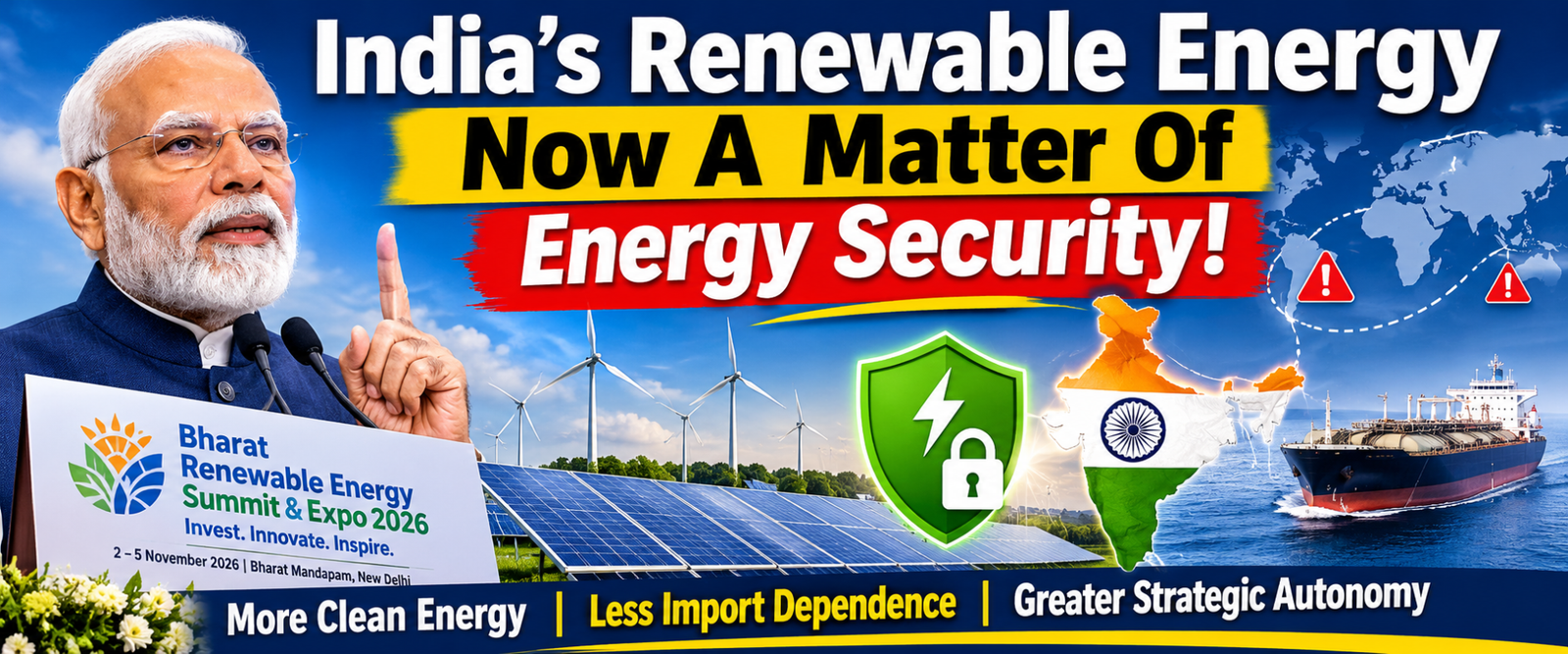
India’s renewable energy transition is no longer just a climate policy or an effort to diversify its electricity mix. It is becoming central to the country’s energy security strategy. Conflicts, shipping disruptions and geopolitical rivalries can affect fossil-fuel supplies and prices. Generating more energy domestically therefore has direct economic and strategic value. The challenge is to build an energy system less exposed to external shocks.
The Bharat Renewable Energy Summit & Expo 2026, held at Bharat Mandapam in New Delhi from 2 to 5 November 2026, reflected this changing priority. Inaugurated by Prime Minister Narendra Modi under the theme Invest. Innovate. Inspire., the event brought together policymakers, investors and industry representatives. Held alongside the ninth Assembly of the International Solar Alliance and the fourth International Conference on Green Hydrogen, it connected India’s energy ambitions with wider discussions on investment, technology and international cooperation.
Energy security beyond oil and gas
India’s dependence on imported fossil fuels exposes its economy to international price movements and supply disruptions. Oil and gas remain essential to transport, industry, power generation and households. Rising prices can affect inflation, production costs and government finances.
Renewable energy can reduce these vulnerabilities. Solar and wind resources are available domestically and require no continuous fuel imports once infrastructure is operational. Expanding their use can reduce exposure to international fuel markets and give India greater control over its energy mix.
However, renewables cannot immediately replace conventional fuels. India needs reliable electricity throughout the day, including when sunlight and wind generation are limited. Coal, gas and other sources will continue to support the energy system during the transition. The objective is to reduce import dependence while building a more diverse supply base.
The scale of India’s ambition
India’s progress has been substantial. According to the Ministry of New and Renewable Energy, installed non-fossil fuel capacity had reached 308 GW ahead of the summit. At its inauguration, the government reported that capacity had crossed 310 GW, moving the country closer to its 500 GW target for 2030.
Achieving this ambition will require significant investment. The MNRE has estimated that around $220 billion will be needed between 2027 and 2030. The government also cited $63.7 billion in renewable energy investment between July 2024 and June 2026, based on Bloomberg NEF data.
These figures underline the scale of the opportunity. Renewable energy development requires more than power projects. Manufacturing, transmission networks, storage systems and skilled employment must expand alongside generation capacity.
Building an energy ecosystem at home
Solar power remains central to India’s expansion. Rooftop installations, solar parks and domestic manufacturing have widened the sector’s reach. The government reported that the PM Surya Ghar scheme had crossed 65 lakh household installations. It also highlighted solar module manufacturing capacity of 225 GW and solar cell capacity of 45 GW.
Domestic manufacturing has strategic importance. Dependence on imported equipment, components and critical materials can create vulnerabilities even when the energy source is domestic. Strengthening production can reduce exposure to external supply chains. However, manufacturing capacity alone does not guarantee self-reliance; access to advanced technology and critical materials remains important.
Wind energy can complement solar generation, while hybrid projects and storage can improve electricity availability. Green hydrogen could support sectors where direct electrification is difficult, including heavy industry, refining and fertiliser production. Developing these technologies together will be essential to build a more resilient energy system.
The difficult test: reliability
India’s renewable energy ambitions will ultimately be judged by the reliability of electricity delivered to consumers, not installed capacity alone. Solar generation varies with sunlight, while wind output depends on weather. Managing these fluctuations becomes increasingly important as renewables supply a larger share of electricity.
Energy storage is therefore essential. Batteries can store surplus electricity and release it when generation falls or demand rises. Other storage technologies and flexible power sources will also be needed. However, storage remains capital-intensive and requires commercially viable projects.
Transmission infrastructure is equally important. Renewable resources are not always located near major centres of demand. Electricity generated in resource-rich states must reach industrial centres and cities efficiently. Green Energy Corridor investments are intended to strengthen these networks. Without adequate transmission, additional generation may not translate into usable electricity.
Land availability, project approvals, financing costs and coordination between central and state authorities also present challenges. Addressing them will determine how quickly new capacity becomes dependable supply.
From capacity targets to strategic resilience
The renewable transition offers India an opportunity to deepen international partnerships. The participation of more than 130 countries and nine country partners at Bharat RE 2026 demonstrated the sector’s international reach. Through the International Solar Alliance, India can strengthen cooperation with countries seeking affordable solar technology, financing and technical expertise.
Such engagement can attract investment and create opportunities for Indian manufacturers. Yet international cooperation must complement domestic capability. Replacing dependence on imported fossil fuels with excessive dependence on imported clean-energy technologies would leave important vulnerabilities unresolved.
India’s priority must now extend beyond installing more solar panels and wind turbines. It must ensure that electricity can be stored, transmitted and distributed reliably and affordably. Renewable energy is becoming an investment in economic stability, industrial capability and strategic autonomy. Its real value will lie in building an energy system that can withstand external disruptions while meeting the demands of a growing economy.

