
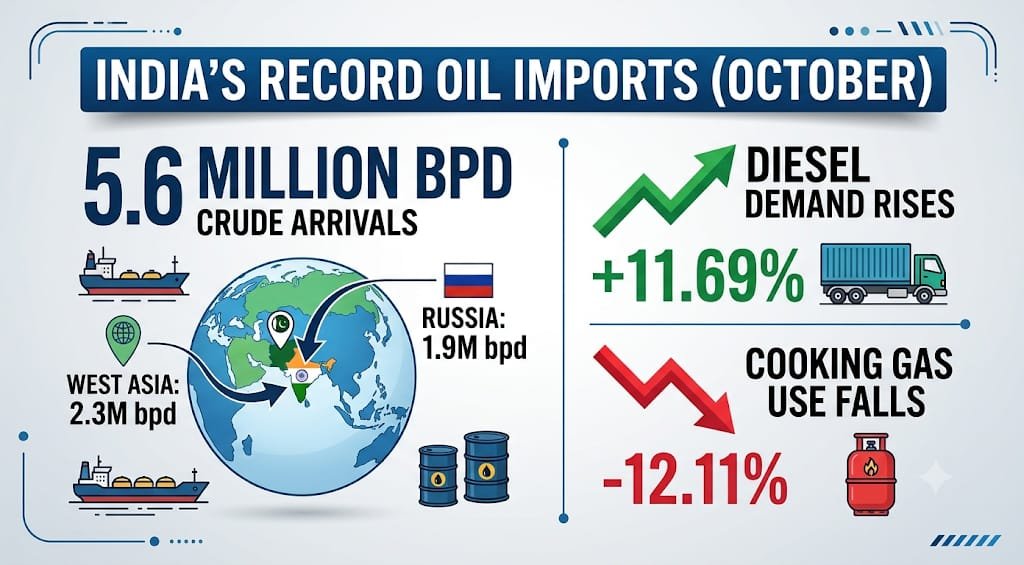
India’s crude oil imports reached a record 5.6 million barrels per day in October, as refineries increased purchases from West Asia and Russia. The rise came despite geopolitical tensions, showing how refiners continued to balance prices, supply security and the country’s fuel requirements.
West Asian supplies accounted for about 2.3 million barrels per day, while Russian shipments reached around 1.9 million barrels per day, according to tanker-tracking firm Kpler. Russian arrivals were slightly below the roughly 2 million barrels per day recorded in September.
The increase was not simply about buying more oil. Indian refiners were also adjusting where their supplies came from and how those shipments reached the country. Higher ship-to-ship transfers helped move more crude through the Strait of Hormuz, supporting supplies despite concerns over possible disruptions. Greater availability also gave refiners more flexibility in choosing cargoes, making it easier to compare prices and manage purchases.
West Asian shipments could moderate in November and December as attacks in the Black Sea push up freight rates, making those barrels less competitive when transportation costs are included. However, Gulf suppliers are offering competitive delivery prices to regain market share in India, according to Kpler analyst Nikhil Dubey. This competition matters because the cheapest crude at its loading point does not always remain the cheapest once shipping expenses are added.
A larger disruption to oil flows through the Strait of Hormuz remains an important concern. The route is crucial for shipments from the Gulf, so any interruption could complicate supplies. At the same time, the report noted that demand for Russian crude remained strong, including in transportation fuels. An October 16 waiver could also ease concerns among some Indian buyers about the risks associated with purchasing Russian oil, potentially giving refiners greater flexibility in procurement.
Russian oil continued to attract buyers, although its price advantage had narrowed considerably. Urals crude was trading around $3 a barrel below Brent, compared with discounts of about $23 in late 2022 and early 2023. A discount represents the difference between the price of that crude and the benchmark against which it is compared. Even with smaller savings, Russian supplies remained commercially relevant for Indian refiners.
Discounts alone, however, did not determine buying decisions. The report highlighted uncertainty over possible sanctions and supply disruptions from West Asia. These competing risks meant refiners had to assess both cost and reliability before deciding how much Russian crude to purchase.
Meanwhile, domestic fuel consumption showed a mixed picture. Diesel sales rose about 11.69 per cent year-on-year in October, while petrol consumption increased 3.11 per cent, according to the Petroleum Planning and Analysis Cell. Cooking gas consumption moved in the opposite direction, falling 12.11 per cent to 2.64 million tonnes. Aviation turbine fuel demand declined 1.34 per cent to 762,000 tonnes.
Record crude arrivals therefore came alongside stronger demand for some fuels, rather than an increase across every category. The figures underline why crude imports and consumption of individual petroleum products need to be viewed separately.
India’s record oil imports in October highlight the importance of balancing affordable prices with reliable supplies. Higher purchases from West Asia and continued shipments from Russia gave refiners more options, even as shipping costs and geopolitical tensions created uncertainty.
Meanwhile, rising diesel and petrol consumption, alongside falling cooking gas and aviation fuel demand, showed that fuel use was not growing evenly. The key challenge remains securing enough crude at competitive prices while adjusting purchases to changing domestic needs.

