
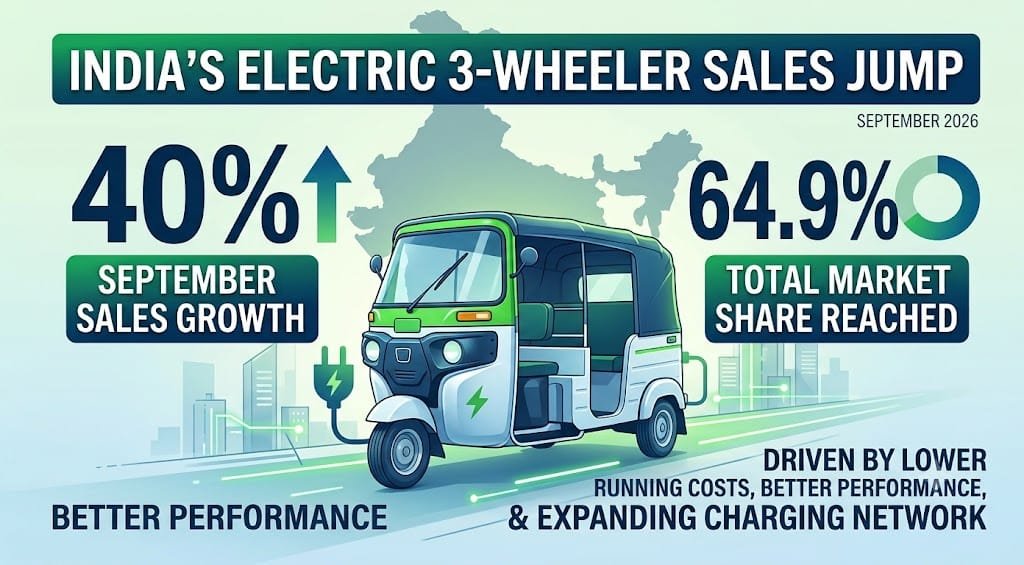
India’s electric three-wheeler market has delivered a strong performance in September 2026, showing that electric mobility is no longer a small experiment but a major part of everyday transport. Retail sales of electric three-wheelers, commonly called e3Ws, increased by 40 per cent compared with the same month last year.
The sales figure reached 86,024 units in September 2026, up from 61,434 units in September 2025. This information was reported by The Hindu BusinessLine, based on data from the Federation of Automobile Dealers Associations, or FADA.
The most important point is not only the rise in sales but also the growing share of electric three-wheelers in the total three-wheeler market. In September 2026, e3Ws accounted for 64.9 per cent of all three-wheeler sales in India.
A year earlier, this share was 56.7 per cent. This means electric three-wheelers gained 8.2 percentage points in market share within one year. In simple terms, nearly two out of every three three-wheelers sold in September were electric.
This growth reflects a clear change in the way people and businesses are choosing vehicles for short-distance travel and last-mile delivery. Electric three-wheelers are widely used for passenger rides, local goods movement, e-commerce deliveries and small commercial work.
Their popularity is rising because they usually cost less to run and maintain than petrol, diesel or CNG vehicles. As fuel prices remain a concern for daily earners, the lower cost per kilometre becomes a major advantage.
Better vehicle performance has also played an important role. Earlier, many buyers were worried about limited range, weak loading capacity and the lack of charging facilities. Now, manufacturers are offering improved batteries, better driving range and more capable vehicles.
At the same time, the charging ecosystem is expanding, making it easier for drivers and fleet operators to keep their vehicles running through the day. These improvements are helping electric three-wheelers become a practical choice rather than just an environmentally friendly option.
Among manufacturers, Bajaj led the electric three-wheeler sales chart in September. Mahindra Group followed in second place, while TVS Motor Company stood third. YC Electric Vehicle was the only company among those tracked by FADA to record a decline in sales compared with the previous year.
The strong presence of established brands suggests that larger automakers are now playing a central role in shaping the electric three-wheeler market.
Industry experts believe that the next stage of growth may be slower than the current surge because electric three-wheelers already hold close to two-thirds of the market. Poonam Upadhyay, Director at Crisil Ratings, said that e3Ws have established a clear lead and that future expansion will depend on how much they can enter the remaining part of the market, where CNG vehicles are still a strong alternative. She added that the next phase of electric vehicle growth is likely to be more gradual and increasingly driven by replacement demand.
Replacement demand means that existing vehicle owners will gradually replace their old petrol, diesel or CNG three-wheelers with electric models. This process may take time because many operators already own vehicles that are still useful.
However, as electric vehicles prove their value over time, more owners are expected to make the switch. The decision will often depend on the total cost of ownership, which includes purchase price, fuel or charging cost, maintenance, vehicle uptime and long-term resale value.
Rajat Gupta, Business Head of the Commercial Mobility Business at TVS Motor Company, said changing customer preferences are influencing purchase decisions.
For commercial users, lower running and maintenance costs, improved range, convenient charging and connected vehicle features are making electric three-wheelers more attractive for daily operations. He also noted that greater customer familiarity and a stronger electric vehicle ecosystem are building confidence among buyers.
CNG vehicles are expected to continue alongside electric three-wheelers in cities where CNG infrastructure and operating patterns remain suitable, including Chennai, Bengaluru and Mumbai. Still, as customers increasingly compare vehicles based on total cost, reliability and long-term value, electric three-wheelers are likely to gain more ground.
Deependra Sharma, CEO of e-3W at Montra Electric, part of the Murugappa Group, said electric three-wheelers are becoming a key driver of electric commercial vehicle adoption in India. He pointed out that lower operating and maintenance costs, improving range and performance, and a growing charging network are supporting demand. Importantly, he observed that adoption is increasingly market-led rather than being driven mainly by government incentives.
Overall, September’s figures show that electric three-wheelers have become the preferred choice for a large share of India’s three-wheeler buyers. The 40 per cent sales growth and 64.9 per cent market share indicate strong acceptance among drivers, small businesses and fleet operators.
While CNG will remain relevant in some markets, the combination of lower daily costs, improving technology and expanding charging support is likely to keep electric three-wheelers at the centre of India’s last-mile mobility transformation.
In the end, the Draft National Steel Policy Vision 2047 represents more than a plan to increase steel production; it is a roadmap for strengthening India’s industrial future. By aiming to raise crude steel capacity to 604 million tonnes, expand domestic consumption, boost exports, secure raw materials and encourage cleaner production, the policy seeks to connect economic growth with self-reliance and sustainability.
Its real success, however, will depend on timely investment, strong infrastructure, stable raw-material supply and effective adoption of green technologies. If these efforts move together, the policy can help India meet its growing steel needs, create employment, support manufacturing and establish the country as a leading force in the global steel industry.

