
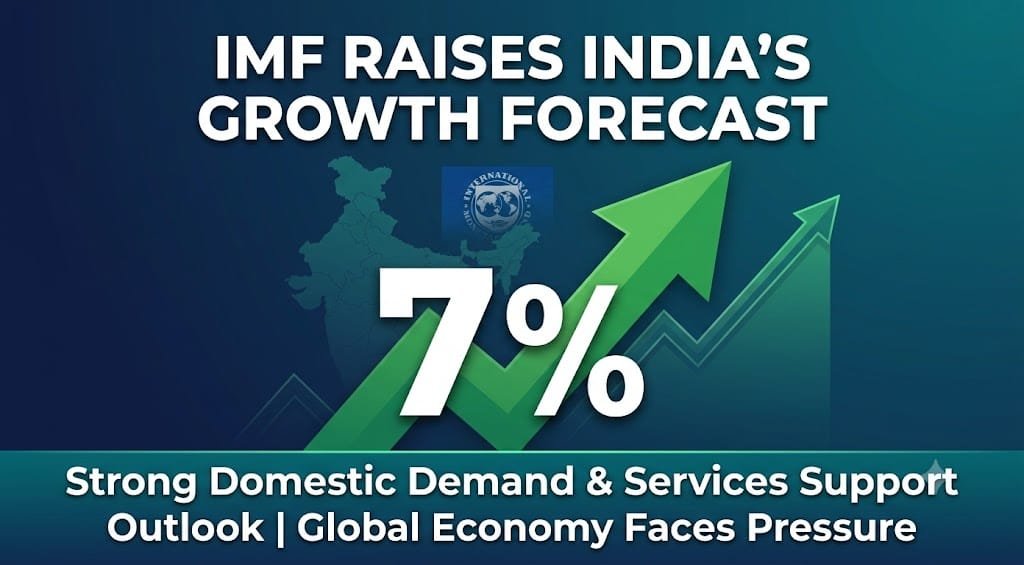
The International Monetary Fund has raised India’s economic growth forecast to 7% for both 2026-27 and 2027-28, offering an encouraging outlook at a time when the world economy faces growing pressure. Strong demand within India and healthy activity in services are supporting this growth, despite higher oil prices and global uncertainty. The latest projections keep India among the fastest-growing major economies.
An important detail is the period covered by these figures. The 7% forecasts refer to India’s financial years, rather than January-to-December calendar years. FY27 runs from April 2026 to March 2027, while FY28 runs from April 2027 to March 2028. On a calendar-year basis, the IMF projects India’s growth at 7.4% in 2026 and 7% in 2027. This distinction helps avoid confusion when comparing different reports.
The latest estimates mark an improvement from the IMF’s July outlook. Its forecast for FY27 has increased from 6.4% to 7%, a rise of 0.6 percentage point. For FY28, the projection has moved from 6.7% to 7%, an increase of 0.3 percentage point. These changes show that the IMF now expects stronger economic activity in India than it anticipated a few months earlier.
The main support comes from resilient domestic demand and strong services activity. In simple terms, spending and business activity within the country are helping the economy maintain momentum. This matters because a difficult global environment can weaken overseas demand and raise business costs. India’s domestic strength provides support, although it does not remove the risks created by expensive oil or wider international uncertainty.
The global picture is less comfortable. The IMF expects world economic growth to slow from 3.5% in 2025 to 3.1% in 2026, before improving to 3.4% in 2027. Its latest estimate for 2026 is slightly above the 3% projected in July, while the 2027 forecast remains unchanged. The improvement is modest, suggesting that the world economy continues to expand but still faces significant challenges.
The IMF has warned that global economic resilience is becoming more fragile and uneven. This means the ability to withstand shocks is weakening, and growth is not equally strong everywhere. Emerging market and developing economies are expected to grow by 3.7% in 2026 and 4.4% in 2027. India’s projected pace is considerably higher, highlighting its stronger outlook within this group.
Rising prices remain a concern. Global inflation is projected to reach 4.7% in 2026, driven largely by higher energy and food prices, before easing to 4.1% in 2027. These pressures matter beyond economic reports because fuel and food costs affect household budgets and business expenses. The 4.7% figure describes global inflation; it should not be presented as India’s inflation forecast.
For India, the IMF separately expects consumer inflation to average 5% in FY27 and moderate to 4.4% in FY28. The overall outlook therefore combines stronger growth with continuing price pressures. The projections are encouraging, but they remain forecasts rather than guaranteed results. India’s domestic demand and services provide important support, while higher oil prices and global uncertainty remain risks to the expected performance.

