
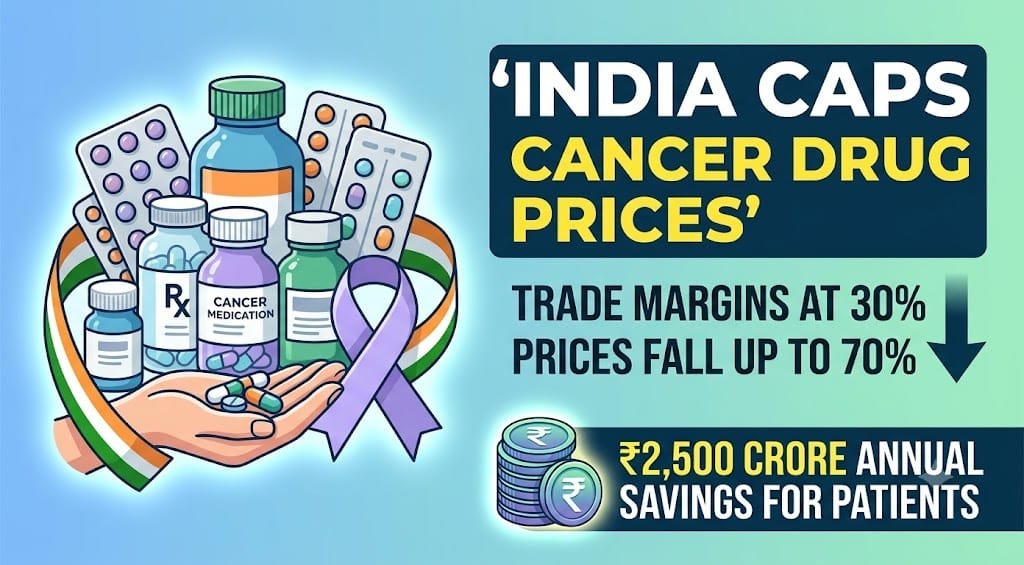
Cancer treatment can bring a heavy financial burden to patients and their families. Along with hospital visits and tests, the cost of medicines can continue for months or even longer. To reduce some of that pressure, the Union government has approved a cap on trade margins for non-scheduled cancer medicines. The limit is set at 30% of the maximum retail price (MRP), and the government expects the step to lower the prices of some medicines by as much as 70%.
The decision covers medicines that are not included in the government’s scheduled list of drugs with fixed ceiling prices. It is intended to address the extra mark-ups added as medicines move from manufacturers through distributors and sellers to patients. The government’s market analysis found that non-scheduled cancer medicines had an average mark-up of about 170%, with some reaching 700% or more. In everyday terms, the price paid by a patient could be far above the amount at which a medicine entered the supply chain.
The cap is expected to apply across different kinds of products, including branded and generic medicines, Indian-made and imported drugs, and patented and non-patented medicines. This matters because the cost of treatment can vary depending on the medicine and where it is purchased. A limit on the trade margin aims to narrow the gap between the medicine’s cost earlier in the supply chain and the price charged to the patient.
The expected savings are significant, but they are estimates rather than a guarantee that every patient will see the same price reduction. The government estimates that cancer patients could save around ₹2,500 crore each year, while the price of some medicines may fall by up to 70%. The actual change will depend on the drug and the mark-ups already built into its price.
The National Pharmaceutical Pricing Authority (NPPA) will issue the notification after an expert committee under the Directorate General of Health Services finalises the list of medicines covered. Until that list is notified, patients and pharmacies will not know exactly which products are included or when the revised prices will apply. The government has also said manufacturers must maintain current production levels, with the aim of keeping medicines available while prices are brought under control.
This decision builds on an earlier price-control step. In 2019, the NPPA capped trade margins on 42 selected non-scheduled cancer drugs. Government figures say that prices across 526 brands fell by as much as 91%, with reported annual savings of ₹984 crore for patients. The new measure extends the effort to a wider group of non-scheduled cancer medicines.
For families managing cancer treatment, even a partial reduction in medicine costs can make a practical difference to household budgets. The key test will be how quickly the final list is issued, how clearly new prices are displayed, and whether the savings reach patients at pharmacies and hospitals. A margin cap can address one part of the treatment bill; its real value will depend on transparent implementation and continued access to the medicines patients need.
In the end, this step can bring meaningful relief to thousands of families facing the high cost of cancer treatment. A 30% cap on trade margins is not only about reducing the price printed on a medicine pack; it is about making essential treatment more reachable at a time when every medical expense can feel overwhelming.
If the final drug list is notified quickly and the revised prices are properly followed by manufacturers, distributors, hospitals and pharmacies, the benefit could directly reach patients. The move also sends a clear message that life-saving medicines should remain affordable and that excessive mark-ups cannot stand between a patient and timely treatment.

