
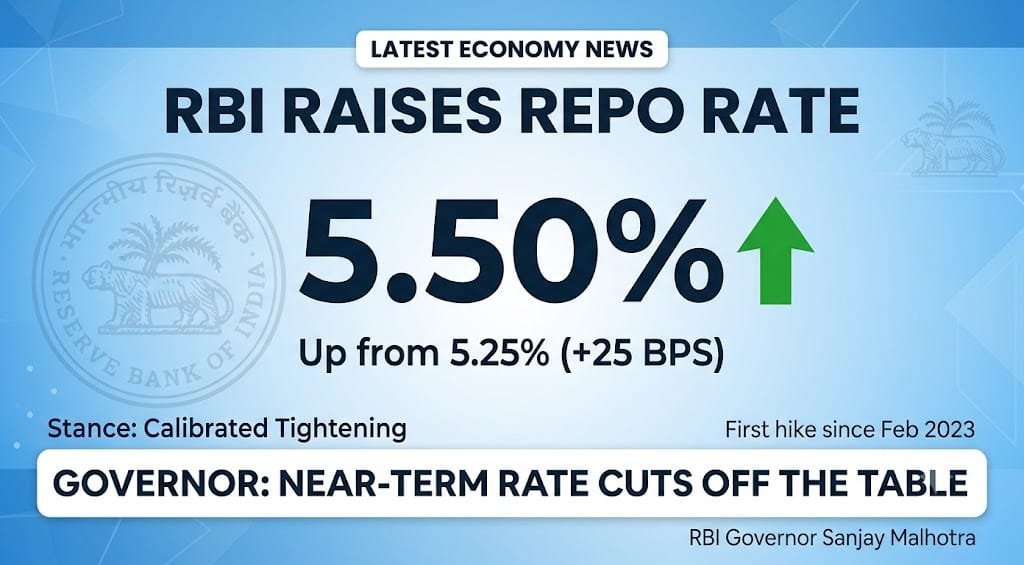
The Reserve Bank of India has increased the policy repo rate by 25 basis points, taking it from 5.25% to 5.50%. The decision was announced by RBI Governor Sanjay Malhotra after the three-day meeting of the Monetary Policy Committee held from October 5 to October 7, 2026. This is the first increase in the repo rate since February 2023. The decision was taken unanimously by all members of the MPC.
The repo rate is the interest rate at which the RBI lends money to commercial banks. When this rate rises, banks may face higher borrowing costs. As a result, interest rates on some home loans, vehicle loans, personal loans and business loans may also increase. The impact may not be immediate for every borrower because the final change depends on the type of loan, the lender’s policy and the interest-reset schedule.
The RBI has also changed its monetary policy stance from neutral to “calibrated tightening”. In simple terms, this means that the central bank is now giving greater priority to controlling inflation and preventing price pressures from becoming permanent. Governor Sanjay Malhotra indicated that rate cuts are not expected in the near term. According to his guidance, the next policy move could either be another hike or a pause, depending on inflation, growth and financial market conditions.
The RBI’s decision comes at a time when inflation risks are becoming more visible. Food and fuel prices remain important concerns, while higher crude oil prices and global uncertainty can increase the cost of imports. International bond yields and borrowing costs have also remained elevated. These developments can put pressure on India’s inflation outlook and can affect the value of the rupee and the cost of imported goods.
Governor Malhotra said that inflation and its outlook are no longer as comfortable as they were during the previous year. The central bank is therefore trying to act early rather than waiting for inflation to become deeply established. A gradual increase of 25 basis points is intended to control demand and inflation expectations without creating a sudden shock for businesses, households or financial markets.
At the same time, the RBI has maintained a positive view of India’s economic growth. The central bank has raised its real GDP growth forecast for the financial year to 7.1%, compared with the earlier projection of 6.7%. This reflects the continued strength of domestic demand, investment, government spending and other economic activities. India’s growth outlook remains stronger than that of many major economies despite global uncertainties.
The policy decision shows that the RBI is trying to maintain a balance between growth and price stability. Very low interest rates can support borrowing and spending, but if inflation rises for a long period, household budgets and purchasing power come under pressure. A moderate rate increase can help keep inflation expectations under control and support stability in the financial system.
For borrowers, the immediate effect may be a possible rise in lending rates and monthly installments, particularly in loans linked to external benchmarks. For savers, higher interest rates may gradually improve returns on fixed deposits and other interest-bearing products. However, the actual impact will depend on how banks revise their deposit and lending rates.
The RBI’s message remains cautious but constructive. The central bank is not indicating weakness in the Indian economy. Instead, it is using monetary policy to protect price stability while keeping growth on a strong path. With GDP growth projected at 7.1%, inflation being closely monitored and future decisions linked to incoming data, India’s economic outlook continues to remain hopeful and resilient.

