
green energy
India’s newly approved Green Energy Corridor Phase-III has drawn strong appreciation from the United Nations climate leadership, with UN Climate Change Executive Secretary Simon Stiell calling it a major step that will deliver big dividends for people and the economy.
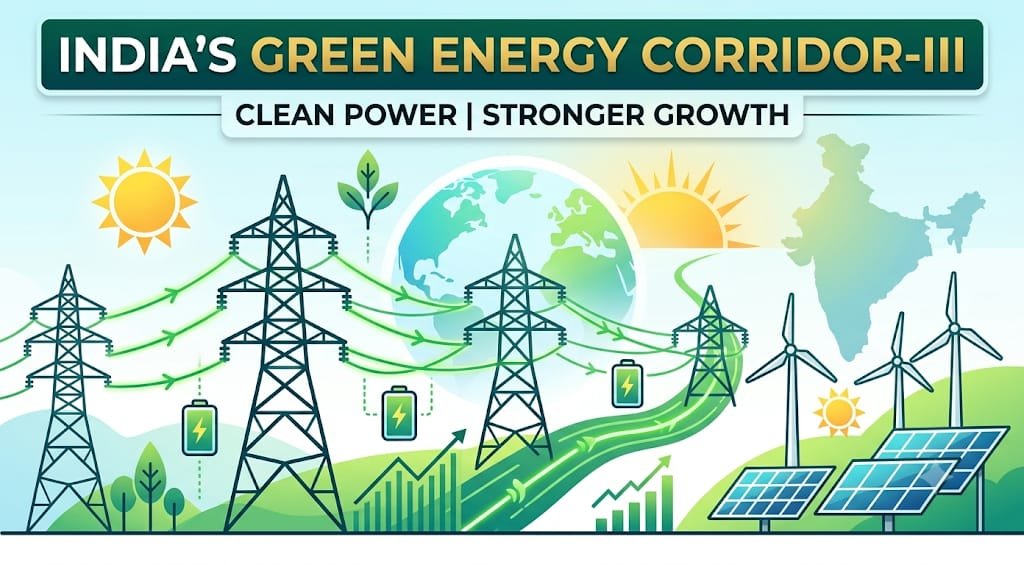
The initiative, cleared by the Union Cabinet with a total outlay of Rs 1,86,405 crore, is designed to make the power system ready for a future where most electricity comes from sun and wind. It focuses on two critical pieces: stronger intra-state transmission networks and large-scale battery energy storage.
Together, these are expected to help integrate about 135 GW of renewable power and deploy 50 GWh of battery capacity by FY 2032–33, supporting India’s target of 500 GW of non-fossil installed capacity by 2030.
The plan is built around the simple idea that clean energy must reach homes and factories reliably. To do this, the scheme envisages creation of 51,126 circuit kilometres of transmission lines and 2,28,903 MVA of transformation capacity across states.
This network will carry renewable power from where it is generated—often in sunny or windy regions—to where it is needed most. By strengthening intra-state systems, the project reduces bottlenecks that can otherwise lead to curtailment or delays in supplying green power.
The government has indicated that Central Financial Assistance of Rs 54,082 crore will be provided, with Rs 45,005 crore earmarked for intra-state transmission and Rs 6,000 crore for battery storage through viability gap funding. An additional Rs 3,050 crore will meet committed liabilities from earlier phases, and Rs 27 crore is allocated for programme management and grid studies.
Battery storage sits at the heart of making renewables dependable round the clock. Simon Stiell highlighted that battery storage offers a strategic opportunity for large economies like India to achieve energy security and economic growth.
When the sun is not shining or the wind is not blowing, stored energy can be released to keep lights on and machines running. This reliability makes it easier for industries to plan production and for households to depend on steady supply. It also helps balance the grid when renewable generation fluctuates, reducing stress on the system and improving overall efficiency.
Employment generation is another positive outcome expected from this push. Stronger grids and battery infrastructure are likely to create more jobs in manufacturing, construction, and energy storage as the global transition toward renewables and electrotech accelerates.
The government estimates that Central support will leverage around Rs 1.32 lakh crore in transmission investment, besides enabling investment linked to 135 GW of renewable energy—estimated at roughly Rs 4.6 lakh crore. Such scale implies sustained activity across multiple sectors, from cables and transformers to battery systems and project management.
The design of GEC-III also encourages wider participation from the private sector. Greenfield intra-state transmission projects will be awarded through tariff-based competitive bidding, while brownfield projects will be implemented on a cost-plus basis.
This mix aims to bring in efficiency where new assets are built and ensure continuity where existing networks are upgraded. By opening space for private players, the scheme can speed up execution and introduce innovative approaches to grid planning and operations.
From a climate and development perspective, the initiative aligns with India’s broader clean-energy ambitions. Stiell noted that the scheme would help harness the country’s growing renewable capacity, meet rising electricity needs, and further strengthen India’s status as a global solar superpower.
With transmission infrastructure acting as the backbone, renewable power generated across geographically dispersed regions can be evacuated and integrated smoothly. This is crucial because solar and wind resources are not evenly spread; some states have more sun, others more wind, and a robust grid ensures that surplus power flows where demand is high.
The positivity around GEC-III stems from its practical approach: build the wires and storage that make clean energy usable at scale. As battery costs decline and grid technologies improve, the combination of transmission expansion and storage deployment can deliver reliable, affordable, and low-carbon electricity.
For citizens, this can mean fewer disruptions and cleaner air. For businesses, it can mean predictable power costs and better competitiveness. For the country, it can mean progress toward energy independence and climate goals without compromising growth.
In short, the Green Energy Corridor Phase-III is more than a transmission project; it is an enabler of a cleaner, more resilient power system. With clear timelines up to FY 2032–33, defined financial support, and a focus on both wires and storage, the plan sets a strong foundation for the next stage of India’s energy transition.
The endorsement from the UN climate chief underscores how such infrastructure can translate climate ambition into everyday benefits—steady power, new jobs, and a stronger role in the global clean-energy landscape.

