
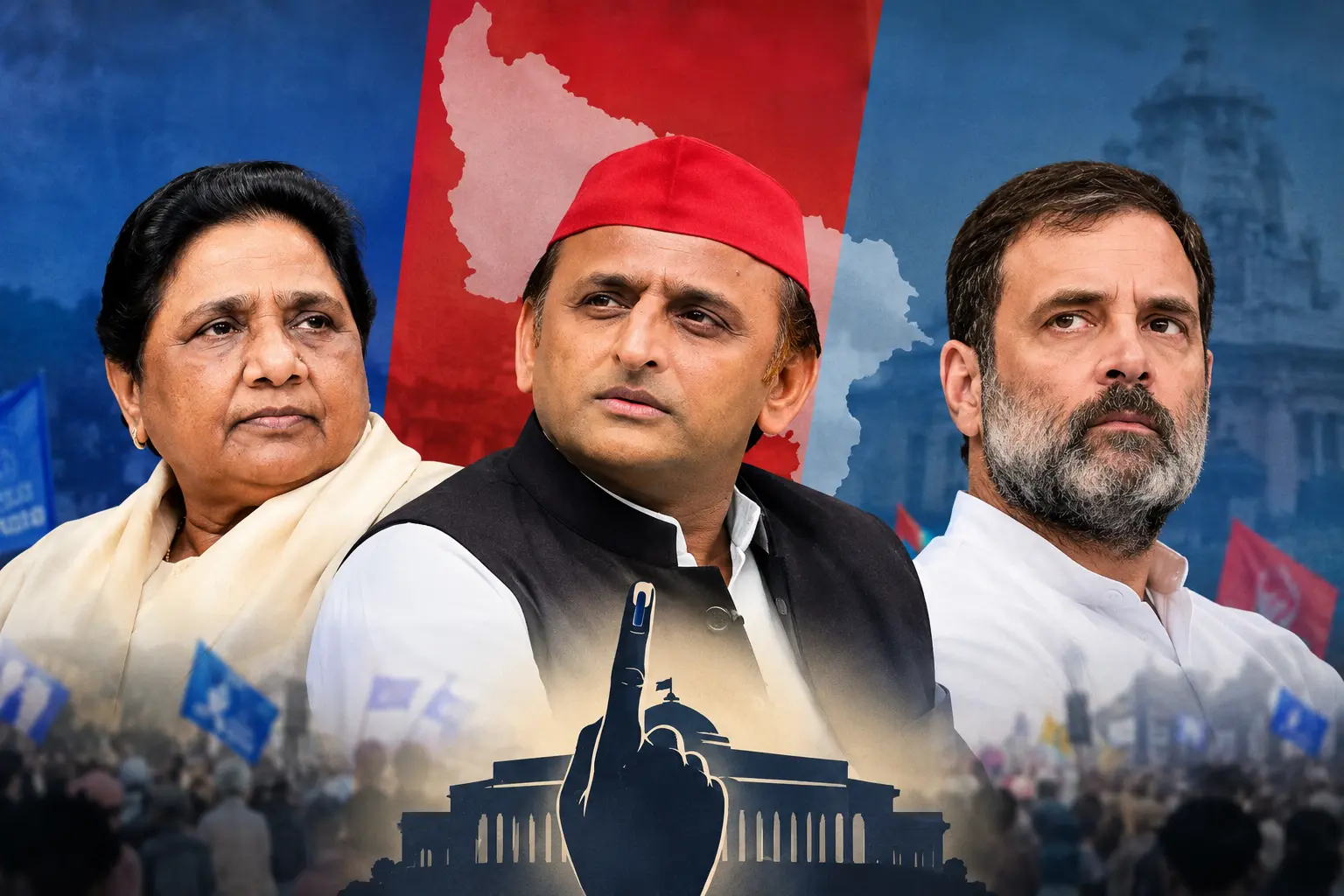
The Uttar Pradesh Assembly election is still months away, but the political battle for 2027 has already intensified. And the contest is not simply between the opposition and the ruling BJP. A parallel battle is unfolding among opposition parties themselves, particularly the Samajwadi Party, Congress, and Bahujan Samaj Party.
At the centre of this contest among the opposition is the question of minority support, particularly the Muslim vote bank, which has traditionally been an important component of electoral calculations in Uttar Pradesh.
The latest flashpoint came after BSP supremo Mayawati attacked Samajwadi Party Chief Akhilesh Yadav over the colour and symbolism of his new PDA (Pichhda, Dalit, Alpsankhyak) campaign vehicle. Mayawati questioned why the SP’s traditionally red campaign colour has been replaced by saffron and asked whether the party had lost confidence in Muslim voters. She also urged Muslim voters to reconsider their political choices and look towards the BSP.
Akhilesh subsequently responded to Mayawati’s criticism, saying that opponents were focusing on the colour of his campaign vehicle rather than his political message. The political friction does not stop with the SP and BSP.
The relationship between the Congress and Samajwadi Party is also becoming increasingly complicated ahead of the 2027 election. Congress MP Imran Masood has publicly urged the SP to finalise the alliance quickly, warning that Congress would prepare to contest independently if an agreement is not reached.
This has brought the question of seat-sharing into sharper focus. Congress wants clarity on the constituencies it will contest, while the SP is continuing its own preparations and has indicated that it could contest all 403 Assembly seats if an alliance arrangement does not work out.
The political calculation becomes particularly significant when viewed through the lens of Muslim voters.
For the SP, retaining its existing social coalition is a central part of its electoral strategy. A contest in which opposition parties divide voters who might otherwise support the same broader political camp could alter the arithmetic in individual constituencies.
Congress, meanwhile, is seeking a larger role in Uttar Pradesh and is negotiating from the position that it needs enough seats to maintain and expand its political presence in the state. At the same time, Congress leaders have continued to publicly describe the SP-Congress alliance as intact, despite disagreements over seat-sharing and timing.
And then there is Mayawati.
The BSP remains an important variable because any movement of support towards or away from the party could affect contests across the state. Mayawati’s recent attack on the SP’s PDA campaign shows that the BSP is actively seeking to distinguish itself from Akhilesh Yadav and challenge the SP’s claim over sections of the electorate.
This is why the 2027 Uttar Pradesh election is already shaping up as a multi-layered contest.
The SP wants to protect its electoral base. Congress wants a larger role within the opposition alliance. The BSP is attempting to rebuild its political space outside the SP-Congress arrangement.
The question, therefore, is not simply whether Akhilesh Yadav, Rahul Gandhi’s Congress or Mayawati will challenge the BJP. It is also about how opposition parties divide constituencies, votes and political space among themselves.
As the election approaches, the crucial question will be whether these parties can maintain a common front or whether competition for the same voter groups, including Muslim voters, will deepen the divisions within the opposition.
For now, one thing is clear, the 2027 Uttar Pradesh battle has already begun, and much of the action is taking place within the opposition camp itself.

