
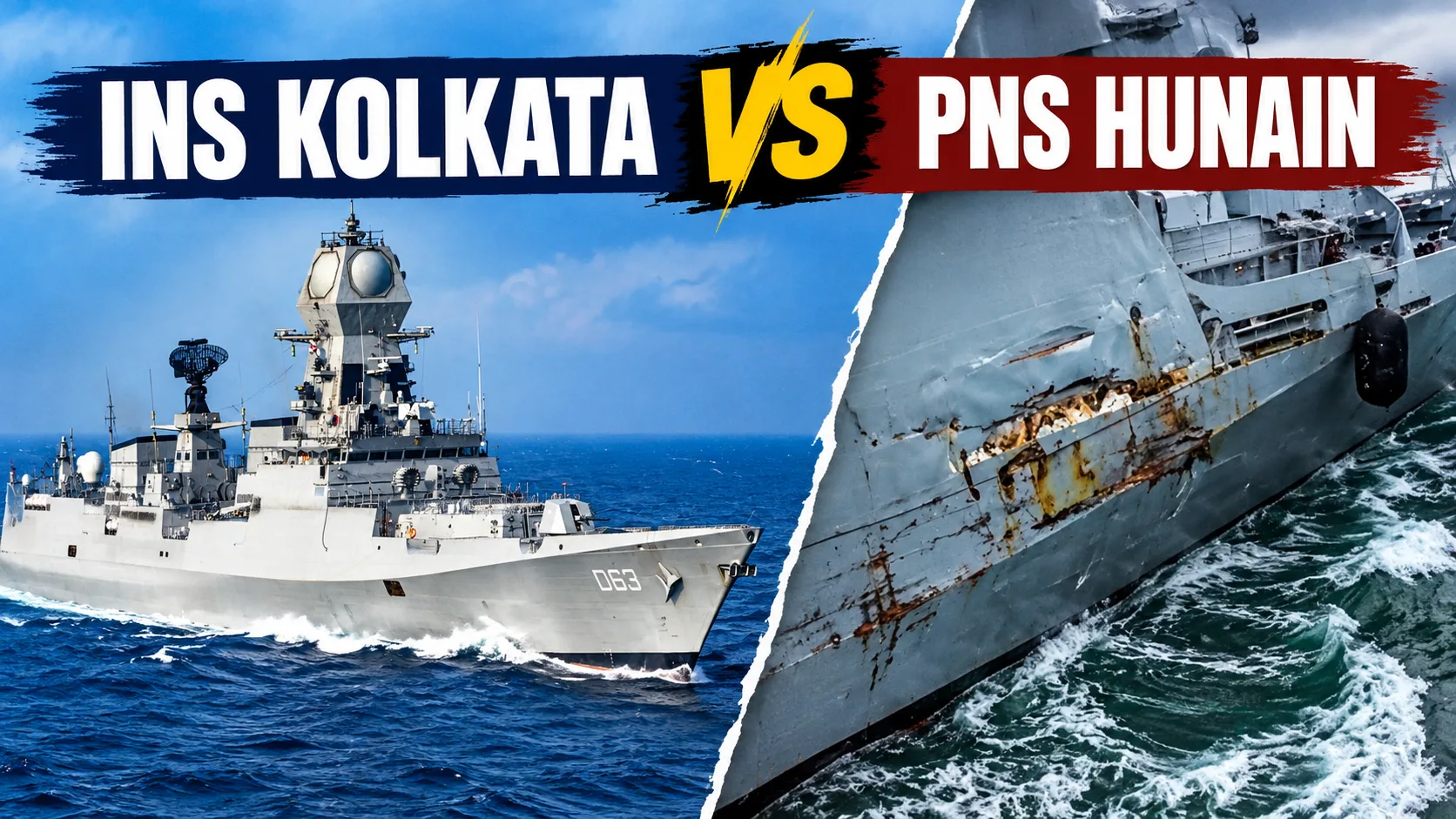
The 15 September 2026 naval misadventure in the North Arabian Sea ended badly for Pakistan Navy’s PNS Hunain, which suffered significant damage after colliding with the much larger Indian Navy warship INS Kolkata. The incident followed what Indian officials described as a high-speed and dangerous manoeuvre by the Pakistani vessel turning its alleged misadventure into a costly encounter with INS Kolkata.
The collision has brought maritime safety, naval seamanship and India–Pakistan military confidence-building measures sharply back into focus. India says INS Kolkata was on a routine surveillance mission and that PNS Hunain approached at high speed and manoeuvred dangerously close. Pakistan has presented the opposite version, alleging that INS Kolkata carried out “aggressive manoeuvres in dangerously close proximity” while PNS Hunain was participating in exercise SEASPARK-26. At the centre of the dispute is the 1991 Agreement between India and Pakistan on advance notice on military exercises, manoeuvres and troop movements. Article 10 states that naval ships and submarines of the two countries operating in international waters “are not to close less than three Nautical Miles (NMs) from each other so as to avoid any accident” a separation of approximately 5.6 kilometres. The competing accounts leave the precise sequence of manoeuvres and responsibility contested, but the PNS Hunain–INS Kolkata collision has once again exposed the importance of the three-nautical-mile safety buffer and the wider India–Pakistan maritime confidence-building architecture.
The importance of this provision lies in its operational character. It is not simply a diplomatic confidence-building statement it establishes a clear maritime risk-reduction mechanism. The Indian Ministry of External Affairs, while lodging a protest, described the conduct of Pakistani naval units as “unacceptable and unprofessional” and said that it was in “direct contravention” of the 1991 agreement. Pakistan, in its counter-demarche, described the Indian action as “highly provocative and unacceptable.” The competing claims mean that the precise allocation of navigational responsibility should ultimately rest on evidence such as bridge logs, radar tracks, electronic records and the reconstruction of the vessels’ relative courses and speeds rather than on political statements alone, from a professional naval perspective, however, the central issue is immediately apparent two warships belonging to adversarial navies should not have been allowed to progress into a collision geometry. A competent bridge team is expected to maintain a continuous surface picture, assess relative bearing and range, identify developing close-quarters situations and take timely action in accordance with the applicable rules of navigation and standing orders. When two military vessels are operating in a politically sensitive theatre, the threshold for maintaining separation should be even more conservative. What appears externally as a few minutes of shiphandling can, in a nuclearised bilateral relationship, create a potentially serious escalation problem.
The physical characteristics of the vessels make the incident particularly striking. INS Kolkata is a Project 15A guided-missile destroyer, approximately 164 metres long and around 7,400 tonnes full-load displacement, designed as a high-end multi-role combatant with area-air-defence, anti-surface and anti-submarine capabilities. PNS Hunain is an approximately 98-metre, 2,600-tonne Yarmook/OPV 2600-derived offshore patrol vessel. The difference is therefore close to three-to-one in displacement. Open-source reporting sometimes cites a lower figure of around 2,400 tonnes for the Pakistani vessel, but approximately 2,600 tonnes is the more commonly reported figure for the OPV 2600-derived batch.
That disparity has a direct bearing on the physical consequences of such an ill-judged close-quarters contact, although displacement alone does not explain the damage. The energy generated in such an encounter is also a function of relative speed, impact angle, point of contact and structural characteristics. Nevertheless, a 7,400-tonne destroyer possesses substantially greater mass and structural volume than a 2,600-tonne patrol vessel. Reports indicate that PNS Hunain sustained substantial external damage and returned to harbour, whereas INS Kolkata remained operational. The lesson for naval professionals is less about “winning” the encounter than about the dangers inherent in a reckless close-quarters approach by a smaller platform towards a much larger frontline combatant.
The episode also has a historical precedent. In June 2011, PNS Babur approached INS Godavari at high speed during an anti-piracy deployment in the Gulf of Aden. According to the Ministry of Defence, the Pakistani vessel conducted a manoeuvre in “gross violation of the relevant regulations on navigational safety” and touched INS Godavari, causing minor damage to the ship’s helicopter-deck safety netting. India subsequently lodged a formal protest with Pakistan. The recurrence of a broadly similar close-quarters episode 15 years later demonstrates why the 1991 maritime safety provisions remain operationally relevant.
The strategic context is even more important after Operation Sindoor in May 2025. During that confrontation, India’s naval posture in the Arabian Sea became a major component of the overall deterrent framework. Speaking aboard INS Vikrant on 30 May 2025, Raksha Mantri Rajnath Singh stated “Our mighty Carrier Battle Group, albeit silent, ensured that the Pakistani Navy did not venture out or else it would have faced the consequences.” The Ministry of Defence subsequently described the Indian Navy’s deployment as part of an offensive deterrent posture and stated that the presence of the carrier battle group compelled the Pakistan Navy to remain in a defensive posture close to its shores.
Commercial satellite imagery analysed by India Today’s OSINT team provided an additional, albeit non-governmental, indication of this posture. Imagery from the period showed several Pakistani naval vessels at Karachi’s commercial terminals, while other vessels were reported near Gwadar rather than operating forward into the Arabian Sea. The OSINT assessment interpreted this as a defensive disposition during the height of Operation Sindoor.
This background creates an obvious strategic question regarding the behaviour seen in the present incident, after a conflict in which the Pakistan Navy’s visible role was principally one of fleet preservation, coastal defence and deterrence, there may be an institutional incentive to demonstrate greater operational presence and relevance in subsequent naval activity. PNS Hunain was operating in the context of SEASPARK-26, which Pakistan describes as a major multi-domain exercise integrating surface ships, submarines, aircraft, unmanned systems, Marines and special forces, as well as Army and Air Force components. The exercise is explicitly intended to test combat readiness and multi-domain operations across maritime, air, land, cyber, space-enabled and information environments.
It would nevertheless be too strong to conclude from the available evidence that the misadventure was deliberate or that the Pakistan Navy was “desperate” to provoke a conflict. No public evidence currently establishes such an intent. What can reasonably be discussed is strategic signalling. A navy operating under intense scrutiny after a major crisis may seek to demonstrate that it remains capable of forward presence, surveillance, interception and tactical engagement. The danger is that signalling through close maritime interaction can produce the opposite effect, especially when conducted against a much larger combatant and within a bilateral framework that expressly requires separation.
The broader force balance reinforces the asymmetry. According to IISS data reported by Reuters, India possesses 16 submarines, 11 destroyers, 16 frigates and two aircraft carriers, while Pakistan has eight submarines and 10 frigates. These figures do not constitute total fleet inventories, but they illustrate the fundamentally different force structures of the two navies. India’s fleet is oriented increasingly towards blue-water operations, carrier battle-group employment, long-range maritime surveillance and sustained expeditionary deployment, whereas Pakistan’s force structure places greater emphasis on sea denial, submarines, frigate operations and coastal defence.
Against this backdrop, the INS Kolkata–PNS Hunain reckless act should be understood as a warning about close-quarters naval operations in a contested maritime environment. The immediate damage may be limited, but the operational and diplomatic risks are not. Article 10 of the 1991 agreement exists precisely because the Arabian Sea does not provide a visible boundary between two rival fleets. Once ships enter close-quarters geometry, the distinction between an unsafe manoeuvre, an interception, surveillance, signalling and hostile intent becomes increasingly difficult to manage. The most important conclusion, therefore, is not the relative damage suffered by the two ships. It is that professional seamanship, disciplined bridge management and adherence to bilateral maritime confidence-building measures remain essential instruments of escalation control. A 7,400-tonne guided-missile destroyer and a 2,600-tonne patrol vessel have fundamentally different roles and survivability characteristics. Yet, despite the reckless and determined close-quarters attempt by PNS Hunain, INS Kolkata continues to stand tall, operational and mission-ready a stark reminder of the resilience and structural robustness of India’s frontline surface combatants.
For Pakistan, the incident demonstrates the risks inherent in aggressive or overly close surface interaction while conducting a major naval exercise. For India, it reinforces the requirement to maintain persistent surveillance, clear rules of engagement and measured tactical responses while operating in proximity to Pakistani units, and for both sides, the episode underlines why the 1991 three-nautical-mile provision remains relevant more than three decades after it was signed.
In naval warfare, presence is a strategic signal seamanship determines whether that signal remains controlled. The North Arabian Sea incident shows how quickly an attempt at tactical positioning can move from the bridge of a warship to the desks of diplomats and why the safest naval encounter is invariably the one in which professional distance is maintained.

