
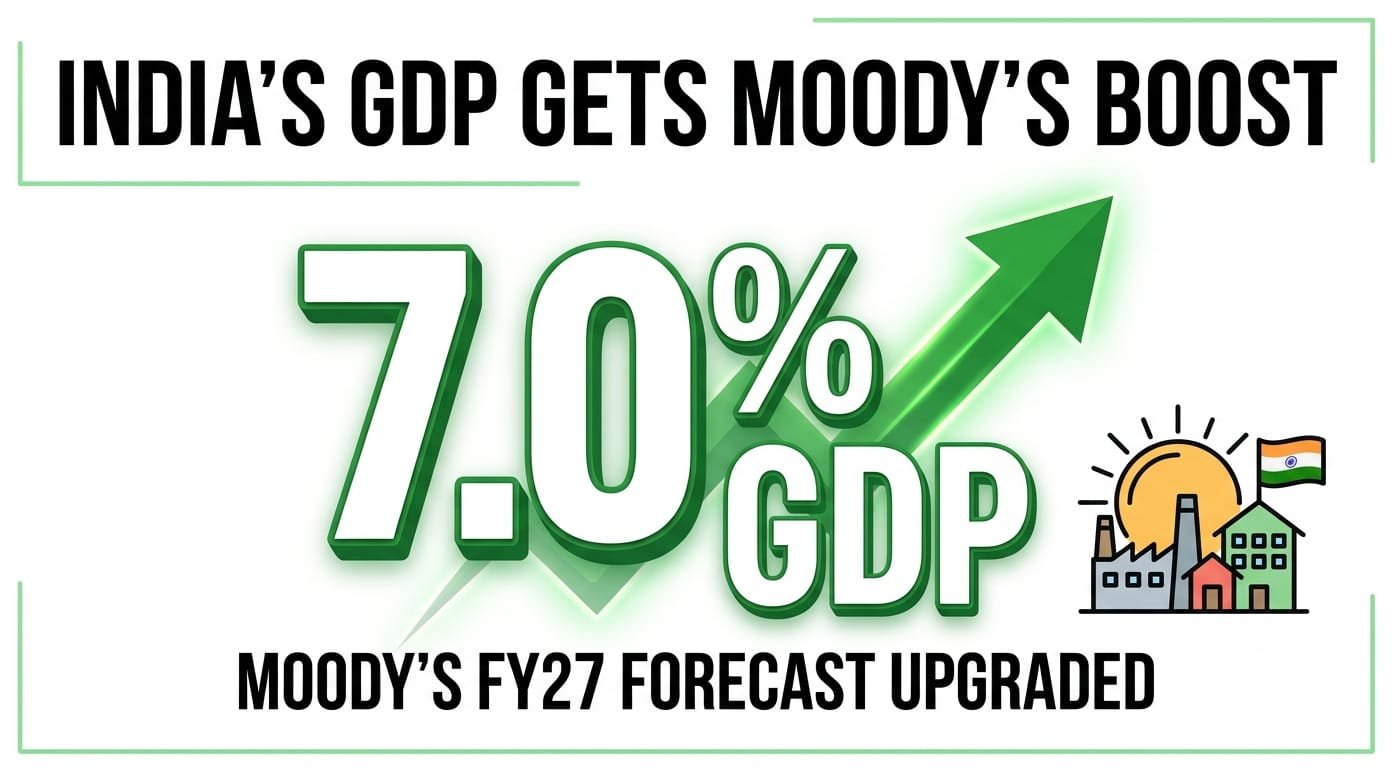
A fresh upgrade from Moody’s Ratings has added optimism to India’s economic outlook for the coming year. The agency now expects the country’s real GDP to grow at 7% in fiscal 2026–27, up from an earlier estimate of 6%. This revision comes after India’s economy showed more strength than expected in the face of global disruptions, especially the shock from the Middle East conflict.
The change is not just a small adjustment on paper. It reflects how household spending, government-backed infrastructure work and a steady services sector have together kept momentum intact. India’s real GDP growth had already accelerated to 8.2% in the first half of calendar 2026, compared with 7.3% for the full year in 2025, according to Moody’s. That early surge gave the ratings agency confidence to lift its full-year forecast.
What makes this upgrade stand out is how it compares with other big names in the global financial world. The International Monetary Fund, in its July update, had projected 6.4% growth for FY27, while S&P Global Ratings had put the number at 6.6% in June.
Even the Reserve Bank of India had trimmed its own FY27 forecast to 6.6% from 6.9%, pointing to risks from higher energy prices and global uncertainty. Moody’s 7% call is therefore 0.6 percentage point above the IMF’s view and 0.4 point higher than both S&P and RBI estimates.
Behind the higher number lies a mix of familiar drivers that have supported India’s growth story. Private consumption has stayed firm, helped by steady jobs and income flows in many parts of the economy. At the same time, gross fixed capital formation, essentially investment in plants, machinery, buildings and infrastructure, has remained robust.
Public spending on roads, railways, ports and urban projects has continued, while early signs of a revival in private investment have also been noted. The services sector, from IT and business services to travel and finance, has continued to show strength, adding another layer of support.
Moody’s also highlighted India’s ability to absorb an external shock without a major slowdown. The conflict in the Middle East had raised fears of sharp jumps in oil prices, supply disruptions and tighter global financial conditions.
Yet India’s growth path has stayed relatively steady, thanks in part to diversified crude import sources, large foreign exchange reserves and strong domestic demand. This resilience has allowed the agency to move from a cautious 6% view to a more confident 7% stance for FY27.
At the same time, the report does not ignore the risks that could still test this optimistic picture. Elevated energy prices remain a concern, especially if the Middle East tension drags on. Higher oil and fertiliser import bills could push up inflation and widen the current account deficit.
Moody’s has flagged that annual average inflation could move beyond its 4.8% projection for the fiscal if energy costs stay high. There is also the possibility of El Niño-related weather disruptions, which could increase food prices and weigh on rural consumption and overall activity.
On the fiscal side, the government’s approach has been seen as disciplined. Moody’s noted a “muted” fiscal response to the Middle East shock, reflecting a commitment to gradually reducing the fiscal deficit to 4.3% of GDP in the current fiscal from 4.4% in FY26.
This path of slow but steady fiscal consolidation is expected to continue over the next few years, helping to keep debt dynamics in check while still allowing space for growth-supporting spending.
For someone following the economy from day to day, the message is simple: India’s growth engine is running faster than many global agencies had assumed, and domestic forces are playing a bigger role than external headwinds.
The 7% forecast for FY27 places India among the fastest-growing major economies in the world, ahead of most G20 peers and similarly rated emerging markets. Yet the journey ahead will still depend on how oil prices, monsoon patterns and global demand evolve in the coming months.

