
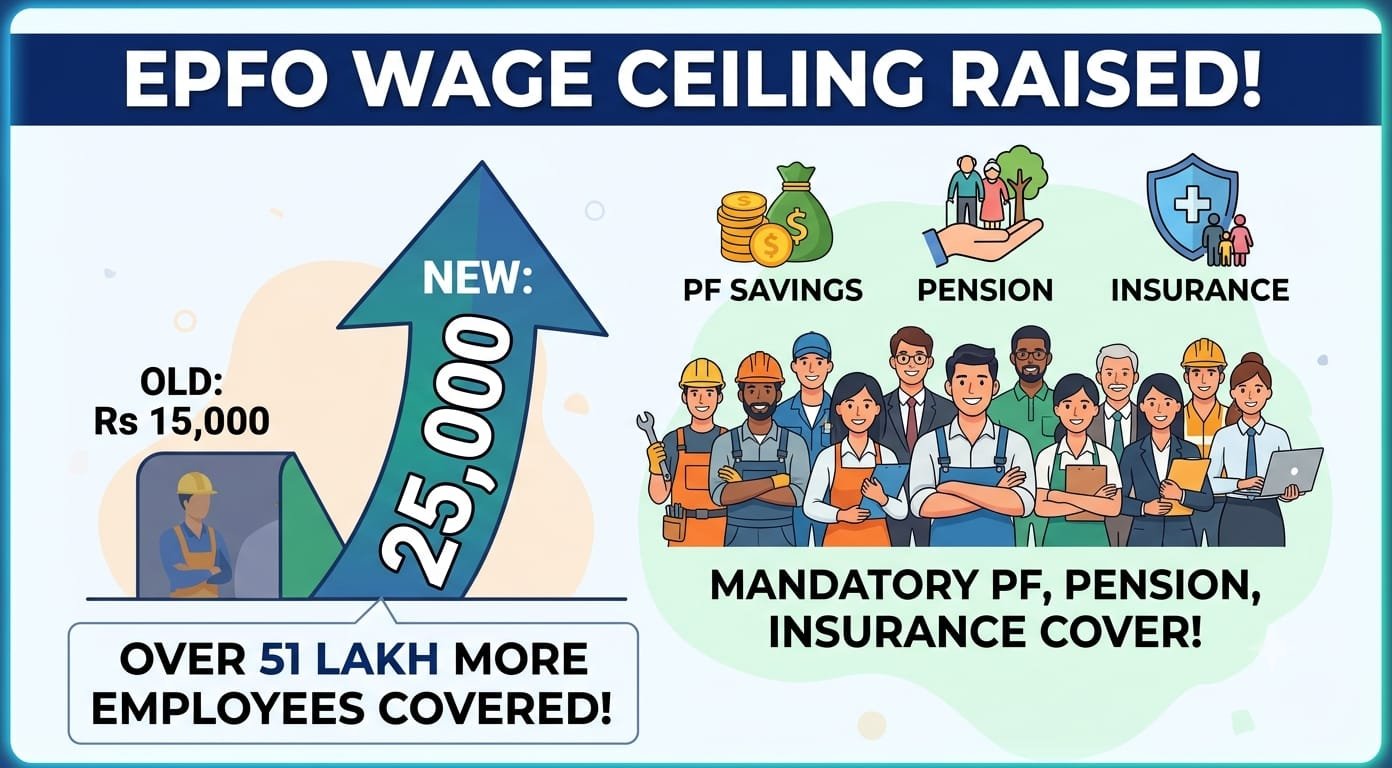
A major change has been announced for India’s formal workforce. The Union Cabinet, chaired by the Prime Minister, has approved an increase in the wage ceiling for mandatory coverage under the Employees’ Provident Fund Organisation from Rs 15,000 to Rs 25,000 per month.
This move is expected to bring more than 51 lakh additional employees into the EPFO net, ensuring they automatically receive provident fund savings, pension protection and linked insurance benefits.
The decision updates a threshold that had stayed unchanged for a decade between 2004 and 2014, and was last raised to Rs 15,000 in September 2014, to reflect the reality of higher wages and a larger formal job market today.
At present, a new employee joining with a monthly wage above Rs 15,000 is not automatically covered under the EPF framework and may remain outside mandatory retirement and insurance protection.
By lifting the ceiling to Rs 25,000, a large group of workers earning between Rs 15,000 and Rs 25,000 will now come within the statutory social security system. This means access to long-term savings through the Employees’ Provident Fund, pension rights under the Employees’ Pension Scheme, and life-cover benefits under the Employees’ Deposit Linked Insurance Scheme, as per the rules of each scheme.
The change also aligns contribution and pensionable-wage calculations with current pay levels, making the system more relevant to today’s income patterns.
The timing of this reform makes sense when seen against the backdrop of the last decade. Since 2014, India has seen steady wage growth, rising incomes and a continued push towards formal employment. In many states and occupations, minimum wages have moved closer to the old Rs 15,000 threshold, making the earlier limit feel outdated.
Raising the cap to Rs 25,000 ensures that the social security framework keeps pace with these changes and does not leave out workers who are now earning more but still need strong retirement and insurance cover. It also supports the broader goal of formalisation, where formal jobs come with portable and assured benefits that travel with the worker.
For employees, the impact is direct and long-lasting. Being inside the EPFO net means a part of the salary goes into a retirement corpus that earns interest and can be withdrawn at the time of need, while another portion builds pension entitlements for life after retirement.
The linked insurance scheme adds an extra layer of protection for the family in case of unfortunate events. For employers, wider coverage can improve employee retention, workforce stability and morale, as people tend to stay longer in jobs that offer secure, long-term benefits.
A more secure workforce also supports productivity and helps build a future-ready labour market aligned with India’s growth ambitions.
The financial side of this decision has also been worked out in detail. The proposal went through inter-ministerial consultations and was recommended by the Expenditure Finance Committee in June 2026.
The annual government contribution is estimated at around Rs 11,339 crore, compared to the existing annual budgetary support of about Rs 10,250 crore. Over five years, the estimated expenditure comes to roughly Rs 56,696 crore.
This additional outlay is seen as an investment in human capital, ensuring that social protection expands alongside economic growth and rising wages.
EPFO already runs one of the world’s largest social security systems. Current data show nearly 7.98 crore contributing members across about 7.68 lakh establishments, while the pension scheme supports around 82 lakh pensioners.
The insurance scheme provides life cover linked to EPF membership. With this new ceiling, the architecture becomes more inclusive and resilient, bringing a bigger share of the formal workforce under a single, portable safety net.
As India moves towards its Viksit Bharat@2047 vision, such steps ensure that employment generation and formalisation are matched by stronger, wider and more modern social security protections.
Implementation will follow through necessary statutory and administrative steps by the Ministry of Labour & Employment and EPFO.
For workers, employers and the wider economy, the message is clear: as wages rise and jobs become more formal, the rules around retirement and insurance are being updated to match that progress, so that growth is accompanied by lasting security.

