
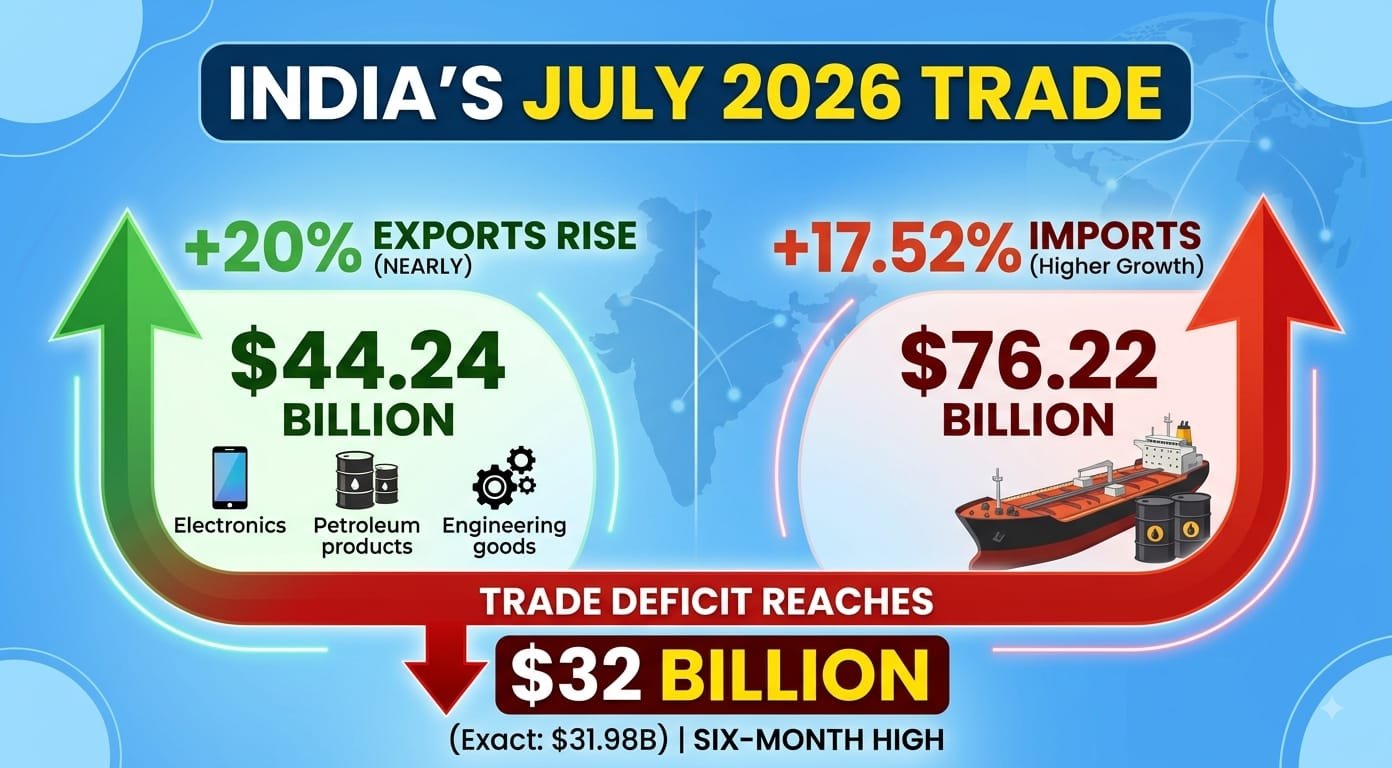
The export performance of India in July 2026 brought both encouragement and concern. Goods exports increased by nearly 20% compared with the same month last year and reached $44.24 billion. This was the highest monthly export growth recorded since June 2022.
However, imports also rose strongly, reaching $76.22 billion. As a result, the difference between the value of goods sold abroad and goods purchased from other countries widened to $31.98 billion, making it a six-month high.
In simple terms, India sold more products to global markets, but it also spent much more on buying goods from overseas. A trade deficit occurs when imports are higher than exports. In July, India exported goods worth about $44 billion but imported goods worth more than $76 billion.
This created a gap of almost $32 billion. The deficit was higher than the $27.88 billion recorded in July 2025 and also above the $30.43 billion gap reported in June 2026.
Several sectors supported the rise in exports. Petroleum products remained an important contributor, while electronics, engineering goods, gems and jewellery, iron ore, marine products, meat, dairy and poultry shipments also recorded growth.
The expansion of electronics exports is especially significant because it reflects the increasing role of India in global manufacturing and supply chains. Growing production of mobile phones, electronic components and other manufactured products has helped improve India’s export capacity.
The rise in electronics exports also connects with the wider effort to make India a major manufacturing centre. Government incentives, including production-linked support for selected industries, have encouraged companies to produce more goods within the country.
This has helped create additional export opportunities. However, the benefits of higher exports can be reduced if the country continues to depend heavily on imported raw materials, energy and components.
Imports rose 17.52% year-on-year in July to $76.22 billion. Crude oil was one of the major reasons behind the increase, as India depends substantially on overseas supplies to meet its energy needs. Higher input and transportation costs linked to tensions in West Asia also affected the import bill.
When the price of crude oil rises, the impact reaches fuel costs, transport expenses, manufacturing and household budgets. This is why a wider trade deficit can affect everyday economic activity even when export numbers look strong.
The impact of global uncertainty was also visible in India’s trade with West Asian countries. According to the Commerce Ministry, India’s exports to the region increased by 8.6% year-on-year to $5.7 billion in July.
This suggests that trade flows continued despite geopolitical tensions and disruptions affecting shipping routes and supply chains. At the same time, changing oil prices and transport risks remain important concerns for future trade performance.
The wider picture becomes clearer when exports of both goods and services are considered. India’s total exports, including services, were estimated at $80.14 billion in July, showing annual growth of 13.31%. Total imports, including services, stood at around $95.16 billion.
This resulted in an overall trade gap of approximately $15.03 billion for the month. Services exports, such as information technology, business support and professional services, continue to provide an important cushion against the merchandise deficit.
During the first four months of the financial year 2026-27, merchandise exports rose 17.04% to $173.78 billion. However, imports grew faster, increasing 19.27% to $292.38 billion.
The cumulative merchandise trade deficit for April-July therefore widened to $118.60 billion, compared with $96.66 billion during the same period of the previous financial year. This shows that the challenge is not limited to one month; the import bill is rising faster than export earnings.
Economists are watching these figures closely because a sustained increase in the trade deficit can put pressure on India’s current account balance. Strong exports are a positive sign, but long-term improvement will depend on whether export growth remains broad-based and whether dependence on imported oil, gold, electronics and industrial inputs can be reduced. The central task is to convert higher production into higher value-added exports while keeping energy and input costs under control.

