
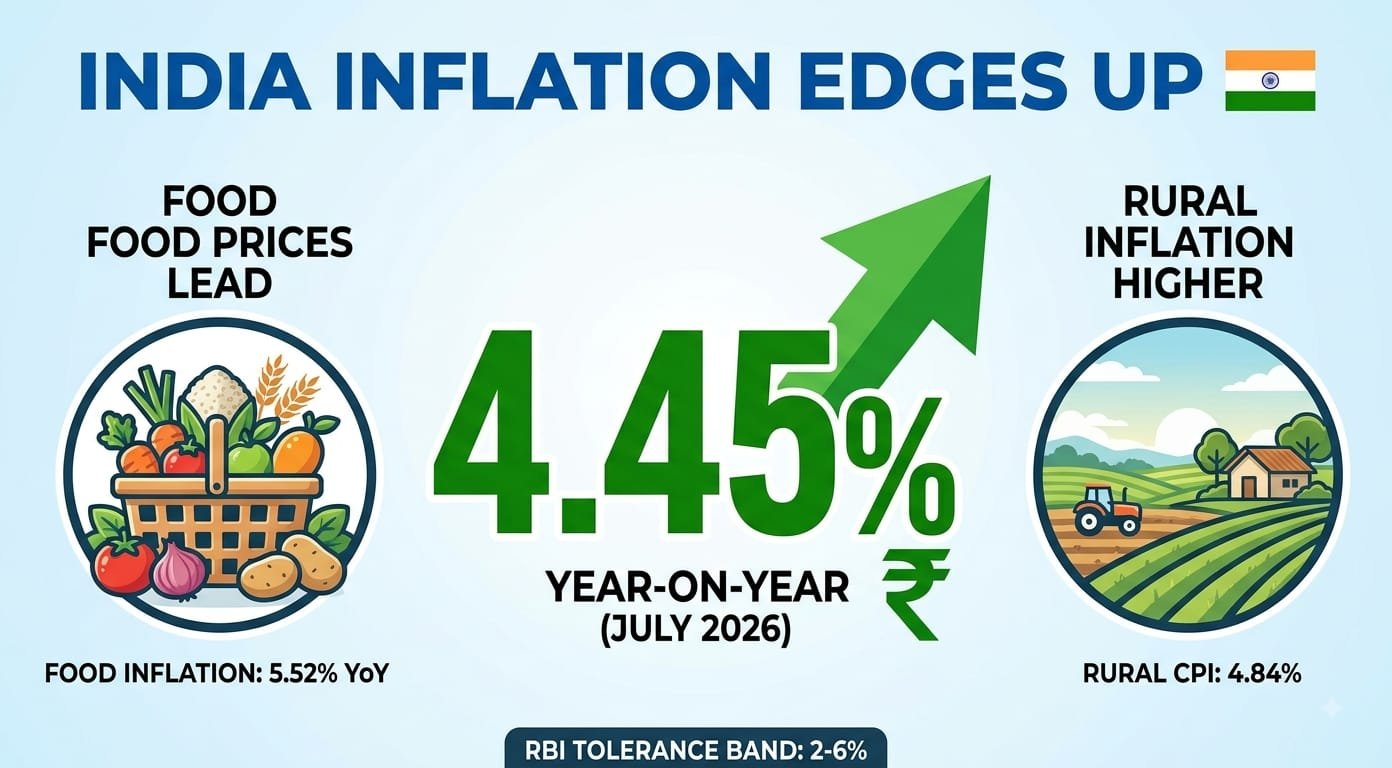
A clear picture emerges from the July consumer price numbers, which show headline inflation moving up to 4.45% year-on-year, a small rise from June’s 4.38% and the second consecutive month above the Reserve Bank of India’s 4% medium-term target while still remaining comfortably within the broader 2–6% tolerance band.
The advance is mainly traced to food items, with food inflation measured by the Consumer Food Price Index climbing to 5.52% year-on-year in July, reflecting price pressures in several food categories that matter for everyday household budgets.
The rural and urban patterns differ: rural inflation is noticeably higher at 4.84% while urban inflation sits at 3.96%, a split that underlines how price movements in farm-produce and market access can show up differently across regions and livelihoods. This combination of rising food costs and stronger rural inflation explains much of the modest upward push in the aggregate CPI reading for the month.
Sectoral details make the drivers clearer, with food items forming the largest component of the monthly change and housing-related costs remaining subdued by comparison; housing inflation was recorded around 2.22% in July, which softened the overall increase even as edible prices rose.
Within food, staples and certain seasonal vegetables and condiments showed sharper gains that disproportionately affect households with limited budgets, and this helps explain why the headline move feels larger for rural consumers who allocate a bigger share of spending to food.
The July print therefore carries both cyclical and seasonal elements: some spike in select food categories pushed the monthly number up, while the broader inflation backdrop stayed steady enough that the central bank’s policy stance is not suddenly put under pressure.
The policy implications are moderate rather than dramatic, since the headline rate remains inside the RBI’s tolerance band and the uptick appears concentrated rather than broad-based, factors that make an immediate tightening of interest rates unlikely according to several market and analyst reads.
Still, a consecutive move above the 4% objective signals that inflationary forces are not entirely dormant, so ongoing monitoring of food prices and rural inflation dynamics will matter for near-term policy deliberations and market expectations.
For households and businesses, the message is one of cautious attention that food price volatility can erode real incomes for lower-income groups quickly, while firms and investors will watch whether wage pressures or broader commodity costs begin to push non-food inflation higher.
On the data front, the July numbers are provisional and published using the new 2024 base for the Consumer Price Index, which means comparisons over time follow the updated basket and weights published by the statistics office; this technical context helps interpret why month-to-month and year-on-year moves may differ from older series while remaining the official government measure for policy and analysis.
Simple arithmetic shows the month-on-month CPI rise was modest in absolute terms, but the year-on-year jump to 4.45% marks the highest since late 2024 in this series and therefore draws attention even if it does not yet constitute a broad inflation breakout.
The practical takeaway is straightforward that the July reading highlights food prices as the immediate concern and underlines higher inflation pressures in rural markets, while the overall inflation environment remains manageable for monetary policy within the RBI’s tolerance range.
Those tracking short-term price trends will focus on coming months’ food-price moves and whether non-food categories begin to pick up, because that will determine whether the current gentle rise becomes a sustained trend needing policy action.
A close eye on the next CPI releases and on seasonal patterns in agricultural markets can provide early signals about whether inflation will settle back toward the 4% objective or continue to move up.

