
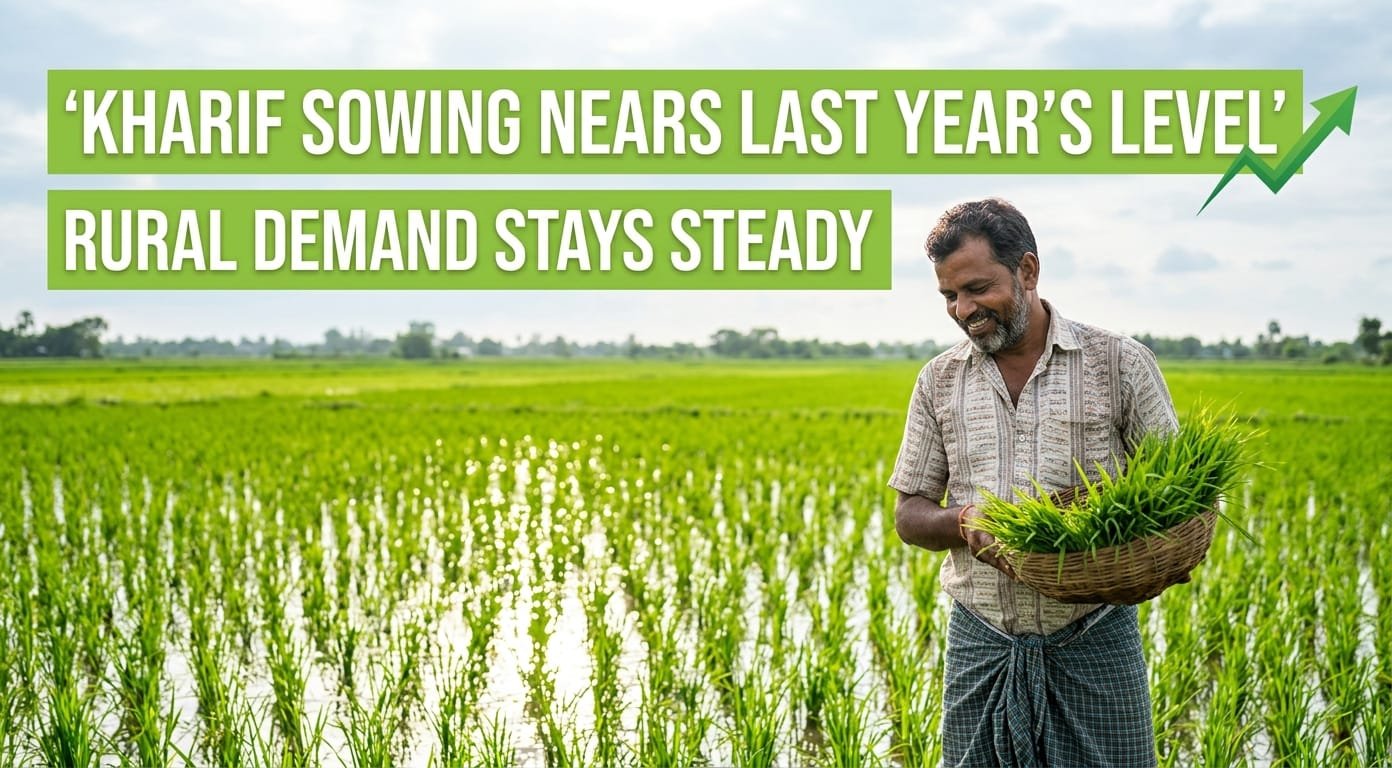
Kharif sowing in India has moved close to last year’s level, showing that the farming season has recovered much of the ground lost earlier in the monsoon. The latest report says the gap in acreage has narrowed sharply as rainfall improved in many regions, and this has given farmers more confidence to continue planting. At the same time, rural demand is not showing a sudden fall, because farm income, government support, and easier credit conditions are helping families stay stable in daily spending.
The main story is simple. When rain comes on time and in the right amount, sowing improves, crop decisions become easier, and the farm economy breathes better. That is what appears to be happening now. After a weak start to the season, rainfall revived in July and early August, and this helped lift kharif planting across major crop groups. The report notes that the total acreage gap has narrowed to a small level compared with the large shortfall seen earlier in the season.
A closer look at crop movement shows mixed results, but the overall picture is more positive than before. Some crops such as paddy, pulses, arhar, moong, maize, and cotton, are still below normal area levels, while crops like sugarcane, oilseeds, and groundnut are closer to or above expected levels in parts of the country. This means sowing is not fully uniform, but the broad trend is improving as weather conditions support planting decisions in more areas.
Rural demand is also holding up because many families in farming regions entered this season with stronger financial backing than in earlier weak years. UBS points to better farm cash flows from two good monsoon years, government welfare transfers, GST-related benefits, and stronger credit growth as reasons why household purchasing power has stayed firm. In simple terms, many rural households are not relying on rain alone; they also have some support from savings, loans, and public spending.
There is still reason to stay careful. El Niño-related concerns have not disappeared, and rainfall in the coming weeks will remain important for the final sowing stage and for crop health later in the season. Even so, the report suggests that a sharp fall in rural demand in FY27 looks unlikely. The more likely outcome is a slower but still resilient pace of growth, with rural spending continuing to support areas such as tractors, farm equipment, and basic consumer goods.
This means that the farm sector is sending a cautious but encouraging signal. The season has not been risk-free, yet it has not broken down either. Better rains have improved planting, strong rural balance sheets have softened pressure, and support from policy has added another layer of protection. In everyday terms, this is a case of recovery rather than boom, but recovery still matters because it keeps food production, farm incomes, and rural buying power moving in the right direction.
In the broader sense, the situation reflects how closely India’s rural economy depends on weather, but also how much it has learned to absorb shocks. A weak monsoon can still slow growth, but the latest evidence shows that timely rain, support systems, and steadier cash flows can prevent a major setback. That is why kharif sowing near last year’s level is important: it signals that rural India is managing stress with more strength than before.

