
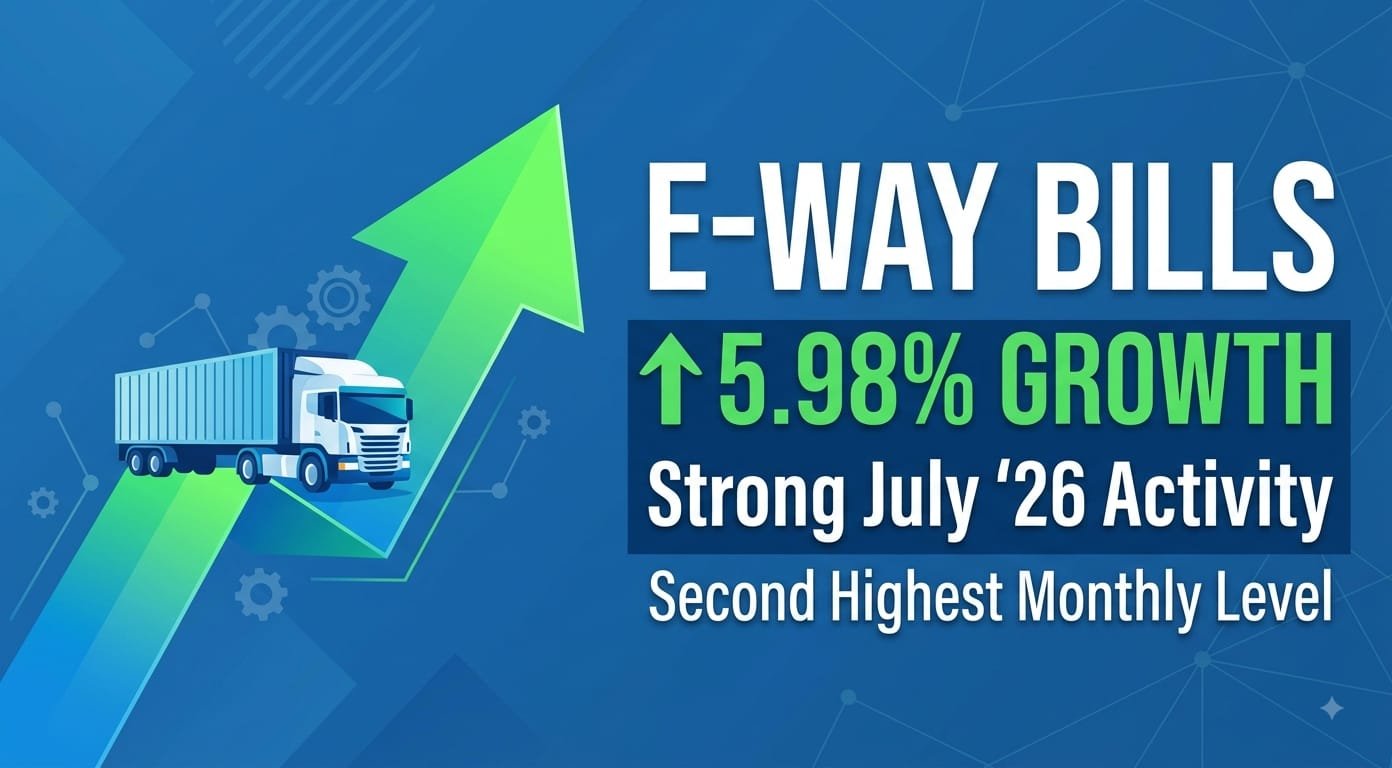
July 2026 brought a strong signal of business movement across India, as e-way bill generation touched its second-highest monthly level. E-way bills are needed for the transport of goods under t
he GST system, so a rise in these numbers often reflects active trade, steady demand, and smooth movement of products from one place to another.
In simple terms, when more e-way bills are generated, it usually means goods are moving across markets more freely and commercial activity is holding firm. The latest figures show that this trend remained visible in July, even after an already strong performance in earlier months.
According to GSTN data, e-way bill generation rose 5.98 percent year-on-year to 139.79 million in July 2026, compared with 131.91 million in the same month last year. This was also higher than the 136.77 million recorded in June 2026, showing a month-on-month increase of 2.21 percent.
The number was only slightly below March 2026, when e-way bill generation reached 140.60 million, which still remains the highest point in the recent series. This pattern suggests that goods movement stayed close to peak levels for several months, instead of dropping sharply after one strong month.
The steady rise in e-way bills gives a useful picture of the wider economy. Such numbers are often read as a sign that factories, traders, distributors, and transporters are all working at a healthy pace. When supply chains are functioning well, goods can move without major delay, and that usually supports business confidence.
In this case, the July data points to resilience in domestic trade, along with continued strength in movement across supply chains. That makes the number important not only for tax tracking, but also for understanding the rhythm of everyday economic activity.
Experts have linked this sustained movement to a broader sense of stability in trade and consumption. The pattern of growth during the year shows that the momentum did not depend on one single month. Instead, the monthly figures stayed strong across March, April, May, June, and July, which creates a more reliable sign of ongoing activity.
A consistent flow of e-way bills often reflects that orders are being placed, goods are being shipped, and business transactions are not slowing down in a major way. This kind of trend can matter for both policy makers and businesses, since it offers a practical clue about how active the market really is.
Another important point is that strong e-way bill generation may also support expectations of healthy GST collections. When goods move more actively, tax-related activity usually becomes more robust as well. At the same time, the real impact still depends on the value and nature of transactions, so the number should be seen as an encouraging indicator rather than a final result.
Even so, the July figure clearly suggests that the flow of goods remained steady and that economic momentum continued through the month. For many observers, that is a reassuring sign, since it reflects movement, demand, and confidence all at once.
Overall, the July 2026 e-way bill data tells a simple but important story: trade activity remained firm, supply chains stayed resilient, and goods continued to move across the country at a healthy pace. The second-highest monthly level is not just a number; it is a reflection of how strongly day-to-day business activity is holding up. In a period where stability matters, such a trend stands out as a positive sign for the economy and for the wider business environment.

