
On the 24th of April, 2026, Raghav Chadha, the youngest Rajya Sabha MP in Indian history, one of the Aam Aadmi Party’s most articulate and publicly visible faces, an MP whose media presence had made him one of the more recognisable opposition voices in the country, the man who had once decried the BJP as a “party of illiterate goons”, crossed the floor and joined the same party.
The anti-defection law, whose spirit he had once invoked against political opportunism, now hung over his own head.
His departure was certainly not clean. The AAP stripped him of his deputy leader post in the Rajya Sabha on April 2nd, citing his prolonged absence from key party events and his conspicuous silence on sensitive issues.
“The Aam Aadmi Party, which I nurtured with my blood and sweat and to which I gave 15 years of my youth, has now completely deviated from its principles, values, and core morals,” Chadha said upon resigning. “The party is no longer working for the country or in the national interest, but for personal gain.”
Chadha’s defence holds substantial evidence to back it. The party had once spearheaded a new age of politics, where the ordinary Indian chose institutional contest over permanent protests, animated by the India Against Corruption agitation and the moral authority of Anna Hazare’s hunger strikes. It had positioned itself as a platform for the aggrieved to fix the system. Now it found itself caught in the very issues it had set out to fight.
The foundations of AAP were laid in the massive anti-corruption protests initiated by Anna Hazare in 2011, in response to the financial scams under the Second Manmohan Singh ministry led by the UPA. Hazare was supported by a clutch of activists and professionals, including a civil-servant-turned-activist, Arvind Kejriwal. Hazare had wanted to keep the movement politically neutral, but Kejriwal argued that direct involvement in politics was necessary.
Kejriwal ended up winning that debate, and the proof was in the results. In 2015, his party swept 67 out of 70 seats in Delhi. It wasn’t just a win; it was a total blowout that showed just how fed up people were with the way things used to be.
By 2025, the party held 22 seats.
Allegations that AAP’s excise policy had been engineered to benefit private liquor cartels, with kickbacks allegedly flowing to party functionaries, swept through its upper echelon with a ferocity that recalled the very institutional abuses the party had been founded to resist. Manish Sisodia was arrested in February 2023, followed by Sanjay Singh and Satyendar Jain. In March 2024, Arvind Kejriwal became the first sitting Chief Minister in Indian history to be arrested.
A CBI court would ultimately discharge Kejriwal and his associates in early 2026, citing insufficient evidence. But a legal discharge doesn’t restore a reputation. The corruption taint had done its damage regardless of the legal outcome.
Chadha’s journey from drafting the Delhi Lokpal Bill in 2012 to joining the party that Lokpal was designed to hold accountable mirrors the biography of Indian opposition politics. Indians have seen this cycle play out so many times that it has acquired the cadence of inevitability: a legitimate crisis produces a surge of public outrage. The outrage is channelled into a new political formation with messianic purpose. The formation captures power on a mandate for rupture; and then, almost without exception, it begins to replicate the pathologies it was created to correct. The cure becomes the disease. The protest becomes the establishment it wanted purged.
The INDIA bloc: United in performance, divided on principles
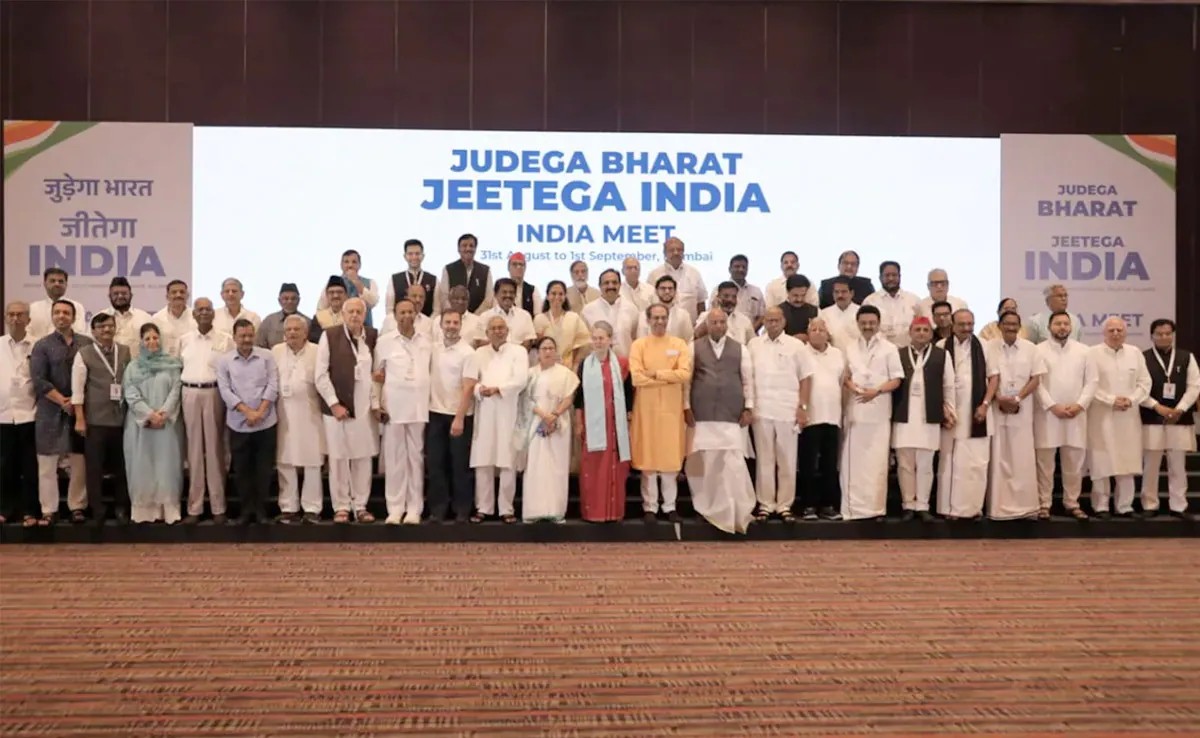
The Indian National Developmental Inclusive Alliance was announced in 2023 as an opposition to the BJP-led NDA. The range of parties it had garnered was formidable: the INC, TMC, SP, RJD, JMM, AAP, Shiv Sena (UBT), NCP (SP), and many other regional parties. In 2024, it performed beyond exit poll predictions, securing 234 seats to the NDA’s 293. But the narrative of a reborn opposition was short-lived, as the West Bengal Assembly elections of 2026 have dissolved the perception of the bloc as a united force.
In Raiganj, Rahul Gandhi delivered a sweltering public attack not on the BJP, but on Mamata Banerjee, his own alliance partner. He accused her government of paving the road for the BJP’s expansion in Bengal, and claimed that “had there been a clean government,” the BJP would never have found space in the state. He positioned Congress as the only force capable of genuine ideological contest against the BJP, an assertion that dismissed every other INDIA bloc constituent as strategically inadequate, the same bloc it once deemed capable of governing the nation.
At the same moment, across the same campaign, Hemant Soren of the JMM, Tejashwi Yadav of the RJD, Akhilesh Yadav of the SP, and Uddhav Thackeray of the Shiv Sena (UBT) were actively campaigning in support of Banerjee and the TMC. Tejashwi Yadav held multiple roadshows in Jagaddal, Bhatpara, and Khardaha. Banerjee, dismissing Gandhi’s remarks as practically irrelevant, told voters: “Don’t count on CPI(M) and the Congress in Bengal. At the all-India level I’m part of the INDIA alliance. But they are not with us here; they are with the BJP.”
The INDIA bloc’s fault lines are rooted in the fundamental incompatibility of parties whose regional ambitions are irreconcilable with any coherent national programme.
The governance question that no one in the opposition has answered is this: if a state assembly election is sufficient to fracture the bloc into competing camps, what would a national government in a parliamentary coalition crisis look like?
One could dismiss AAP as an anomaly, a party that burned too bright, too fast. But this would ignore a persistent and recognisable pattern in Indian political history.
A coalition of outrage forms around a legitimate crisis. It mobilises the public, wins elections on a promise of rupture with the old order, and then, almost without exception, gradually reproduces the very tendencies it had pledged to end. The 1977 Janata Party experiment, which brought together sworn ideological enemies solely on the basis of their opposition to Indira Gandhi’s Emergency, collapsed within two years, falling prey to personal ambition and internal contradictions.
However, India’s experience with coalition governance is not entirely substandard. Atal Bihari Vajpayee’s NDA became the first coalition in Indian history to complete a full five-year term, governing from 1999 to 2004 with 24 coalition partners and a demonstrated capacity for statecraft that distinguished it from every previous coalition experiment. But the recipe of a successful coalition government remains with the NDA, for the INDIA bloc has produced no equivalent evidence of governing maturity, no minimum programme, no designated prime ministerial face, no institutional architecture for managing the disagreements that governing inevitably produces. It has only produced press conferences and posed with linked hands.
The hegemony problem
Within the INDIA bloc, Congress occupies the most peculiar position precisely because it is the most indispensable member. Its historical legacy, commencing from 1885 in Bombay to five decades of post-Independence governance, gives it a legitimacy that no other opposition formation possesses. It also gives it an entitlement that continuously undermines the project it claims to lead.
Congress’s hegemonic disposition is not merely an attitude problem. It produces concrete strategic failures. In Bengal, the party chose to contest independently in multiple constituencies rather than consolidate behind the TMC, the dominant regional force, a decision read universally as an assertion of presence over pragmatic alliance management. In Telangana, the party prioritised upper-caste Reddy candidates in its ticket allocation over OBC nominees, a decision that demonstrably cost it seats. At the UPA era’s peak, marginalised communities accounted for just 30% of Congress’s cabinet, a figure that falls well short of the 50% reservation cap they now vehemently advocate expanding. For comparison, at the NDA era’s peak, the union cabinet had 62% representation of non-upper-caste communities. For all its national rhetoric about subaltern representation, Congress continues to operate with an internal power structure that skews toward dynastic and upper-caste leadership in practice.
The central paradox is this: Congress is too weak to win a national majority alone, yet too unwilling to genuinely subordinate its ambitions to build a coalition that could. It is the dominant member of an alliance it cannot lead to power by itself, and whose prospects it actively undermines by insisting on terms that stronger regional partners will not accept.
The voters the opposition cannot explain: Cross-Ideological support for BJP
The most revealing voter in contemporary Indian politics is not the committed BJP supporter. It is the voter who holds views that should, by conventional political mapping, place them in the opposition’s camp, yet who still, in the privacy of the ballot, ends up voting for the BJP. The opposition’s dismissal of this voter as an “andhbhakt” (a blind devotee, manipulated by propaganda) is both analytically wrong and strategically self-destructive. Every time the opposition calls this voter deluded, it forfeits the chance to understand why it is losing them. The voter who crosses ideological lines is not the opposition’s problem. She is the opposition’s diagnosis.
This voter is making a comparative judgement. They look at the alternative and see not a vision but an aggregation of power-hungry regional parties masquerading as a joint force. But the same voter has also observed that the highways near their town improved measurably. They know someone who received a Jan Dhan account, an Ujjwala connection, an Ayushman Bharat card, and used them. They remember, or have been told by parents who remember, the texture of governance in the UPA’s second term: the paralysis, the scams, the strategic drift on national security, the silence after 26/11 and other attacks. They make their decision on this basis rather than coercion, in the privacy of the polling booth, and press for the lotus. They are choosing the BJP because they are making a retrospective assessment of which party has already delivered tangible progress, and finding the opposition’s prospective promises unable to compete with that ledger.
They may remain sceptical of the current government. But when the choice is between a governing formation with a demonstrated track record of macroeconomic management, infrastructure delivery, and foreign policy coherence, and an opposition that offers competitive caste-outbidding, fiscal populism, and a coalition whose most public feature is its internal warfare, they choose the former.
There is also a dimension of cultural confidence at work that liberal political commentary consistently misreads as bigotry. India’s secular Hindu majority, the vast majority of Indians who practise Hinduism without aspiring to theocracy, whose daily lives are marked by genuine personal pluralism, is uncomfortable with an opposition that treats all expressions of Hindu cultural identity as equivalent to communalism. The Shah Bano judgment reversal of 1986, when a Congress government overturned a Supreme Court ruling granting maintenance rights to a divorced Muslim woman in order to appease religious conservatives, remains the definitive example of how “secularism” has historically been operationalised in India: not as the protection of individual minority rights, but as the protection of minority patriarchies at the expense of the most vulnerable members of those communities. A voter who has absorbed this history is not a Hindu nationalist for declining to find it reassuring. They are constitutionalists, and they have not yet found an opposition that speaks that language credibly.
Freebie politics and the fiscal reckoning
The INDIA bloc’s electoral propositions have leaned heavily on welfare transfers, direct benefit programmes, and what critics have aptly termed “freebie politics.” Free electricity, free bus rides, cash transfers for women, unemployment allowances, expanded food subsidies: these are the building blocks of opposition election campaigns across states. They have proven electorally effective and fiscally damaging.
Punjab provides the most unambiguous case study. The state’s debt stood at approximately Rs. 3.27 lakh crore in 2023-24, representing a debt-to-GSDP ratio approaching 47%, among the highest for any Indian state, and structurally threatening its capacity to fund even basic public services. The AAP government’s free electricity guarantee (300 units per month) was implemented without a corresponding revenue model, accelerating a fiscal deterioration that predated AAP but has deepened materially under its watch. Himachal Pradesh, which rolled out an ambitious Congress-led welfare programme following the 2022 assembly elections, faces fiscal crisis eighteen months in, serious enough to prompt the state government to seek emergency transfers from the Centre, with debt servicing consuming an estimated 20% of revenue receipts.
Karnataka’s Congress government introduced five guarantee schemes, including free electricity, free bus travel for women, Rs. 2,000 monthly transfers, free rice, and unemployment allowances, estimated to cost in excess of Rs. 52,000 crore annually. The state’s fiscal deficit increased sharply in the subsequent budget cycle. While welfarism is rooted in a noble cause, the data ends up presenting arguments against the specific model of welfarism as an electoral instrument isolated from fiscal planning: the announcement of benefits without the revenue architecture to sustain them, pursued not as development policy but as a vote-acquisition strategy, and funded by borrowing whose costs will be borne by the next government, the next generation, and, most bitterly, the same poor households whose votes were being courted.
Focus on caste politics
The INDIA bloc’s signature political programme is the expansion of caste-based reservations. Congress, in its 2024 Lok Sabha manifesto, pledged to remove the Supreme Court’s 50% cap on caste reservations for SC, ST, and OBC communities, conduct a nationwide caste census, and constitutionally enshrine expanded quotas. Rahul Gandhi has made caste justice a defining cause that the bloc urges itself to deliver.
These are not dishonourable commitments. The socioeconomic underrepresentation of SC, ST, and OBC communities in elite professions, services, and businesses remains a genuine and documented reality. But the hypocrisy surrounding these promises raises questions that the bloc does not address.
The Congress party, which loudly advocates for proportional representation of marginalised castes in government and public institutions, does not consistently practise this within its own organisational structures. Its internal leadership has historically skewed toward upper-caste and dynastic representation. The party that accuses the BJP of not doing enough for OBCs has itself faced criticism, as the 2024 election data from Telangana made plain, for prioritising upper-caste Reddy candidates over OBC nominees in its own ticket allocation.
In comparison, the BJP and NDA have produced Narendra Modi, from the OBC Ghanchi community, as Prime Minister for over a decade, and Droupadi Murmu, from the ST Santhali community, as President of India.
More significantly, the philosophy underlying the INDIA bloc’s reservation push deserves scrutiny against its own stated inheritance of B.R. Ambedkar’s thought. Ambedkar’s project was not simply the permanent entrenchment of caste-based identities or quotas. His enduring vision, most fully expressed in Annihilation of Caste, was the eventual dismantling of caste as an organising principle of Indian society altogether. He conceived of reservations as a transitional corrective, a temporary scaffolding to enable historically oppressed communities to compete on equal terms until structural equality was achieved, and not as a permanent identity framework.
A politics that proposes to entrench and expand caste quotas indefinitely, without a parallel programme to build the educational, economic, and social infrastructure that would make reservations unnecessary, does not advance Ambedkar’s vision. It institutionalises the very categories he wished to transcend. When political parties compete to represent caste blocs, when the Samajwadi Party is the party of Yadavs, when the BSP is the party of Dalits, when regional formations of the INDIA bloc each represent specific jati coalitions, they deepen the salience of caste identity in Indian public life rather than dissolving it. The electoral incentive is to keep caste politically alive, not to render it irrelevant.

