
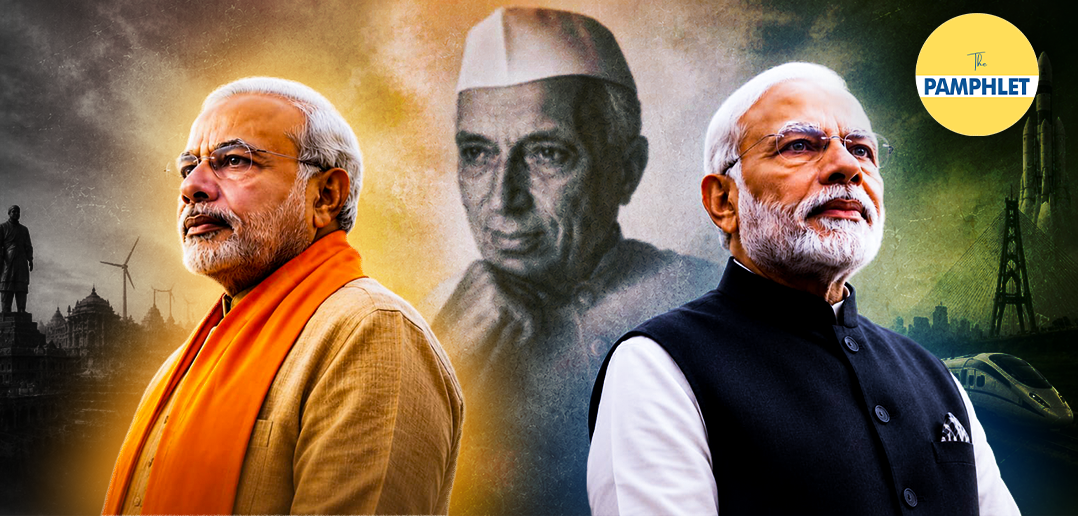
For decades, certain milestones in Indian politics were treated like immutable laws of nature. Chief among them was the shadow of the past: The towering longevity of early post-independence governance. But records are fundamentally mathematical, while politics is driven by momentum.
Prime Minister Narendra Modi’s continuous tenure at the helm of executive power, spanning a historic streak from State Capital to the National Capital, stands as one of the most resilient runs in modern democratic history. By maintaining an undefeated record across major executive elections, Modi didn’t just break a timeline; he fundamentally redrew the center of gravity in modern Indian politics. When combining his 13 years as the Chief Minister of Gujarat with his historic tenure as Prime Minister, he officially crossed the 8,930-day record previously held by former Sikkim CM Pawan Kumar Chamling, establishing a new 8,931-day watershed as India’s longest-serving head of an elected government.
This milestone isn’t just about survival. It is the culmination of an entirely new grammar of leadership, one that transformed a state-level experimental laboratory into a national blueprint.
The laboratory and the leap
The foundation of this historic streak was not laid in New Delhi, but in Gandhinagar. When Modi assumed the Chief Ministership of Gujarat in 2001, he inherited a state reeling from institutional and physical tremors, the catastrophic Bhuj earthquake, and fiscal inertia.
It was here that the “Gujarat Model” was synthesized, navigating severe structural crises and shifting the state’s narrative:
- Crisis Management & Communal Fracture: Following the 2002 Godhra violence, his political survival relied on a highly effective consolidation of his regional voter base, positioning himself as a defender of regional pride against external critics.
- Administrative Efficiency in Disasters: When massive floods hit Gujarat in the mid-2000s, the administration deployed a centralized, tech-driven response system that prioritized top-down, outcome-oriented executive machinery over legislative delays.
- The Pivot to Global Capital (Vibrant Gujarat): To break political isolation, the Vibrant Gujarat summits rebranded the state as a bureaucratic fast-track for big industry, securing the backing of India’s corporate elite.
When the national transition occurred in 2014, the pitch was simple: scale the laboratory. The table below outlines exactly how those state-level experiments were expanded into national systems.
| The Gujarat Blueprint (2001–2014) | The National Replication (2014–Present) | Core Governance Principle |
| Welfare Delivery: Direct, localized state-to-citizen safety nets to prevent corruption. | JAM (Jan Dhan-Aadhaar-Mobile) Trinity: Mass Direct Benefit Transfers (DBT) directly to bank accounts. | Eliminating middlemen to create a loyal, pan-Indian voter base of Labharthis (beneficiaries). |
| Infrastructure Focus: Power-surplus state initiatives and rural electrification (Jyotigram Yojana). | National Megaprojects: PM GatiShakti, massive highway expansions, and digital public infrastructure. | Positioned the state as a tangible builder of modern national assets. |
| Centralized Command: A powerful Chief Minister’s Office (CMO) directing top bureaucrats directly. | PMO-Centric Governance: Direct real-time project tracking via digital platforms, bypassing traditional layers. | Ensuring rapid execution of high-profile flagship schemes through centralized accountability. |
The dual architecture of dominance
Surpassing historical benchmarks requires more than just administrative efficiency; it demands an unprecedented dual alignment of public empathy and raw political force. PM Modi achieved this by operating with two distinct, parallel personas.
- The public leader: Empathy and trust
As a public figure, PM Modi excels at subverting institutional distance to establish an intimate connection with the masses. He positions himself not as a distant ruler, but as a selfless custodian (Pradhan Sevak) who sacrificed personal family life to serve the nation.
Through disciplined communication tools like Mann Ki Baat, he completely bypasses traditional media filters, engaging the electorate on everyday, non-political topics like education, cleanliness, and local culture. This has built an immense reservoir of personal trust. In difficult times, the masses overwhelmingly trust his intent, separating the leader from systemic bureaucratic failures.
2. The political leader: Fierce & formidable
In stark contrast to the benevolent public persona, his political identity is unyielding, highly competitive, and combative, making him a structural nightmare for competitors.
- Master Orator: His speeches effectively combine sharp wit, nationalistic fervor, and direct takedowns of the opposition. He possesses an acute sense of timing, turning opposition critiques and personal jibes into immediate campaign assets.
- Geopolitical Realist: On the global stage, his diplomacy projects India as a rising, self-reliant global power (Vishwa Mitra). This muscular foreign policy, characterized by a firm stance on national security, feeds directly back into domestic pride.
- Ruthless Competitor: Backed by an incredibly disciplined, 24/7 organizational machinery, his party treats every regional poll with the intensity of a national referendum, consistently out-resourcing and psychologically exhausting an uncoordinated opposition.
Reaching the 8,931-day milestone is more than just a triumph of political endurance; it is a definitive shift in the structural reality of Indian governance. Narendra Modi’s journey from the fractured landscape of post-earthquake Gujarat to an absolute majority in New Delhi marks the rise of a highly refined style of leadership, one that successfully bridged the gap between fierce electoral warfare and direct, emotional mass communication.
By utilizing Gujarat as an administrative laboratory, he built a tangible template of welfare delivery and centralized execution that dismantled traditional political rules when scaled nationally.
Ultimately, this unprecedented run proves that in a diverse, complex, and intensely competitive democracy, long-term dominance is not achieved by merely holding a position. It is secured by a leader who deeply understands the pulse of the electorate, converting personal trust into an institutional shield and an undefeated political legacy.

