
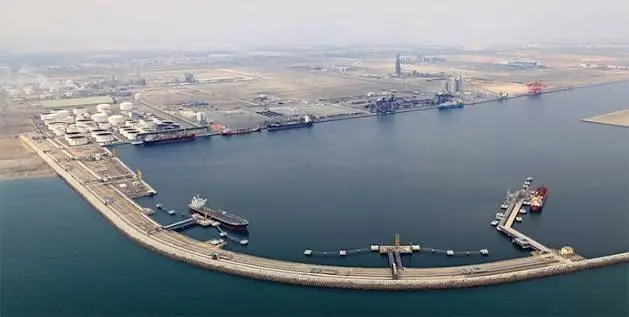
As the crisis around the Strait of Hormuz continues to disrupt global shipping and energy supplies, Oman’s Sohar Port is emerging as an important alternative gateway for India and other Asian economies. Located on Oman’s northern coast, Sohar sits outside the Strait of Hormuz, giving it a crucial geographical advantage at a time when commercial traffic through the Strait of Hormuz has come to a standstill.
The significance of Sohar lies in its location. Unlike ports deeper inside the Persian Gulf, cargo reaching Sohar does not have to pass through the Strait of Hormuz. Oman has increasingly been pitching its ports, particularly Sohar, as alternative gateways for trade with the Gulf and West Asia. Recent reports say Omani authorities and Sohar Port are actively courting Indian businesses, presenting the port as a logistics base where companies can store, process and re-export goods while reducing exposure to Hormuz-related disruption.
Why Sohar matters for India
India has extensive commercial and energy links with the Gulf. Any prolonged disruption in Hormuz can affect crude oil, LNG, petrochemicals, fertilisers and other imports reaching Indian markets.
Sohar cannot simply replace the Strait of Hormuz for all these flows. But it can provide an additional logistics option, particularly for cargo that can be moved through Oman and then transported overland or by sea.
The port is already a major industrial and deepwater hub, handling containers, bulk cargo and petrochemicals. Its location also gives it access to Oman’s road network and the wider Gulf logistics system. An Atlantic Council analysis has identified Oman’s ports as potential gateways outside both Hormuz and the Bab el-Mandeb chokepoints.
The oil connection
Sohar’s importance has become particularly visible in the oil trade.
Saudi Arabia, after disruptions to its East-West pipeline and Red Sea export route, has increasingly used ship-to-ship transfers off Sohar to move crude towards Asian buyers. Reuters reported that Saudi Aramco has planned around 60 million barrels of crude exports through such transfers at Sohar during September and October, with India among the major Asian buyers.
The mechanism is relatively straightforward, crude loaded at Saudi terminals is transferred between tankers in waters off Oman, allowing the receiving vessel to continue towards Asian markets without following the conventional route through the Strait of Hormuz.
Though there are issues of tanker availability, insurance costs, security risks and maritime capacity, and the volumes will remain well below normal levels.
For India, therefore, Sohar should not be viewed as a complete “Hormuz replacement.” Its real importance is as another link in a broader diversification strategy.
And Oman appears determined to build on that opportunity. By positioning Sohar as a gateway for Indian trade, energy and manufacturing, Muscat is effectively telling businesses that Gulf connectivity does not have to depend entirely on one vulnerable maritime chokepoint.
In a region where a single blocked waterway can disrupt global energy markets, Sohar’s greatest asset may simply be its geography, access to the Gulf without having to pass through Hormuz.

