
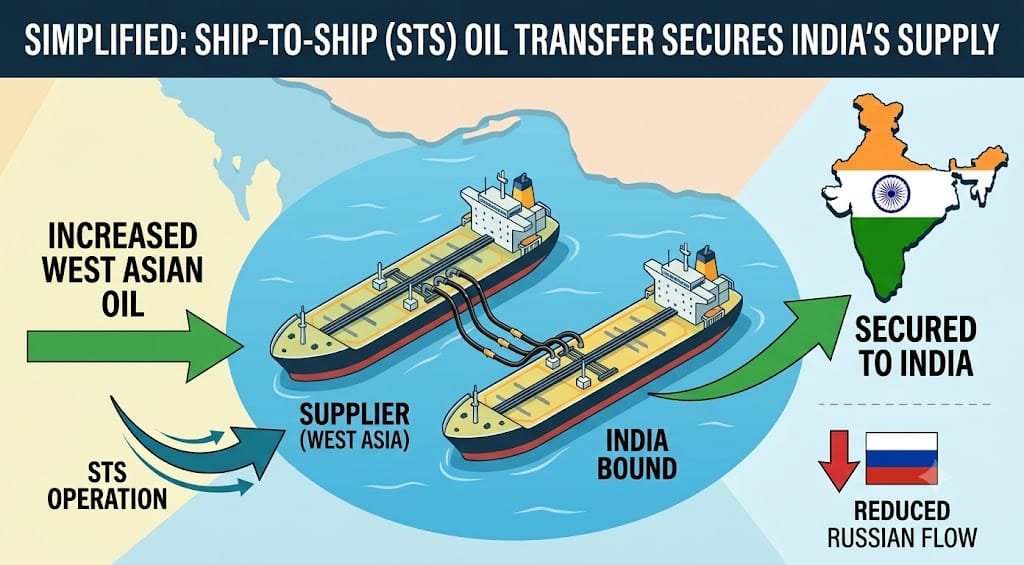
India’s oil import story in September 2026 shows how smart logistics and strategic diversification are helping the country keep its energy engine running smoothly. As tensions persisted around the Strait of Hormuz, a narrow but vital waterway for global oil trade, suppliers from Iraq, Saudi Arabia, Kuwait and Qatar found a smart workaround ship-to-ship transfers to send more crude to India.
At the same time, oil flows from Russia, which had become India’s largest supplier in recent months, saw a decline due to stronger competition from China and disruptions caused by Ukrainian attacks on Russian energy infrastructure. This shift reflects not just market dynamics but also India’s ongoing effort to balance affordability, reliability and geopolitical prudence in its energy strategy.
The rise in West Asian shipments came as a relief for Indian refiners, especially with new US sanctions adding uncertainty around Russian oil purchases. A recently enacted American law, named after Senator Lindsey Graham, allows the US President to impose steep tariffs up to 100% on major buyers of Russian crude, including India and China.
While India has maintained that its priority is meeting the energy needs of its 1.4 billion people through diversified sourcing, the possibility of such penalties has encouraged experts to suggest a gradual reduction in dependence on Russian barrels. In this context, the improved availability of Middle Eastern crude, facilitated by innovative shipping methods, offers a timely alternative.
Ship-to-ship transfers, often called STS operations, have played a key role in making this possible. Unlike traditional shipping where a tanker loads oil at a port and sails directly to its destination, STS involves a shuttle tanker carrying crude partway before transferring it to another vessel in safer waters outside the Strait of Hormuz.
This means the supplier takes on the risk of moving oil through the potentially dangerous strait, while the buyer’s tanker waits in more secure zones to receive the cargo. So far, this arrangement has held up well, with reports indicating that Iran has not been able to disrupt these transfers, possibly due to protection from the American navy. For India, this has meant steadier access to Gulf crude without having to send its own ships into high-risk areas.
Data from September shows just how significant this shift has been. Oil imports from Iraq jumped by more than 238% compared to August, reaching over 551,000 barrels per day. Saudi Arabia’s shipments rose by about 56% to nearly 543,000 barrels per day, while Kuwaiti oil imports more than doubled. Qatar, which had sent no oil in August, supplied almost 110,000 barrels per day in September.
The only West Asian supplier to see a drop was the UAE, with volumes down about 16%. Overall, combined imports from these five Gulf nations reached 2 million barrels per day in September 33% lower than pre-conflict levels in February but a strong recovery from August’s lows. Their share in India’s total oil imports rose from 26% in August to 36.7% in September, though still below February’s 56.3%.
On the other hand, Russian oil imports fell for the second consecutive month, dropping nearly 9% in September to 1.9 million barrels per day from 2.1 million in August. This was a five-month low, though Russian crude still accounted for over 35% of India’s total imports during the month.
The decline was driven by multiple factors: Ukrainian attacks on Russia’s oil and gas infrastructure have made Black Sea routes riskier and less economical; Moscow has been prioritizing domestic refinery output to meet its own fuel needs; and Chinese refiners have increased their purchases of Russian oil, partly due to reduced Iranian supplies amid the Hormuz crisis. These pressures have tightened Russian export availability, making it harder for India to maintain earlier high import levels.
India’s crude import strategy has evolved considerably since March 2026, when disruptions in the Strait of Hormuz first began affecting West Asian flows. With about 40% of its usual crude imports passing through the strait, India faced a significant supply gap.
In response, refiners aggressively diversified toward African, North American and South American barrels, even as Russian crude remained the backbone of the import slate. The September data suggests that this multi-pronged approach is working.
Gulf supplies are bouncing back thanks to STS transfers, while alternative sources continue to provide a buffer. This flexibility is central to India’s energy security, allowing the country to navigate geopolitical headwinds without compromising on fuel availability or price stability.
The bigger picture here is one of resilience and adaptability. Energy security for a nation of India’s size and growth ambitions is not just about finding the cheapest oil, it’s about ensuring steady, reliable supplies even when global conditions turn volatile.
Ship-to-ship transfers may seem like a technical detail, but they represent a practical solution to a complex problem, enabling oil to keep flowing despite regional tensions. At the same time, the gradual shift away from over-reliance on any single source, whether Russia or the Gulf, shows a maturing strategy that balances cost, risk and diplomacy. As India continues to engage with both Washington and Moscow on sanctions and trade, its refiners are already voting with their tankers choosing diversity, discretion and dependability in equal measure.

