
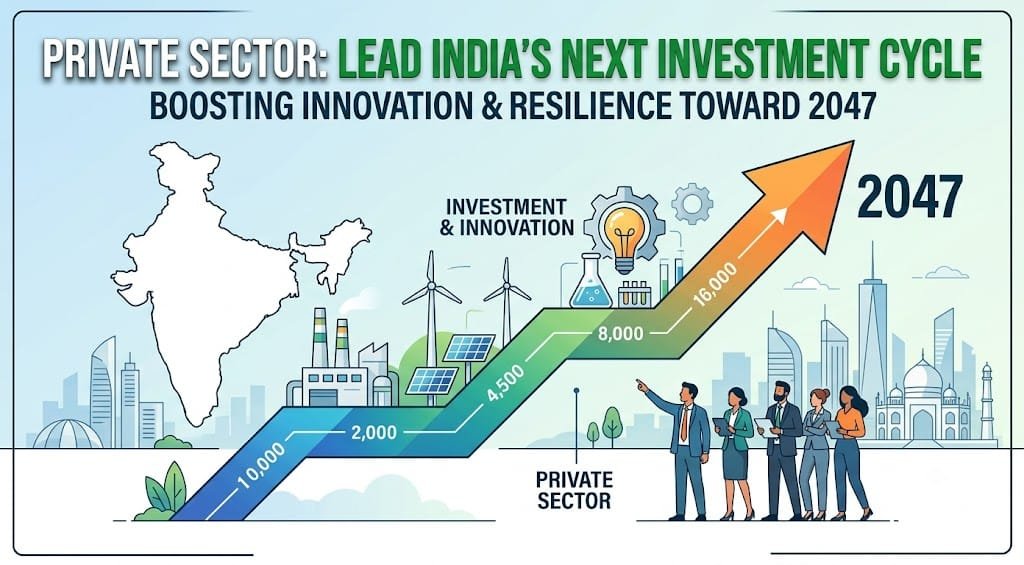
Finance Minister Nirmala Sitharaman has said that India’s private sector must now take the lead in the country’s next investment cycle. The message comes at a time when the Indian economy is showing stronger growth, but global uncertainty continues to create new challenges for businesses and governments.
Speaking at the Kautilya Economic Conclave, Sitharaman said that uncertainty should now be treated as a permanent condition of the global economy. This means that India must remain prepared, strengthen its financial position and continue building resilience. According to her, the country’s economic strength has not been created overnight. It has been developed step by step through reforms, better financial management and long-term policy decisions since 2014.
The Finance Minister placed special emphasis on private investment in research and development, commonly known as R&D. Research spending helps companies create new products, improve technology and compete in international markets. However, India currently spends only 0.83 percent of its GDP on R&D.
This is much lower than the average spending of OECD countries, which stands at around 2.7 per cent of GDP. The private sector contributes only about one-third of India’s total R&D spending, showing that there is significant room for improvement.
Sitharaman’s call comes as signs of a wider investment recovery are becoming visible. India’s GDP grew by 7.8 per cent during the April-June quarter. Gross Fixed Capital Formation, which is commonly used as an indicator of investment, grew by 11.9 per cent during the quarter. In nominal terms, investment growth was even higher at 20.4 per cent. The share of investment in GDP also increased to 34.3 per cent, compared with 31.4 per cent during the same period of the previous year.
The improvement in bank credit is another positive sign. Non-food bank loans increased by nearly 19 per cent year-on-year by the end of August. This suggests that businesses may be preparing to expand factories, purchase equipment, improve capacity and invest in new projects. If this trend continues, private capital expenditure could become a stronger support for India’s economic growth.
Sitharaman also highlighted the importance of reforms in taxation, finance, insolvency, business regulation, infrastructure planning and public administration. These reforms, she said, have been gradual but their overall objective has been transformational. The next task is to convert these foundations into better productivity, more employment and wider opportunities for citizens, companies and different regions.
The Finance Minister also spoke about strategic resource security and the need for greater autonomy in critical inputs. At the same time, she supported continued global openness, diversified partnerships and stable trade. She further called for reforms in global financial institutions so that developing economies can receive larger, faster and more predictable long-term funding.
The overall message is clear. India’s next phase of growth will depend not only on government spending but also on stronger private investment, deeper innovation and greater confidence among businesses. If companies increase investment in technology, research and production, the benefits could reach employment, exports, productivity and the broader development journey towards 2047.

