
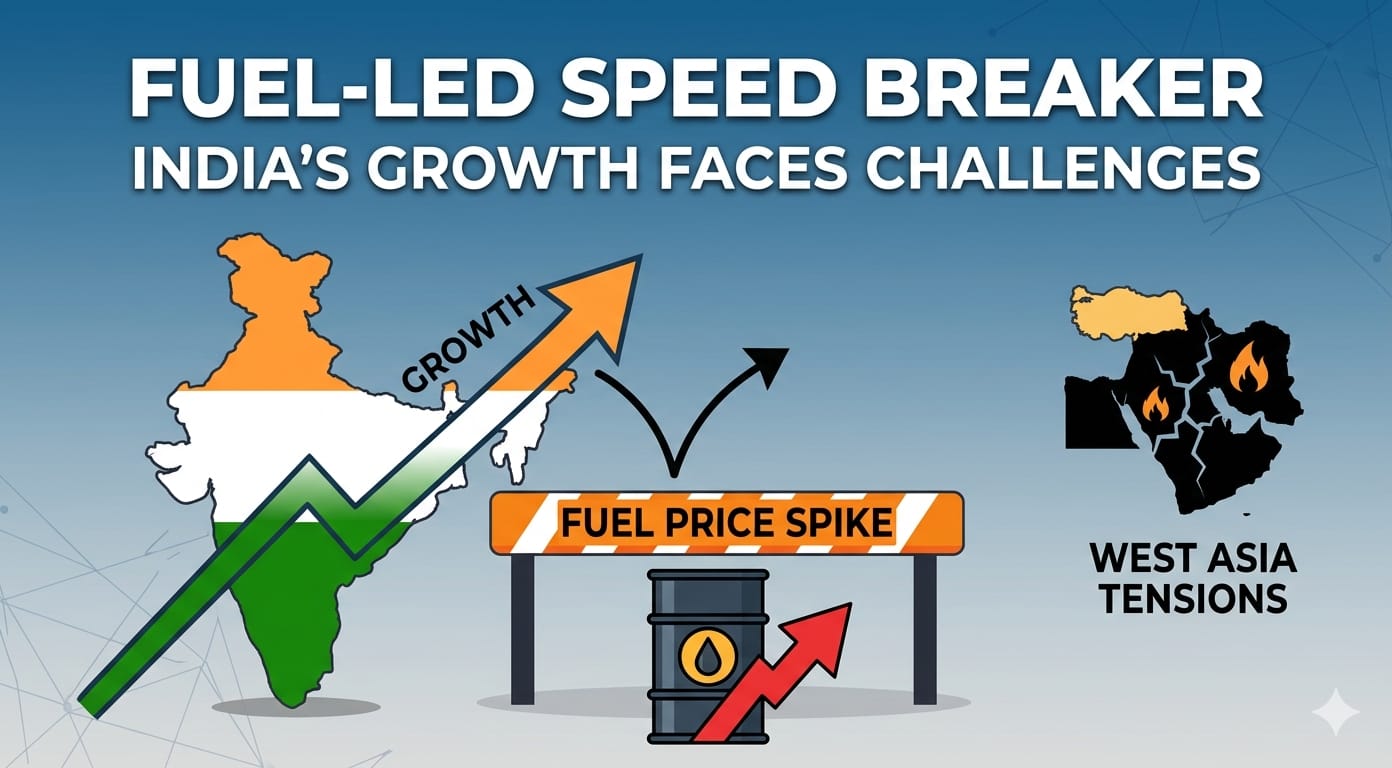
The growth engine is still running because of good governance, but the road ahead looks a bit bumpier than it did a few months ago. The Reserve Bank’s latest State of the Economy report puts it plainly: domestic demand remains the main driver of growth, yet the near‑term outlook is “somewhat clouded by supply‑side pressures” created by the West Asia conflict, higher global oil prices and weather‑related risks.
In everyday terms, this means that while people are still spending, investing and travelling, rising fuel and input costs are quietly pushing up prices and making the economy more fragile in the short run. For an ordinary citizen, this translates into slightly tighter household budgets, extra pressure on petrol and diesel bills, and more uncertainty around how long the current “good‑times” phase of the economy can last.
The core of the RBI’s worry lies in how the West Asia conflict has hit global supply chains and commodity markets. Shipping routes that connect crude oil and gas‑rich regions to the rest of the world have become more unstable, and trade flows have slowed down.
This has pushed up prices of key commodities, especially crude oil. As a result, India’s import bill for oil and related products has swollen, directly feeding into the merchandise trade deficit that widened sharply in April 2026 compared with March.
The RBI staff notes that crude oil and gold imports were the main drivers of this growing gap between what India buys from abroad and what it sells to the world.
For a large oil‑importing country like India, this is not just a statistical concern; it spills over into exchange‑rate pressure, higher borrowing costs and, ultimately, into the prices of transport, food and manufactured goods.
Within India, the data paint a mixed picture. Headline inflation, measured by the Consumer Price Index, is still sitting inside the RBI’s 2–6% tolerance band, but it has climbed to around 3.5% in April, touching a 13‑month high. This rise is mainly coming from food prices, such as vegetables and pulses, which households feel immediately at the kirana shop and the vegetable market.
At the same time, Wholesale Price Index inflation has jumped to about 8.3% in April, a 42‑month high, showing that the cost of raw materials and fuel for businesses is also heating up. Economists describe this as an “incipient price pressure,” meaning that if crude stays high and supply bottlenecks persist, everyday inflation could start to pick up more quickly.
The RBI is especially cautious about any “second‑round” impact, where higher fuel and input costs push companies to raise prices repeatedly, rather than just once, and then workers start demanding higher wages, creating a self‑reinforcing cycle of inflation.
Financial conditions have also tightened a bit. Yields on government securities and treasury bills have edged up, signalling that markets are demanding more return for holding Indian debt in an environment of higher global risk and elevated oil prices.
Capital flows, which include foreign portfolio investment and other cross‑border money movements, are being watched closely because volatility can quickly swing the rupee and stock markets.
At the same time, the RBI and the government are trying to cushion the economy with strong foreign‑exchange reserves, proactive policy measures and a steady flow of foreign direct investment.
Services exports, especially in IT and business‑process outsourcing, continue to be a bright spot, helping to offset some of the strain from a wider trade deficit.
On the farm side, there is cautious optimism. Summer sowing of pulses, oilseeds and coarse cereals has progressed well, supported by above‑normal pre‑monsoon rainfall. This gives some comfort that domestic food production may remain reasonably strong even if global wheat or edible‑oil prices stay elevated.
However, the RBI also flags risks from weather: higher‑than‑normal minimum temperatures and unseasonal rains in some regions could hurt the remaining rabi crops, such as wheat and mustard, during harvesting. If the monsoon turns weaker than expected later in the year, food‑price pressure could rise again, adding another layer of inflation risk.
Putting it all together, the RBI’s message is both reassuring and cautious. It argues that India has entered this phase from a position of macroeconomic strength, with resilient domestic demand, strong services exports and healthy forex buffers. But it also stresses that the near‑term outlook is not smooth; it is clouded by supply‑side pressures from the West Asia war, higher crude oil prices, disrupted trade flows and weather uncertainties.
For viewers, readers and policymakers, this means expecting a bit more volatility in fuel prices, some stickiness in food inflation and a tighter policy environment where the RBI may have to stay alert on interest rates and liquidity. The good news is that the economy is not fragile; the challenge is to manage the shocks so that growth does not slow sharply and common‑people households do not get squeezed too hard.

