
Every year, quietly and without much fanfare in everyday conversation, India’s central bank, the Reserve Bank of India, hands over a large chunk of money to the central government. It is called a “surplus transfer” or simply a “dividend,” and it has become one of the most important sources of income for the government of India, money that does not come from taxing ordinary citizens, but from the RBI’s own earnings. And right now, as the RBI’s Central Board sits down for its crucial meeting this Friday, May 22, 2026, the country is watching closely to see just how big that cheque will be this time.
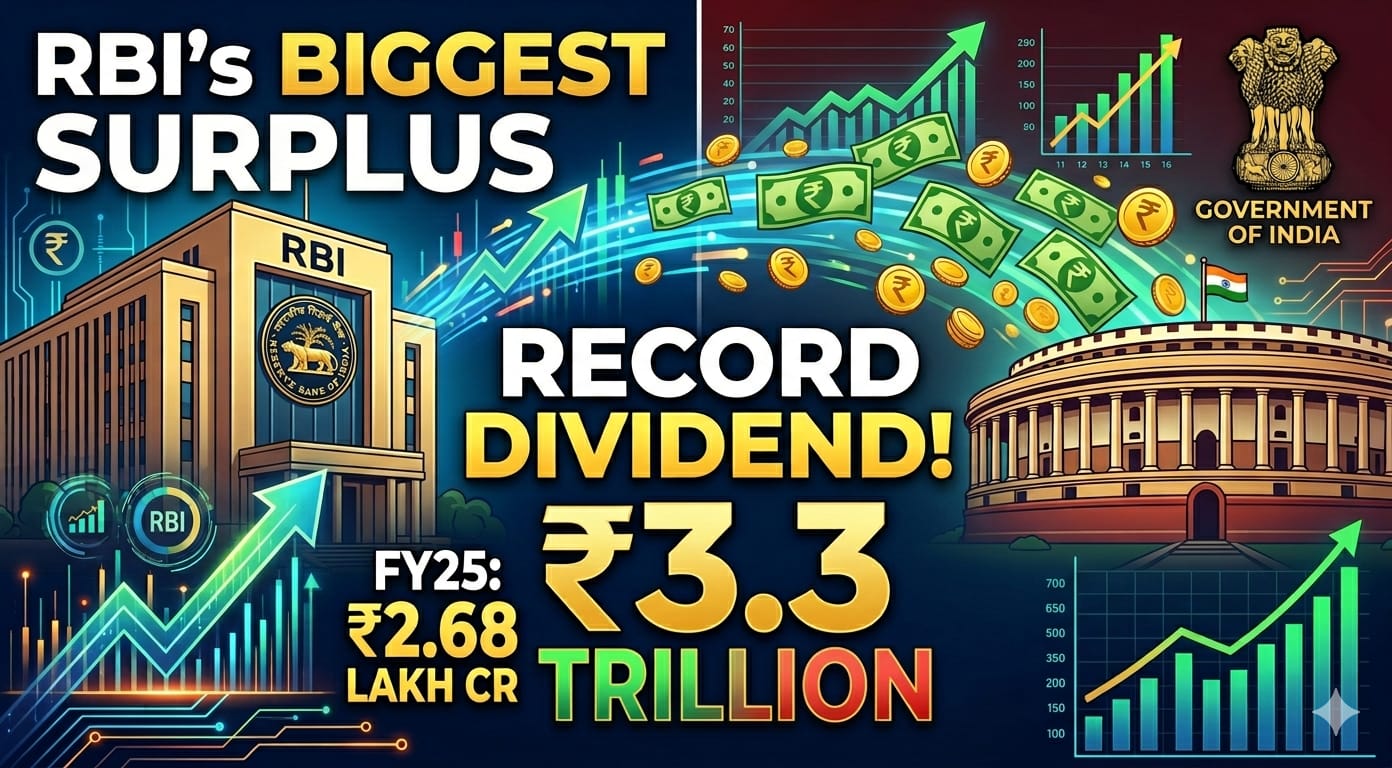
The RBI Central Board is scheduled to meet on Friday to decide on the surplus transfer to the government for 2025-26 (FY26), with economists expecting the payout to exceed FY25’s record dividend of ₹2.7 trillion.
Economists expect the dividend transfer to be in the range of ₹2.8 trillion to ₹3.3 trillion, supported by higher interest income and the possibility of lower provisioning towards contingency reserves.
To understand why this number is so large and why it keeps growing, we need to go back to the basics and then walk through seven years of data that tell a remarkable story.
Think of the RBI as a very large and very powerful institution that earns money from multiple sources. It earns interest on the government bonds it holds, it earns from managing India’s massive foreign exchange reserves, it profits from buying and selling dollars in the currency market, and it even earns fees from printing currency notes. After covering its own operating costs and setting aside a safety cushion called the Contingent Risk Buffer (CRB), whatever is left over is handed to the Government of India as surplus. The RBI makes an annual payout to the government from the surplus income it earns on investments and valuation changes on its foreign exchange holdings, including the dollar, and the fees it gets from printing currency notes.
Since the Government of India is the sole owner of the RBI, this transfer is effectively a dividend from the nation’s central bank to its owner, the people’s government.
Now, here is the data that tells the real story. In FY17 (year ended June 2017), the RBI transferred only ₹30,659 crore to the government less than half of what it paid in 2015-16 because of expenses incurred on printing new currency notes following demonetisation in November 2016.
The very next year, in FY18, things recovered sharply. The RBI transferred ₹50,000 crore as surplus to the central government for the year ended June 30, 2018.
Then came a watershed moment in FY19. The RBI decided to transfer a record ₹1,23,414 crore of its surplus to the central government for the fiscal year 2018-19, and an additional ₹52,637 crore of excess provisions as recommended by the Bimal Jalan Committee on the Economic Capital Framework, making it almost double the previous record of ₹65,896 crore.
In FY20, the RBI transferred ₹57,128 crore of its surplus to the Union government.Then in FY21, the number jumped again the RBI transferred ₹99,122 crore for a nine-month period ended March 2021. But FY22 saw a dramatic fall. The RBI transferred only ₹30,307 crore as surplus to the government for 2021-22 the lowest amount in 8 years because the central bank had infused huge liquidity into the system during the two years of Covid to spur growth, which dented its profitability.
Then in FY23, the pendulum swung back. The RBI transferred a surplus of ₹87,416 crore in FY23. FY24 brought a stunning breakthrough: the RBI’s central board decided to transfer a record surplus of ₹2.11 trillion to the government for 2023-24, even after increasing the contingent buffer to the peak level of 6.5 per cent.
And FY25 pushed the record even further. The RBI’s Board of Directors approved a record transfer of over ₹2.68 lakh crore as surplus to the central government for the financial year 2024-25, with the decision taken during a board meeting chaired by RBI Governor Sanjay Malhotra in Mumbai.
So in a clear sequence: FY17 ₹30,659 crore; FY18 ₹50,000 crore; FY19 ₹1,76,051 crore (including excess provisions); FY20 ₹57,128 crore; FY21 ₹99,122 crore; FY22 ₹30,307 crore; FY23 ₹87,416 crore; FY24 ₹2,11,000 crore; FY25 ₹2,68,590 crore. And for FY26, the decision is being taken today. Over the last two decades, surplus transfers have grown by a staggering 4,873%, from ₹5,400 crore in 2004-05 to ₹2,68,590 crore in 2024-25.
What is driving FY26’s expected record? The sharp rise in the expected surplus comes after a year in which the RBI benefited from currency volatility, gains on foreign exchange operations and higher returns from investments. A major contributor was the nearly 10 per cent depreciation of the rupee against the US dollar during FY26, which boosted valuation gains on the RBI’s foreign currency assets and expanded its balance sheet. India’s foreign exchange reserves increased around 3 per cent during FY26 to nearly $688 billion, further supporting the RBI’s income profile.
What does this mean for you and me? In the Union Budget for 2026-27, the government has estimated ₹3.16 lakh crore in dividends from state-owned companies and surplus transfers from the central bank.
This non-tax revenue helps the government reduce its fiscal deficit meaning it needs to borrow less, which in turn keeps interest rates more manageable and keeps the country’s finances healthier.
It is, in simple terms, money the government earns without taxing anyone and in a year when global uncertainties are high, every rupee of it counts. The RBI’s board meeting today is not just a finance event. It is a decision that will shape how much money the government has to spend on roads, hospitals, and schools and that affects every single one of us.

