
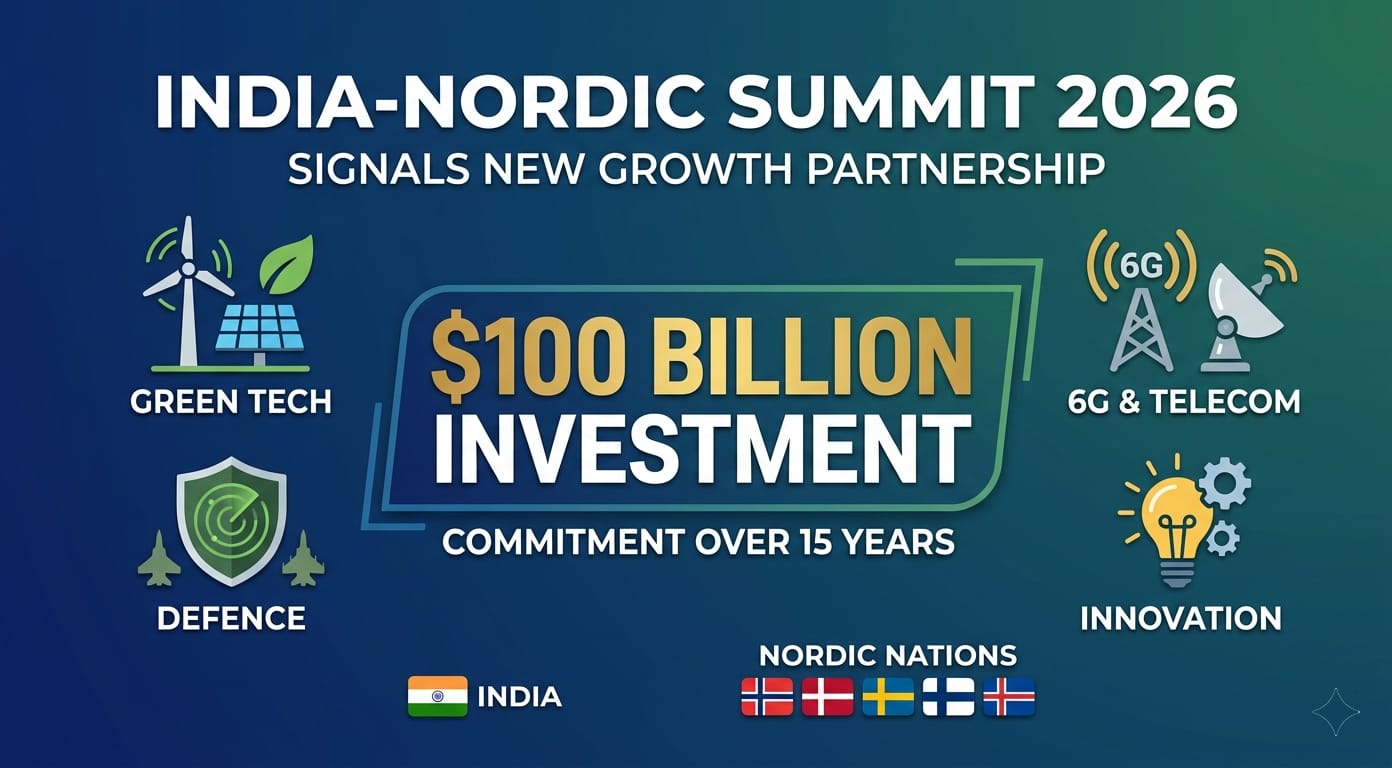
The third India-Nordic Summit held in Oslo has marked a major step forward in India’s global economic partnerships, with five Nordic countries—Norway, Denmark, Sweden, Finland, and Iceland—committing to invest $100 billion in India over the next 15 years. This is not just a financial announcement, but a strategic signal of trust and long-term collaboration between two regions that share common values like democracy, innovation, and sustainability.
If we look at the current numbers, India’s trade with Nordic countries stood at around $19 billion in 2024. Now, with this new commitment, both sides aim to scale this relationship significantly, not just in trade but also in job creation, technology sharing, and climate cooperation. The plan is expected to generate around one million jobs, which makes it highly relevant for India’s growing workforce and economic ambitions.
Prime Minister Narendra Modi, along with leaders from all five Nordic nations, emphasized that this partnership is not limited to investments. It is about building future-ready collaboration. One of the biggest highlights is India offering 100 percent Foreign Direct Investment (FDI) to Nordic defence companies in its defence industrial corridors. This move opens the door for advanced defence manufacturing in India, combining Nordic expertise with India’s scale and cost advantage.
At the same time, green technology emerged as a central pillar of this partnership. India and Nordic countries signed a strategic agreement focused on clean energy, sustainable development, and innovation. This includes cooperation in areas like geothermal energy with Iceland, advanced manufacturing with Sweden, telecom and digital infrastructure with Finland, and cybersecurity and healthcare with Denmark. When you combine this with India’s large talent pool, it creates a powerful ecosystem for global solutions.
Another important dimension is the focus on future technologies and research. Both sides have agreed to strengthen collaboration in STEM fields and emerging technologies like 6G. This is crucial because the next decade will be defined by digital infrastructure and innovation leadership. Increased mobility for students and researchers will also help in knowledge exchange, making this partnership more people-centric rather than just policy-driven.
The summit also highlighted cooperation in the blue economy, which includes sustainable use of ocean resources, fisheries, and maritime development. For a country like India, with a long coastline and growing maritime ambitions, this collaboration can bring both environmental and economic benefits. Similarly, polar research cooperation reflects a shared interest in climate science and global environmental challenges.
Interestingly, Prime Minister Modi used the word “sambandh,” which he pointed out exists in both Indian and Icelandic languages, meaning connection or relationship. This was not just symbolic but reflected the deeper idea behind the summit—building meaningful and lasting ties rather than transactional partnerships.
However, the summit was not without political discussions. Issues related to global conflicts like Ukraine and West Asia were also addressed, with leaders agreeing to work together in a time of increasing global uncertainty. At the same time, domestic political debates in India also surfaced, particularly around Norway’s sovereign wealth fund and its decision regarding Adani Green Energy. The Indian government, however, maintained its position and emphasized transparency and constitutional values when responding to concerns raised by international media.
From an economic perspective, this summit comes at a crucial time when India is actively negotiating trade agreements with Europe, including the India-EU Free Trade Agreement and EFTA arrangements. Leveraging these frameworks will be key to ensuring that the $100 billion investment target is actually achieved and effectively utilized.
Overall, the India-Nordic Summit 2026 is not just about numbers, but about direction. It shows how India is positioning itself as a global hub for investment, innovation, and sustainable growth. For Nordic countries, it offers access to one of the fastest-growing major economies in the world. And for you as an observer, it clearly reflects how international partnerships are evolving—from simple trade deals to deep, multi-sector collaborations that shape the future.

