
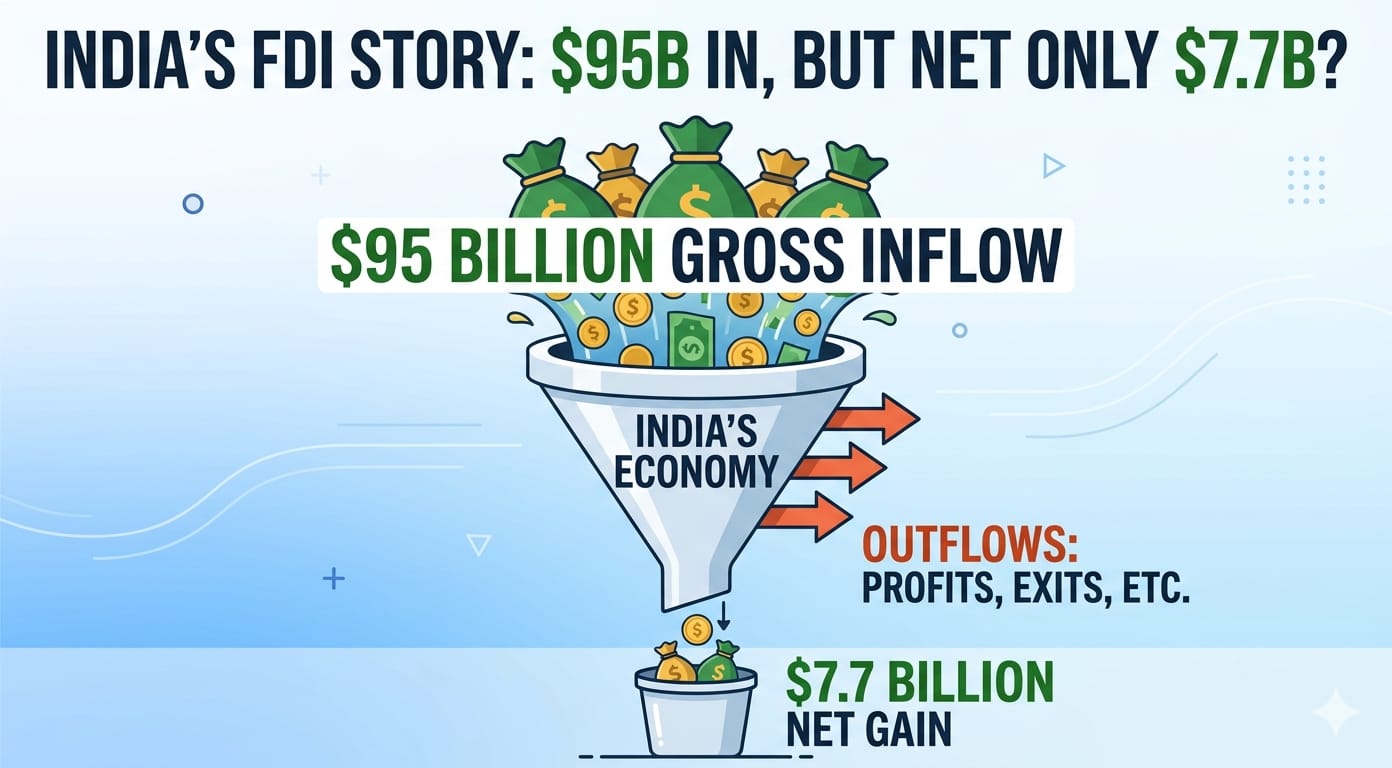
The foreign direct investment story in FY26 looks like a classic “good news‑bad news” situation. On the surface, everything looks strong: Gross foreign direct investment (FDI) into India jumped to a record high of about $94.5 billion in 2025‑26, up roughly 17–18 percent from the previous year’s $80.6 billion.
Big brands, global tech firms, and foreign private‑equity houses are still actively opening offices, building factories, and buying stakes in Indian companies, which naturally feels like a big vote of confidence in the economy.
But when we look at the real money that actually stayed in India, the picture softens sharply: Net FDI inflows were only about $7.6–7.7 billion, compared with less than $1 billion a year earlier. In simple terms, a lot of money came in, but a lot of money also went out, so the net benefit to the country is much smaller than the headline number suggests.
To understand this, think of your own household. Imagine your family earns ₹1 lakh in a month but also spends ₹70,000 on EMIs, bills, and sending money to relatives. Your gross income is ₹1 lakh, but your net saving is only ₹30,000. For India, “gross FDI inflows” is like ₹1 lakh: It measures all the fresh foreign money that foreign companies and investors put into India through new projects, fresh equity, or buying into existing firms.
“Net FDI” is the same as your net saving: it is gross inflows minus money that flows out of India, such as profits taken back to parent companies abroad, sale of stakes, or big‑ticket exits like IPO divestments. In FY26, despite the record $94.5 billion coming in, repatriation and disinvestment amounted to about $53.6 billion, which is still 4 percent higher than the previous year, leaving a much smaller net gain inside the economy.
What this gap actually means for the ground is that India is still an attractive destination for global investors, especially in sectors such as manufacturing, computer and IT services, financial services, business‑process outsourcing, and telecom and communications. When foreign companies expand factories, set up new datacenters, or acquire Indian startups, they create jobs, raise productivity, and bring in technology and management know-how.
But when the same companies later sell their stakes through IPOs or secondary sales, or when they repatriate large chunks of profit to their home countries, a big part of that initial investment money flows back out, which can affect the currency, capital‑market sentiment, and the government’s ability to rely on FDI as a steady, long‑term source of growth.
In fact, outbound FDI by Indian firms also rose sharply in FY26, from about $28.2 billion to around $33.3 billion, which adds pressure on the net number because money is also flowing out of India for foreign acquisitions and overseas expansion.
For an ordinary person, this matters in several ways. If net FDI stays low, it can mean that the benefits of global investment, new factories, better‑paid jobs, and upgraded skills are not as strong as the headline “$95 billion” figure suggests.
On the other hand, if gross inflows keep rising and more of the money is reinvested as profits instead of being taken out, it can translate into more capital for expansion, higher wages, and better‑quality infrastructure over time.
For the government and policymakers, the challenge is to keep pulling in big foreign investors while also creating an environment where companies feel comfortable keeping profits inside India, say by investing in R&D, green energy, or local supply chains rather than just repatriating cash.
This is why recent data showing net FDI turning positive after several months of negative flowsespecially in February and March 2026has been seen as a small but welcome sign that the trend is shifting, even if the net number is still modest compared with the huge gross inflows.
In short, India’s FDI story in FY26 is not just about “record investment” on one hand; it is also about how much of that money truly stays to build the economy on the other.
Yes, $94.5 billion of gross FDI entering the country is a clear sign of confidence and a positive development, especially when global FDI flows are slowing in many other parts of the world.
But if half of that money sooner or later flows back out as profits, exits, or outward investments, the real cushion this foreign money provides to jobs, growth, and long‑term stability is much smaller than the big headline number.
For India to fully convert this record gross FDI into real, lasting economic muscle, the focus will have to shift from just attracting capital to making sure more of it is reinvested, absorbed, and used to create value within the country itself.

