
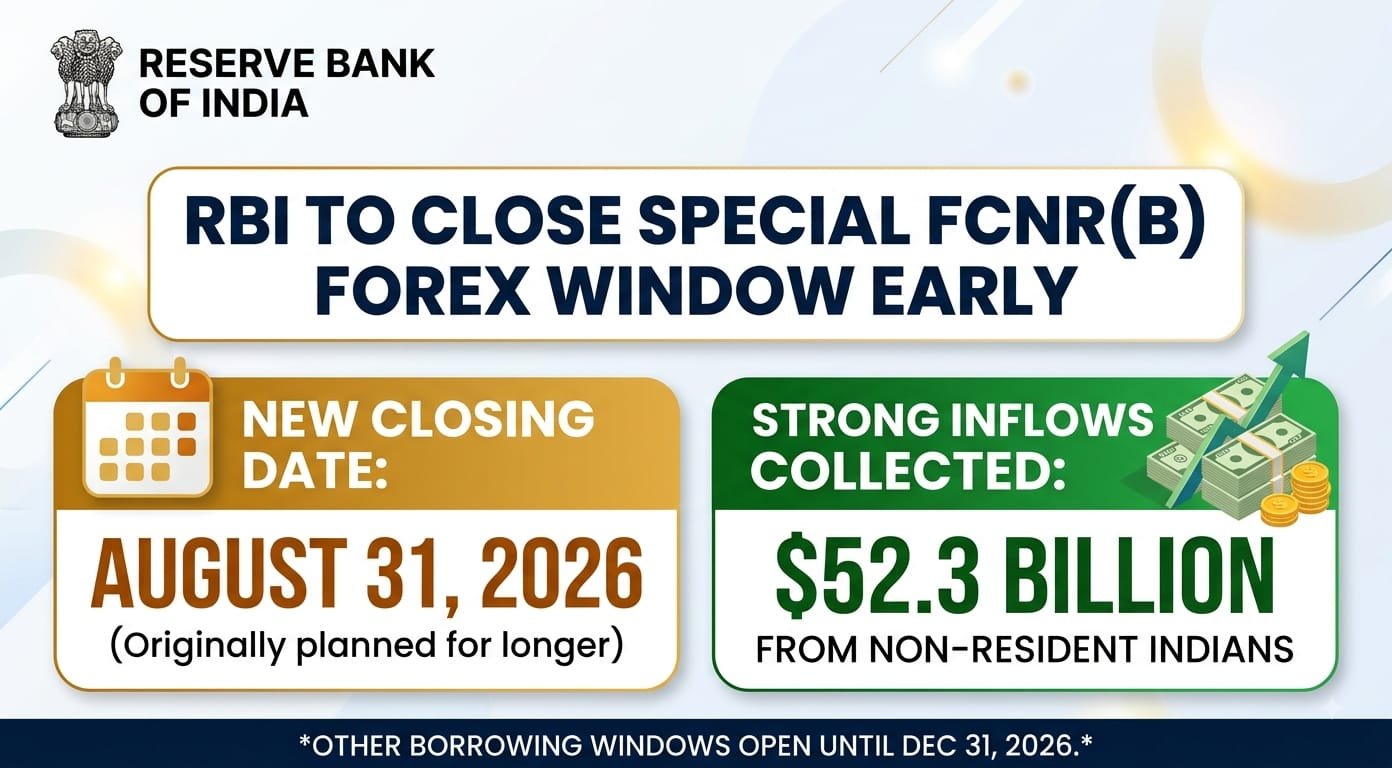
The Reserve Bank of India has decided to close its special forex swap facility for fresh Foreign Currency Non-Resident (Bank), or FCNR(B), deposits on August 31, 2026. The facility was originally expected to remain available for a longer period, but the strong response from banks and overseas Indians has encouraged the central bank to bring forward the closing date.
Through this facility, banks have collected foreign-currency deposits worth $52.3 billion, making it clear that the scheme has attracted much more interest than initially expected.
FCNR(B) deposits are fixed-term deposits held by non-resident Indians in foreign currencies through Indian banks. Since the money remains in a foreign currency instead of being converted directly into rupees, deposit holders do not face the same exchange-rate risk that can arise when foreign money is converted into the Indian currency.
These deposits provide banks to access the foreign funds that can strengthen their overall foreign-exchange position.
The special facility was introduced to encourage fresh foreign-currency inflows into India and to make it easier for banks to raise money from overseas depositors. Under the arrangement, banks could bring in eligible FCNR(B) deposits and exchange the foreign currency with the RBI through a forex swap.
The swap helped banks manage the cost and risk involved in protecting themselves against changes in currency values. The RBI also offered the facility on favourable terms, which made it more attractive for banks to offer competitive returns to non-resident depositors.
The latest data show that FCNR(B) deposits were the biggest source of foreign-currency inflows under the special programme. Between June 8 and August 13, the three parts of the facility together attracted $56.846 billion. FCNR(B) deposits contributed $52.3 billion, while overseas foreign-currency borrowings brought in $2.805 billion and external commercial borrowings added $1.741 billion.
The scale of the response explains why the RBI no longer considers it necessary to keep the FCNR(B) window open until the earlier deadline. The central bank has described the response as encouraging, and the early closure suggests that the main objective of attracting substantial foreign-currency funds has already been achieved. It also prevents the inflow from becoming unnecessarily large if the scheme continues after the target need has effectively been met.
The August 31 deadline applies to the mobilisation of fresh FCNR(B) deposits under the special facility. However, banks will still be able to undertake swaps with the RBI until September 11 for deposits raised within the permitted period. This gives banks additional time to complete the related foreign-exchange transactions after the deposit mobilisation window closes.
The decision does not end the entire special forex programme. The facilities connected with external commercial borrowings and overseas foreign-currency borrowings will continue until December 31, 2026. These channels are separate from FCNR(B) deposits and are meant to help eligible borrowers raise funds from international markets. Therefore, the early closure affects only the FCNR(B) deposit window and not the other two components.
The decision provides bank to access a large pool of foreign currency but also brings an end to the opportunity to raise additional deposits under the special terms after August 31. Banks now have only a limited period to mobilise fresh eligible deposits. For non-resident Indians, the scheme may remain attractive until the deadline because it offers a regulated route to place foreign-currency savings with Indian banks.
The inflows can strengthen India’s external position by increasing the availability of foreign currency in the banking system. They can also support liquidity and give banks greater flexibility in managing their international funding needs.
At the same time, such inflows do not automatically mean that the rupee will rise sharply, because the RBI and banks may manage the money through swaps and other foreign-exchange operations. The broader effect will depend on how the funds are used and how global currency conditions develop.
The RBI’s decision reflects a practical policy approach: open a special window when foreign-currency inflows are needed, offer suitable support to banks, and close the window once the response becomes sufficiently strong.
With $52.3 billion already mobilised through FCNR(B) deposits, the scheme has achieved a significant result in a short period. The next focus will be on completing pending swaps smoothly and ensuring that the inflows contribute to India’s financial stability without creating excessive market pressure.

