
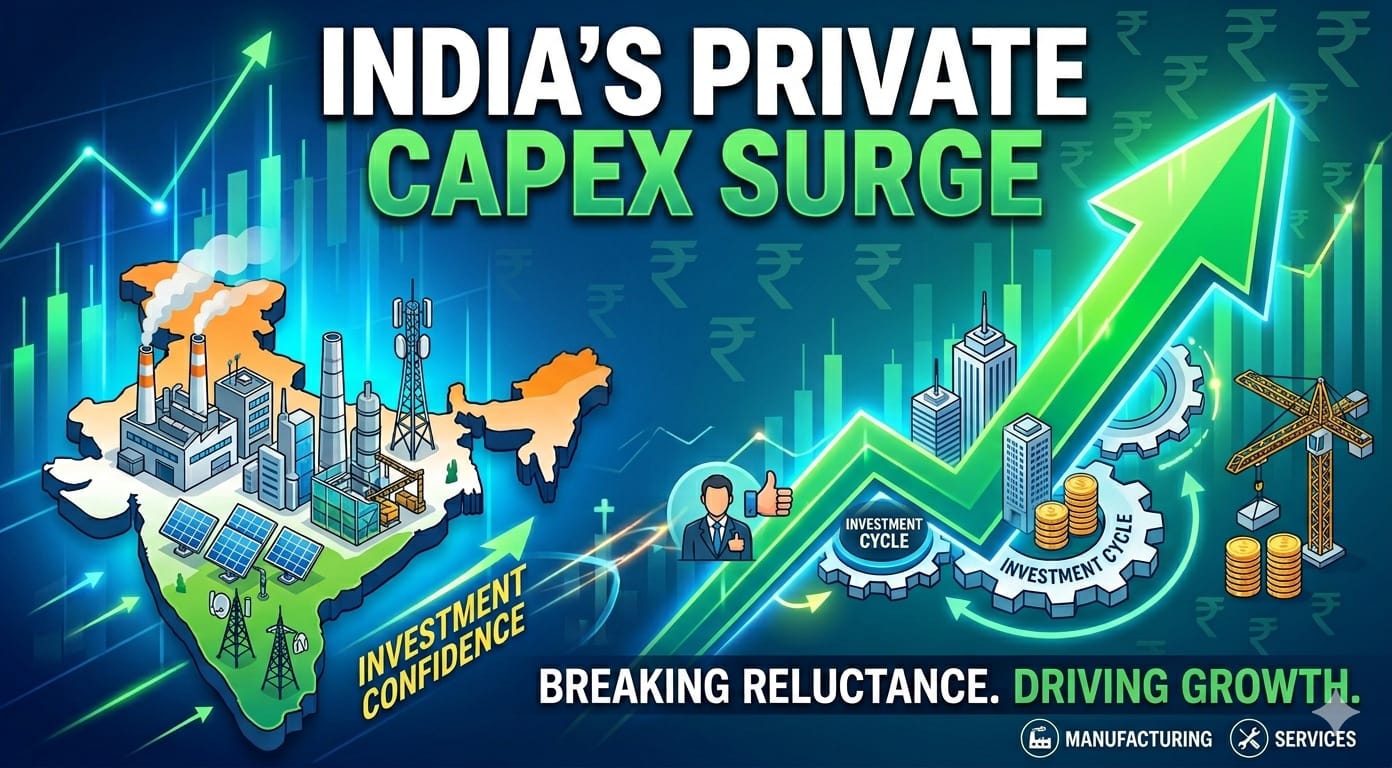
India’s private sector investment story appears to be entering a decisive new phase, breaking away from a narrative that dominated economic discussions for nearly half a decade.
According to the Confederation of Indian Industry (CII), private sector capital expenditure surged 67% year-on-year to ₹7.7 lakh crore in the first half of FY26, compared to ₹4.6 lakh crore in the same period last year. This sharp rise is not just a statistical improvement but a structural signal that the long-awaited corporate investment cycle may finally be turning.
For years, industry experts and business commentators repeatedly pointed out a puzzling trend: Indian corporates were sitting on large cash reserves but were hesitant to invest domestically. Balance sheets were strong, deleveraging had largely taken place, yet fresh capacity creation remained muted. This led to two dominant concerns.
First, that companies lacked confidence in India’s business environment, including demand visibility and policy stability. Second, that Indian firms preferred deploying capital abroad through acquisitions rather than expanding within the country.
The latest data directly challenges both these assumptions. The surge in capex indicates that corporates are now willing to commit capital at scale within India, suggesting improved confidence in domestic demand, policy continuity, and macroeconomic stability.
Manufacturing has emerged as the biggest driver, accounting for ₹3.8 lakh crore, nearly half of the total investment. Key sectors like metals, automobiles, and chemicals are leading this expansion, reflecting both capacity addition and future demand expectations.
The services sector is also contributing significantly, with ₹3.1 lakh crore in capex, driven by trading, communications, and IT/ITeS. This balanced participation across sectors indicates that the investment revival is not narrow or sector-specific but broad-based. Such diversification strengthens the sustainability of this cycle and reduces the risk of it being a short-term spike.
Underlying economic indicators further support this trend. Capacity utilisation has reached 75.6%, a level typically associated with the need for fresh investments. Order books are expanding at over 10% year-on-year, while bank credit growth remains strong at around 14%. These signals collectively suggest that companies are not just reacting to current demand but are preparing for sustained growth in the coming years.
Importantly, this shift also counters the earlier narrative that Indian corporates were more interested in overseas acquisitions than domestic expansion. While global ambitions remain, the current data shows a clear pivot back to India, driven by improving infrastructure, policy support such as PLI schemes, and a relatively stable macroeconomic environment compared to global uncertainties.
At the same time, CII has proposed a five-point action plan to sustain this momentum amid global risks such as the West Asia crisis. The recommendations include gradual rollback of fuel excise cuts, energy efficiency commitments by industry, faster payments to MSMEs, strengthening domestic supply chains, and front-loading future investments. These measures reflect an attempt by industry to position itself as an active partner in economic stability rather than just a beneficiary.
The significance of this capex surge goes beyond numbers. It marks a psychological shift in corporate India. After years of caution, balance sheet repair, and risk aversion, companies are once again willing to take long-term bets. If sustained, this trend could have multiplier effects on job creation, income growth, and overall economic momentum.
In simple terms, what was once seen as a key weakness of the Indian economyprivate sector reluctance to investmay now be turning into a strength. The coming quarters will be crucial in determining whether this is the beginning of a durable investment cycle or just an early spike, but for now, the signal is clear: corporate India is back in expansion mode.

