
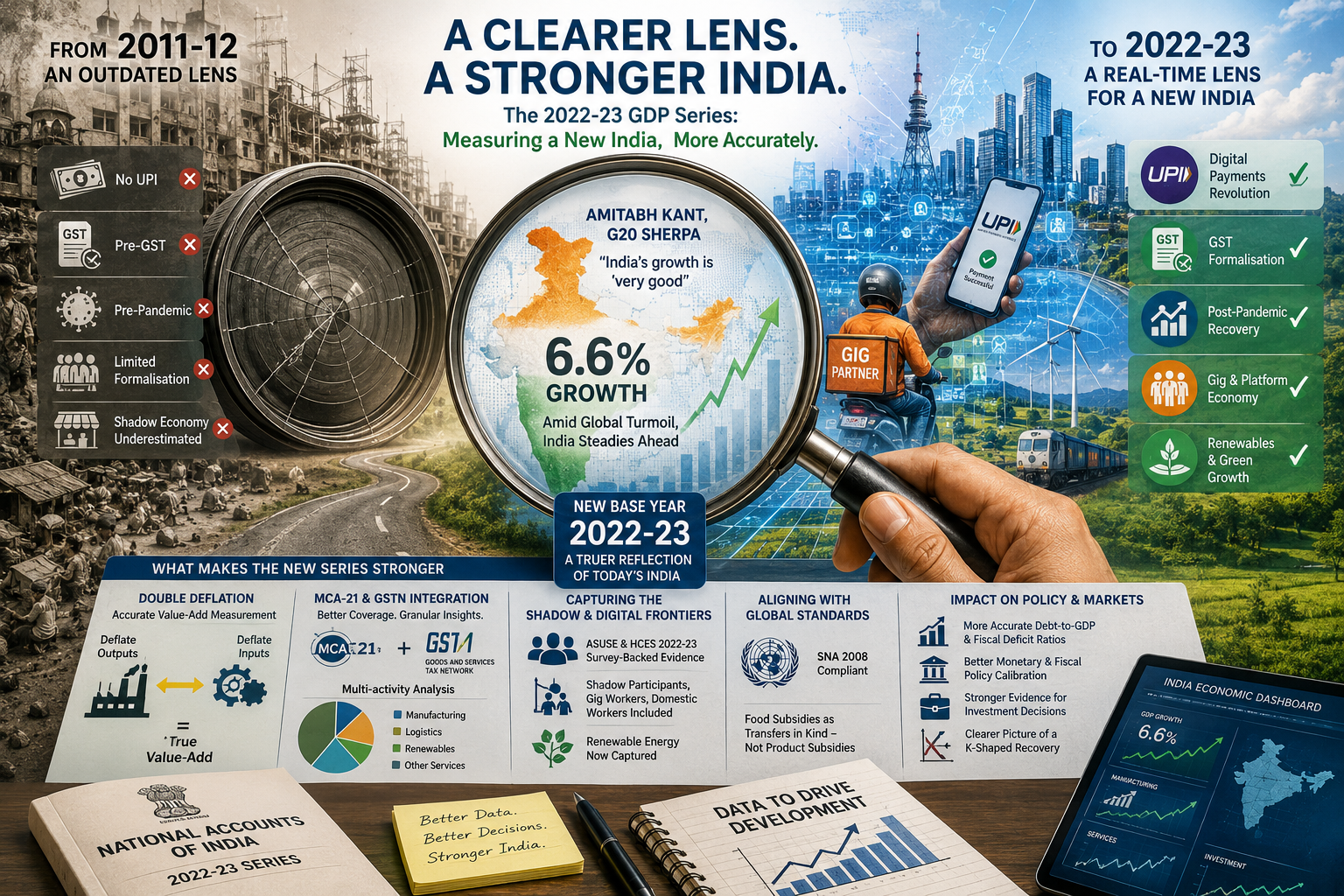
Economic statistics are often dismissed as the dry plumbing of statecraft, yet they constitute the very optics through which a nation views its progress. For over a decade, the Indian policy apparatus had been navigating a rapidly digitising, post-GST, and post-pandemic landscape using the 2011-12 GDP base series – a lens that had become increasingly opaque.
The recent statement by Amitabh Kant, India’s G20 Sherpa, highlighting India’s ‘very good’ 6.6% growth amidst global turmoil, underscores the critical need for an accurate statistical lens. The release of the revamped series, with 2022-23 as the new base year, is therefore far more than a routine update. It is a necessary overhaul of our data infrastructure – an effort to ensure the numbers we track truly reflect the ground reality of a changed economy, providing robust evidence for such pronouncements of resilience.
Beyond the 2011 lens
To understand the gravity of this shift, one must appreciate the sheer velocity of change since 2011. That era predated the Unified Payments Interface (UPI), the formalisation surge of the Goods and Services Tax (GST), and the shift toward a gig and platform-based labour market.
By anchoring our national accounts to 2022-23, the Ministry of Statistics and Programme Implementation (MoSPI) is finally inhaling the fumes of this new reality. As Simon Kuznets, the father of national income accounting, once cautioned, “the welfare of a nation can scarcely be inferred from a measure of national income,” but if we must measure it, the metrics must at least be contemporaneous.
The selection of 2022-23 as the base year is a choice rooted in pragmatic necessity rather than statistical perfection. In the ideal world of a macroeconomist, a base year should be normal, free from the idiosyncratic shocks of global volatility and replete with statistical flatlines.
While 2022-23 carried the residual heat of post-pandemic recovery and the inflationary spikes of the Ukraine conflict, it represents the first full year of normalised economic activity. Waiting for a perfect, frictionless year in an era of perma-crisis is erroneous; MoSPI has rightly prioritised relevance over a theoretical normalcy that may never exist.
Methodological Rigor: Double deflation and MCA-21 integration
Perhaps the most intellectually satisfying aspect of this revamp is the long-overdue transition to ‘Double Deflation.’ For years, India’s reliance on a single-deflator approach – often using the Wholesale Price Index (WPI) to deflate nominal value added created significant distortions. When input prices (like crude oil or fertilisers) diverged sharply from output prices, our GVA figures were often more a reflection of terms-of-trade shifts than genuine productivity gains. By deflating outputs and inputs separately at a granular sector level, the new series finally brings India into the fold of the UN System of National Accounts (SNA 2008) best practices. This is the only way to accurately capture ‘value-add’ in a manufacturing sector characterised by complex global supply chains.
The formalisation tailwinds also find their first true empirical home in this series. The integration of the GSTN database and MCA-21 records (specifically the MGT-7/7A forms) allows the statistician to move away from the dominant activity classification. In the old series, a company’s entire value-add was often attributed to its primary business code, ignoring the diversified reality of modern Indian conglomerates. The new methodology allows for a multi-activity breakdown. For instance, instead of labeling an entire conglomerate under a single dominant code like Steel, the data can now separate the value generated by its logistics arm or its renewable energy ventures. This provides a much sharper picture of how capital is actually deployed across sectors.
Capturing the shadow and digital frontiers
Furthermore, the inclusion of the shadow participants hired domestic workers, gig economy partners, and the burgeoning renewable energy sector addresses a long-standing critique of Indian GDP: its missing middle. The use of the Annual Survey of Unincorporated Sector Enterprises (ASUSE) and the revamped Household Consumption Expenditure Survey (HCES 2022-23) replaces the benchmark-indicator method, which relied on outdated extrapolations. We are finally moving from an era of educated guesses about the informal sector to one of survey-backed evidence.
However, as any seasoned economist knows, every statistical gain comes with a Lucas Critique caveat. As we change the way we measure, we must be wary of how these numbers influence the behaviour of the agents being measured. The inclusion of food subsidies as transfers in kind rather than product subsidies is a masterstroke of accounting clarity, aligning us with international standards. It removes a layer of noise from the GVA of agriculture and trade, providing a cleaner measure of production. Yet, we must be careful that this cleaner data does not mask the underlying fiscal pressures of our social safety nets.
Fiscal optics to economic reality
The implications for our fiscal and monetary architecture are profound. A revised nominal GDP base will inevitably alter the denominator for our most critical ratios: the debt-to-GDP and the fiscal deficit. While a likely upward revision in the level of GDP might offer some immediate optical relief to the finance ministry, the real value lies in the back series. Without a consistent longitudinal view reconciling the disruptions of Demonetization in 2016 and the 2020 pandemic, econometricians will struggle to find the true signal in the growth trend. The use of the Proportional Denton Method to smooth quarterly estimates is a welcome step in eliminating the artificial jumps that often plague our high-frequency data.
From a sectoral standpoint, we should expect a K-shaped recovery. If the new weights in the HCES 2022-23 show a significant tilt toward premium services and digital consumption at the expense of traditional staples, it will provide the empirical weight needed to address the unevenness of our recovery. The digital stack is no longer a peripheral story; it is the central nervous system of the Indian economy. Capturing the value of a zero-marginal-cost digital transaction or the productivity gain of an e-Vahan-registered logistics fleet is what will determine if we can credibly track our progress toward the $5 trillion milestone.
There is, of course, the inevitable political theatre that accompanies any base-year revision. Critics will point to the 11-year gap, longer than the international standard of five years, and proponents will hail the miracle of higher growth rates. As economists, our duty is to look past the headline numbers. Growth is a derivative of productivity, and productivity is a derivative of capital efficiency. If the new series shows that our incremental capital-output ratio (ICOR) is improving, it validates the supply-side reforms of the last decade. If not, it suggests that our growth is still being fueled by the brute force of public capex rather than organic private investment.
In the final analysis, the 2022-23 revamp is an act of statistical maturity. It acknowledges that the Indian economy is no longer the agrarian-heavy, retail-primitive entity it was in 2011. As Diane Coyle noted in ‘GDP: A Brief but Affectionate History’, Measurement is a political choice. By choosing to adopt more granular, survey-based, and digitally-integrated data, India is choosing to confront its complexities.
We must welcome this new series not because it will necessarily give us better numbers, but because it gives us truer ones. In the labyrinth of global macroeconomics, a more accurate map does not guarantee a smoother journey, but it certainly makes it less likely that we will walk off a cliff. The 2022-23 series is the upgrade our national dashboard desperately needed; it is now up to the policymakers to drive with the wisdom that this new clarity demands, ensuring that future assessments like Kant’s are anchored in the most robust and contemporary data available.
Author Ankit Jakhar is a public policy analyst with other interests spanning political economy, political theory, and geopolitics.

