
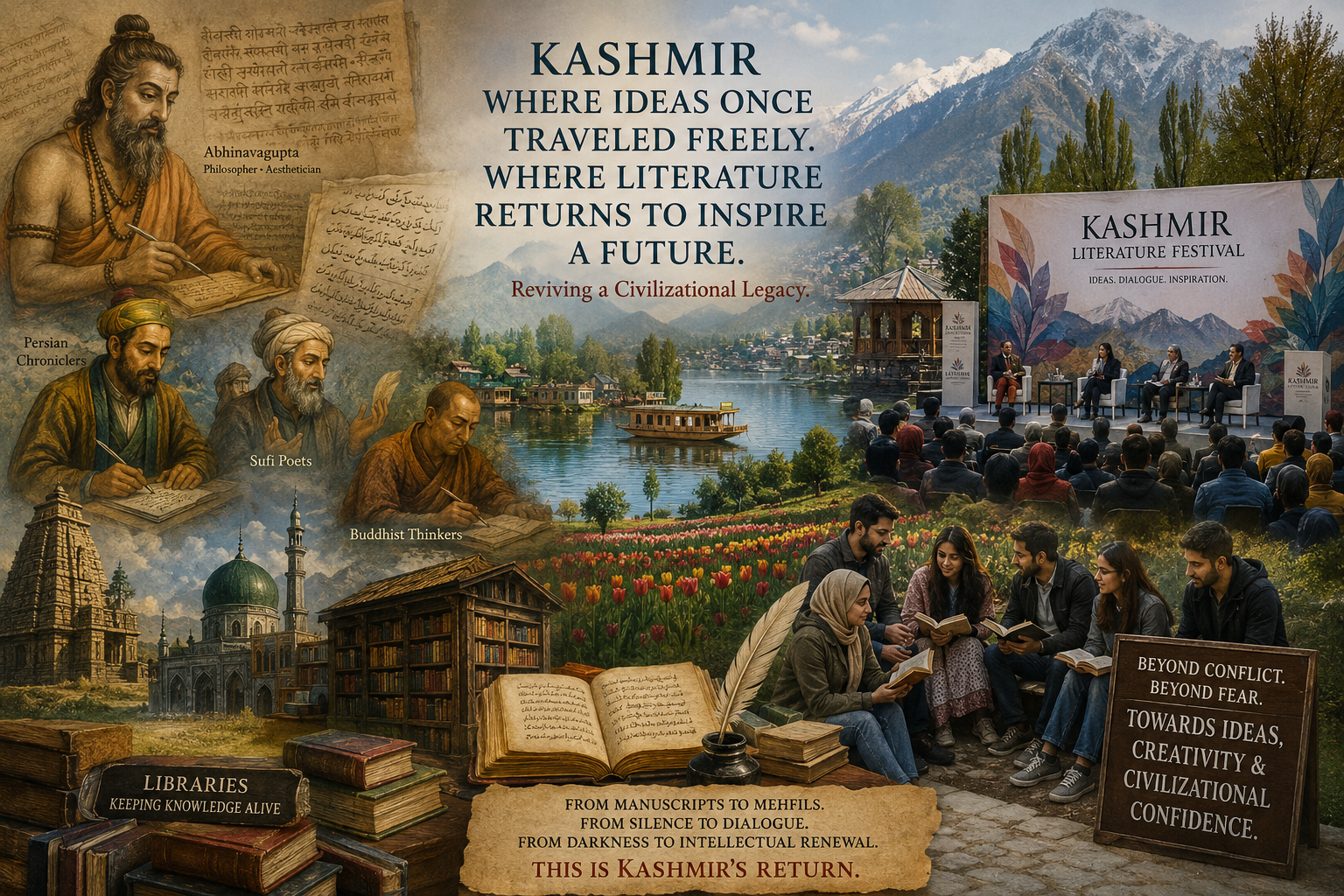
For centuries, Kashmir has been civilizational crossroads of ideas. Long before modern nation states emerged in South Asia, Kashmir had already built a reputation as one of the subcontinent’s great centres of learning, philosophy, poetry, spirituality and intellectual debate. Scholars travelled through the mountain passes into the Valley carrying manuscripts, ideas and traditions. Sanskrit scholars, Persian chroniclers, Sufi poets, Buddhist thinkers and historians all contributed to a deeply layered intellectual culture that once defined Kashmir’s identity far more than conflict ever did.
The story of Kashmir’s literary past is inseparable from the story of knowledge itself in the region. Ancient Kashmir produced philosophers like Abhinavagupta whose work on aesthetics and philosophy influenced Indian intellectual traditions for centuries. The Valley nurtured Sanskrit scholarship at a time when learning centres across the subcontinent looked towards Kashmir for intellectual guidance. Persian literature later flourished under successive Muslim rulers while the Sufi traditions created a unique fusion of spirituality, poetry and social discourse. Shrines, libraries, mosques, temples and informal gatherings became spaces where ideas travelled freely across communities.
Even during politically turbulent centuries Kashmir retained its reputation as a society where literature, poetry, storytelling and intellectual discussion occupied an important place in public life. The culture of mehfils, public readings, debates and scholarly exchanges remained deeply embedded in Kashmiri society. Education was not viewed merely as professional advancement it was in fact treated as a cultural inheritance.
That continuity, however, suffered a devastating rupture after the eruption of Pakistan-backed cross-border terrorism in the late 1980s and early 1990s. The violence that engulfed the Valley did not merely take lives or destabilized politics. It fundamentally altered the social and intellectual character of the valley itself.
For more than three decades the Valley remained trapped under the shadow of terrorism, separatist violence, fear, assassinations, targeted killings, shutdowns, street violence and radical ideological narratives that gradually displaced older traditions of intellectual openness. The exodus of Kashmiri Pandits became not only a humanitarian tragedy but also a civilizational wound for Kashmir’s pluralistic literary and scholarly ecosystem. Institutions weakened and the public spaces for dialogue shrank resulting in decaying of the libraries as the cultural activity became secondary to survival and security.
A generation of Kashmiris grew up in an atmosphere where conflict dominated public imagination more than creativity. Internationally too, Kashmir increasingly became reduced to a geopolitical headline. The Valley that once produced poets, historians, philosophers and thinkers became globally associated almost exclusively with terrorism, insurgency, militarization, and instability. The intellectual identity of Kashmir slowly disappeared behind the far louder noise of conflict.
That is why the emergence and growing significance of the Kashmir Literature Festival carries importance far beyond the boundaries of a cultural event. It represents an attempt to revive an older Kashmiri civilizational instinct that conflict had nearly buried under decades of violence.
As the third edition of the Kashmir Literature Festival is set to take place at the end of May this year, the event has once again pushed intellectual discourse back into the centre of public conversation in the Valley. More importantly, it has reopened an important debate within Kashmiri society itself about what kind of cultural and intellectual identity should define Kashmir in the decades ahead?
The significance of the festival lies not merely in book launches or panel discussions. Its importance lies in symbolism. In a region where public discourse for decades revolved around security, militancy, radicalization, and separatist politics, the return of literature, scholarship, poetry, history, cinema, and intellectual dialogue into mainstream attention signals something deeper about social transformation underway in Kashmir.
The debates surrounding the festival itself reveal this shift. Predictably, sections of the political ecosystem and ideological hardliners have attempted to frame such cultural initiatives through political lenses. But the very existence of these debates indicates that Kashmir’s intellectual space is re-emerging after years of suppression by conflict narratives. The spotlight has returned to the Valley’s intellectual class, writers, artists, historians, educators and young students who increasingly want Kashmir to reconnect with its civilizational heritage rather than remain permanently imprisoned inside the vocabulary of violence.
The timing of this cultural resurgence is equally important. Over the last few years, Kashmir has witnessed gradual normalization in several aspects of public life. Tourism has revived at unprecedented levels and educational institutions are functioning more consistently. Public cultural events once unimaginable due to security fears are slowly returning back to the valley. The literature festival emerges from within this broader atmosphere where society is attempting to reclaim ordinary civic and cultural life after decades of disruption.
But what makes the Kashmir Literature Festival particularly important is that it does not simply celebrate literature. It attempts to rebuild the culture of knowledge sharing itself. That distinction matters enormously.
Civilizations survive not merely through monuments or political systems but through continuous transmission of ideas between generations. Conflict interrupts that transmission. Terrorism creates intellectual isolation. Societies trapped in violence gradually lose spaces for reflection and debate because survival begins to dominate social priorities. Kashmir experienced precisely that rupture for decades.
The literature festival, therefore, becomes an effort to restore those lost spaces of conversation. Young Kashmiris interacting with authors, historians, filmmakers, journalists, academicians and artists represents something larger than cultural programming. It reflects an attempt to reconnect a conflict-scarred generation with traditions of inquiry, curiosity and of course the intellectual confidence that once defined the Valley.
This restoration is especially critical because Kashmir’s younger generation has largely inherited memories of instability rather than memories of Kashmir’s historical intellectual richness. Many grew up in an environment where the Valley’s past was discussed primarily through political conflict rather than through its philosophical, literary, artistic and scholarly contributions. Events like the literature festival help rebalance that historical memory.
The festival also carries another important dimension as it challenges the monopolization of Kashmiri identity by extremist narratives. For years, radical ideological ecosystems attempted to define Kashmir almost entirely through the framework of victimhood, resistance and political grievance. In that process, Kashmir’s broader civilizational identity known for its syncretic traditions, literary culture, intellectual pluralism and artistic heritage was pushed into the background.
Reviving literary culture becomes, in many ways, a quiet resistance against intellectual narrowing itself. A society engaged in reading, writing, debate, history, philosophy, cinema, and art inevitably develops more complex and layered public discourse. Extremist ecosystems thrive in intellectual emptiness thus the cultural revival weakens that emptiness.
The Kashmir Literature Festival is also helping reintroduce the idea that Kashmir can contribute to national and global intellectual conversations not merely as a conflict zone but as a cultural and scholarly space once again. That shift in perception matters deeply both for Kashmiris and for how the Valley is viewed outside.
Equally important is the fact that such initiatives are beginning to create platforms where difficult historical conversations can occur through scholarship rather than slogans. Literature festivals often become spaces where societies process memory, trauma, identity and change through dialogue instead of confrontation. For Kashmir, which has lived through layers of violence, displacement, propaganda and political polarization that role becomes especially significant.
There is also a deeper psychological dimension to this revival. Conflict societies often internalize a sense of intellectual exhaustion. Continuous instability narrows aspirations as the public imagination shrinks. The return of literary and cultural spaces gradually expands those horizons again. It reminds people that societies are capable of producing ideas, creativity, scholarship and cultural confidence even after prolonged periods of violence.
The growing public attention around the third edition of the festival demonstrates that there exists a genuine appetite within Kashmir for such intellectual engagement. The discussions around books, language, history, culture, storytelling, cinema and identity indicate that beneath decades of political turbulence, the Valley’s civilizational instincts never fully disappeared. They merely remained suppressed under the weight of conflict.
Kashmir’s story has too often been narrated exclusively through the language of geopolitics and security. Those dimensions remain important and unavoidable. But societies cannot rebuild themselves through security frameworks alone. Long-term stability ultimately depends upon rebuilding intellectual ecosystems, cultural confidence, educational spaces, and shared civilizational memory.
That is where the Kashmir Literature Festival acquires significance beyond symbolism. It represents a society attempting to rediscover parts of itself that terrorism and radicalization had steadily eroded for over thirty years. And perhaps that is precisely why the festival matters. Because in Kashmir, the return of literature is not merely about books. It is about the return of intellectual life itself.

