
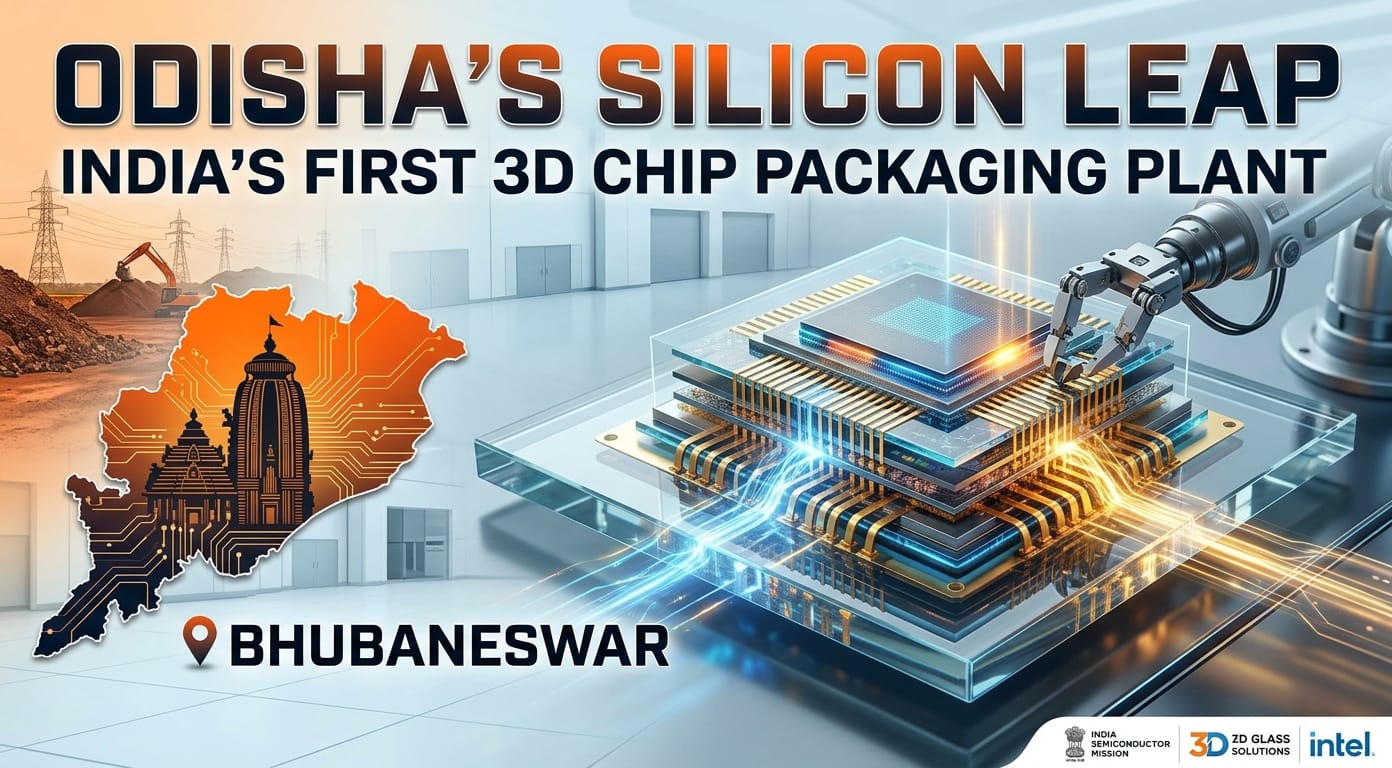
For decades, Odisha has been India’s metal chest iron ore, coal, aluminium, and power. A state that fed the furnaces of industrial India but rarely got to sit at the table of high technology. That changed on Monday, when the ground in Bhubaneswar literally shifted — not under the weight of another mine or smelter, but under the ambition of a semiconductor future.
Odisha Chief Minister Mohan Charan Majhi and Union IT Minister Ashwini Vaishnaw laid the foundation stone for India’s first advanced 3D chip packaging unit in Bhubaneswar, and the significance of that moment cannot be overstated. This isn’t just a factory. This is a statement that India’s semiconductor revolution will not be confined to the usual suspects.
The project is being implemented by US-based 3D Glass Solutions Inc through its wholly owned Indian subsidiary, Heterogeneous Integration Packaging Solutions Pvt Ltd. The Rs 1,934 crore investment had already received approval under the India Semiconductor Mission last year, and with Intel as one of its key funders, the project carries global credibility. Intel’s CEO Lip-Bu Tan joined the foundation ceremony virtually and his words carried weight. “I firmly believe the future of the semiconductor industry will be shaped by advanced packaging, heterogeneous integration, and breakthrough substrate technology capabilities that are increasingly central to performance scaling, power efficiency, and system-level innovation,” he said. “3D Glass Solutions is uniquely positioned in this critical segment of the value chain, and it is gratifying to see this vision take physical form here today.”
So what exactly is being built here? The plant will produce 70,000 glass panels annually, along with 50 million assembled units and around 13,000 advanced 3D heterogeneous integration modules. It is expected to generate approximately 2,500 direct and indirect jobs. But the real story is in the technology itself. 3D glass semiconductor packaging is not your run-of-the-mill chip assembly line. It uses specialised glass substrates not the traditional silicon wafers to enable high-performance, three-dimensional stacking of electrical components. Glass, as a substrate, offers lower electrical loss, superior radio frequency performance, and far better thermal stability, making it the preferred material for next-generation passive component integration. India, with this plant, will now be assembling and packaging chips that meet the demands of a world racing toward AI, 5G, and advanced computing.
Vaishnaw called it a “historic” day, and for once, the word doesn’t feel like bureaucratic hyperbole. His observation that Odisha has long been defined by mining, metal, and power and is now stepping into high-tech manufacturing captures the quiet revolution underway. “Odisha is now becoming an IT hub and an electronics manufacturing hub,” he said, framing this not as a one-off investment but as a directional shift in the state’s economic identity.
Lip-Bu Tan’s assessment of Odisha was equally pointed. He noted that the state offers surplus power, abundant and reliable water supply both critical for semiconductor manufacturing along with a growing base of skilled talent. “Together, these create a strong, sustainable foundation for advanced manufacturing,” he said, adding that Odisha’s “clarity of purpose, speed of decision-making, and commitment to execution” are precisely what building world-class semiconductor infrastructure demands. Coming from the CEO of one of the world’s most powerful chip companies, that is not flattery it is a benchmark.
That endorsement matters beyond the ceremony. India’s semiconductor ambitions have often been discussed in terms of wafer fabrication the glamorous, capital-intensive front end of chip manufacturing. But packaging and assembly, the so-called back end, is where enormous value is created and where India has a genuine competitive window. Countries like Vietnam and Malaysia have built thriving electronics ecosystems on the back of packaging excellence. India is late to this race, but moves like the Bhubaneswar plant suggest it is finally running.
The India Semiconductor Mission, which approved this project alongside another Odisha-based facility, is slowly stitching together a credible domestic ecosystem. Two approvals from a single state is not coincidence it reflects Odisha’s deliberate positioning as an investment-friendly destination with land, power, and policy clarity to offer. As Tan put it, this project “will do more than just establish a facility it will generate high-quality employment, enable local talent development, and contribute to the growth of a resilient semiconductor ecosystem, supporting India’s long-term technology and manufacturing aspirations.”
If India’s semiconductor dream has a chance, it will be built brick by brick or rather, glass panel by glass panel in cities like Bhubaneswar, by investors willing to take the long bet. Monday’s foundation stone suggests that bet is firmly being placed.

