
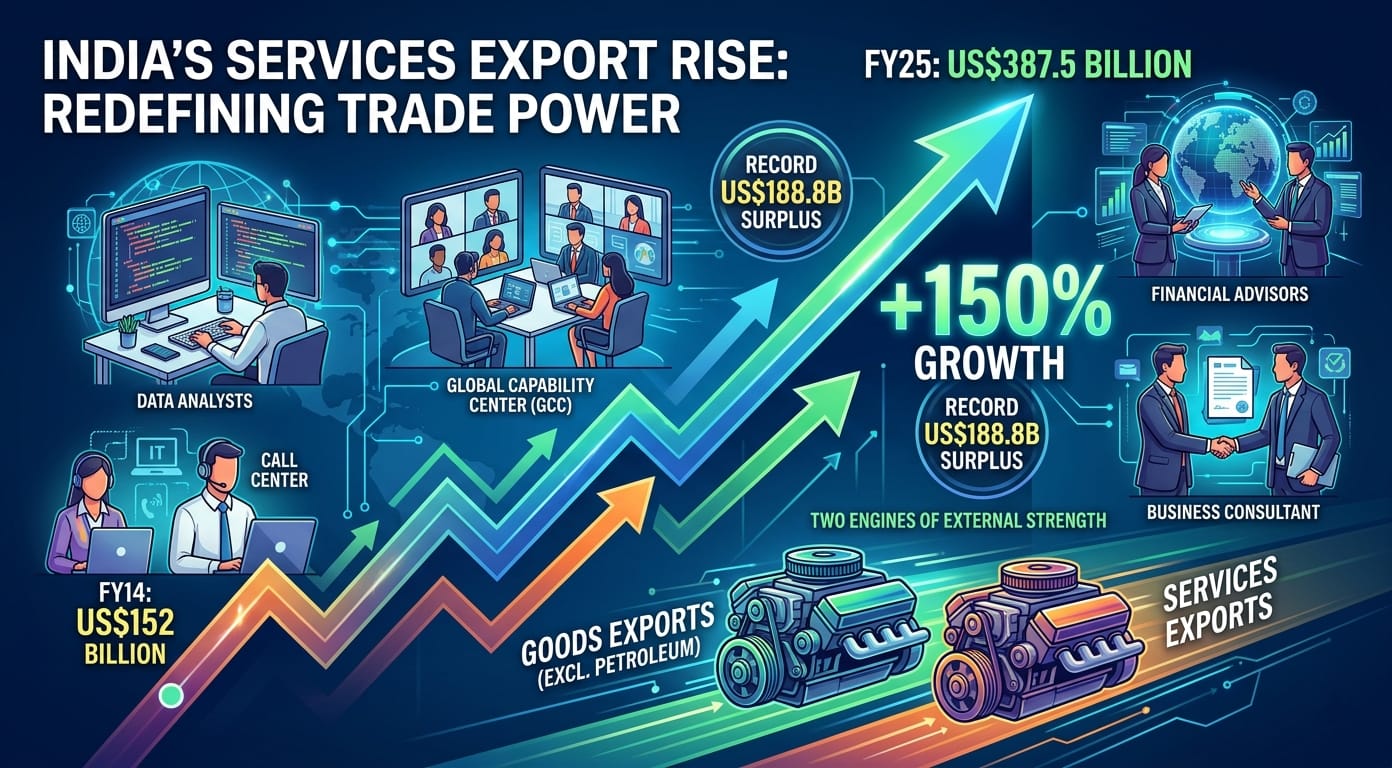
A decade ago, India’s services exports stood at US$152 billion in FY14, and by FY25 they had risen to US$387.5 billion, which reflects a rise of well over 150% in value terms over that period, based on the official figures released by the government.
PIB has also noted that the services sector remains a key contributor to India’s external strength, while the Economic Survey and official trade releases have repeatedly highlighted the sector’s resilience even in a weak global environment. That rise has not happened in a straight line; it has been powered by the long expansion of IT services, business process management, financial services, consulting, and digital platforms that now serve clients across continents.
The shift is striking because India’s export identity used to be dominated by goods. Today, services are not only growing fast, they are also balancing the trade account in a way few other sectors can. In FY25, merchandise exports excluding petroleum also reached a record US$374.1 billion, according to PIB, which means services exports stood almost shoulder to shoulder with goods exports.
That near-parity matters because it shows India is no longer depending on one export engine alone; it now has two engines running in parallel, with services often giving the economy more stability when global commodity cycles become volatile.
What makes the service story even more powerful is India’s improving global position. The Economic Survey 2024–25 said India’s share in global services exports had risen to around 4.3% in 2023 from 1.9% in 2005, and the country ranked among the top exporters of commercial services worldwide.
Some current trade posts and industry graphics now place India as the world’s fifth-largest exporter of services with roughly a 6% share, though official rankings vary depending on the year, category, and whether one counts commercial services or broader services trade . Even with that caveat, the direction is unmistakable: India has become one of the most important service exporters in the world.
This rise is also changing the way India earns foreign exchange. Services exports are increasingly cushioning the country against gaps in merchandise trade, especially when imports rise faster than goods exports. PIB reported that services exports reached a record US$387.5 billion in FY25 and that the services trade surplus hit US$188.8 billion, the highest ever, underscoring how valuable the sector has become for external stability. In practical terms, that surplus helps offset pressure from oil imports, supply-chain disruptions, and swings in global demand, making services a strategic asset, not just an economic statistic.
The most exciting part of the story is that the sector is still expanding into new layers of the economy. The Economic Survey pointed to strong global demand for Indian computer, information, and business services, while also noting the rising role of Global Capability Centres and digitally delivered services.
That means India’s export basket is not frozen in old IT stereotypes; it is moving toward higher-value, knowledge-intensive work. If this momentum continues, India’s services sector will not just be supporting the trade balance, it will increasingly define the country’s place in the world economy.

