
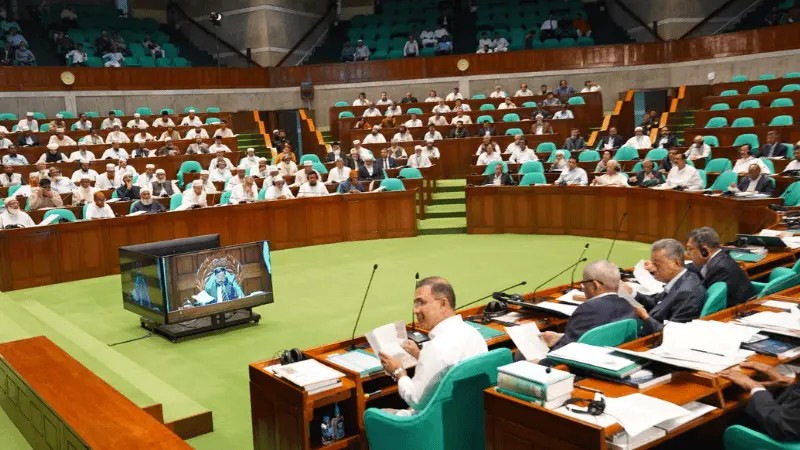
On April 9, 2026, the Jatiya Muktijoddha Council (Amendment) Bill, 2026 (JAMUKA Amendment Bill), introduced by the Liberation War Affairs Minister Ahmed Azam Khan, was passed in the Jatiya Sangsad (Parliament) of Bangladesh.
This Bill retained the names of parties such as Muslim League, Jamaat-e-Islami (JeI), and Nezam-e-Islam as collaborators of Pakistani occupation forces during the 1971 Liberation War. These were listed as forces opposed by freedom fighters. Earlier, on April 8, 2026, the Anti-Terrorism (Amendment) Bill, introduced by Home Minister Salahuddin Ahmed, was also passed in Jatiya Sangsad.
It added a provision allowing the government to ban the activities of individuals or entities involved in terrorism, including the Awami League and its leaders. This ban would hold until their trial at the International Crimes Tribunal (ICT) was completed.
A controversy has arisen over the JAMUKA Amendment Bill, over the retention of references to the then Muslim League, Jamaat-e-Islami, Nezam-e-Islam, and wartime collaborators, in the statutory definition linked to the Liberation War. Opposition Leader and JeI chief Shafiqur Rahman objected on the floor of the Jatiya Sangsad, arguing,
The names of the then Muslim League, Jamaat-e-Islami, and Nezam-e-Islam were not included in the definition by the rulers after independence. Late President Ziaur Rahman did not include them. A three-time honourable prime minister also did not include them… What is in this Bill? It mentions the names of three organisations: the then Muslim League, Jamaat-e-Islami, and Nezam-e-Islam Party. Alongside the Pakistan Army and some ancillary forces, the names of these three political parties have been included, and the current proposal refers to these organisations. In 1979, the Awami League itself was revived in Bangladesh through the Political Parties Revival Act. At that time, all political parties regained the opportunity and the right to engage in politics. We, too, regained that right then.
Rahman asserted that the wording of the Bill breaks post-independence practice. The JeI’s 11-party opposition alliance also opposed the Bill, with the exception of the National Citizen Party (NCP), which supported it and upheld accountability for the 1971 atrocities and war crimes.
The 2026 Anti‑Terrorism Amendment closes a key gap in the 2009 Anti‑Terrorism Act by converting a formal listing power into an explicit ban on activities. Under the 2009 Act, the government could declare an entity terrorist and list it in the Gazette, but the law did not clearly authorise the prohibition of all functions of a listed entity. This left space for an organisation to operate meetings, rallies, media, and online activities even after being proscribed. The 2026 Amendment remedies this by revising Section 18 to allow the government to “prohibit all activities” of designated entities, going beyond mere listing. A new Section 20 then imposes a blackout on communications, publications, media content, online propaganda, rallies, meetings, assemblies, press conferences, and speeches by proscribed groups, extending the ban to digital spaces and giving the state a more comprehensive tool to suppress operational and propagandistic activities.
Similarly, the 2022 Jatiya Muktijoddha Council Act focused on listing Bir Muktijoddha (Brave Freedom Fighters) and managing their welfare. However, the Act remained largely administrative. The Jatiya Muktijoddha Council (Amendment) Bill, 2026, updates this by adding “Associates of the Liberation War,” giving formal recognition to non-combat supporters who contributed from within the country or abroad. It also creates a JAMUKA Fund and allows the Council to appoint administrators or ad hoc committees for freedom fighter organisations when their executive bodies are dissolved or cancelled. These changes strengthen institutional capacity while preserving the core ideals of equality, human dignity, and social justice that the 2022 law originally aimed to uphold.
These legislative enactments under the BNP-led government in Bangladesh’s Jatiya Sangsad, the Jatiya Muktijoddha Council (Amendment) Bill, 2026, and the Anti-Terrorism (Amendment) Bill, 2026, embed the historical narratives of the 1971 Liberation War into the country’s legal frameworks, along with stronger counter-terrorism measures, to strengthen national memory and security effectiveness.
Author: Mantosh Kumar Singh – Research Assistant, Institute for Conflict Management

