
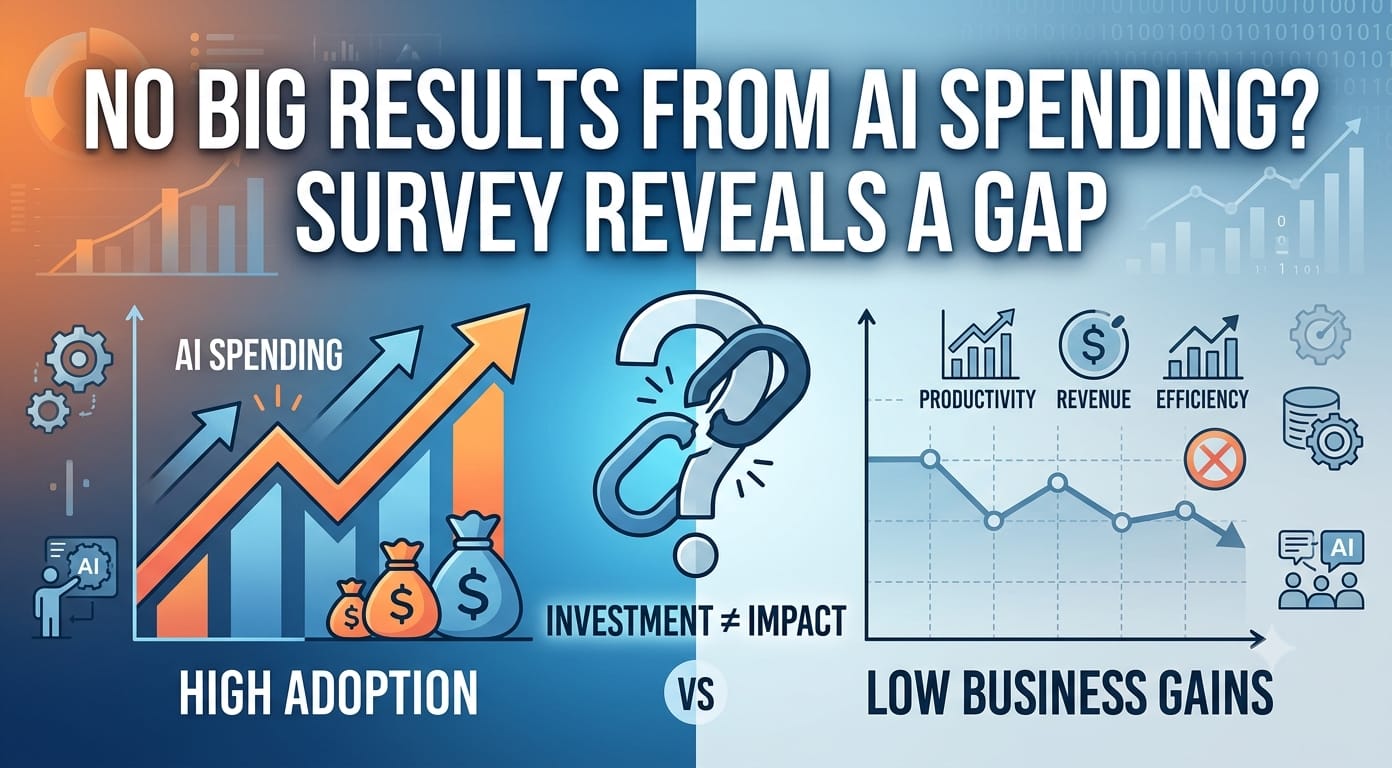
Many companies today are talking about artificial intelligence in a big way, and many are also spending a lot of money on it. Still, the real question remains simple: Is this spending bringing real business value? A recent survey suggests that the answer is not yet strong for most firms.
The main concern is that AI is being adopted faster than it is being used in a meaningful way. In many workplaces, the excitement around AI is visible, but the practical outcome is still limited.
The survey found a clear gap between technology adoption and business impact. On one side, companies are putting money into AI tools, employee training, and enablement programs. On the other side, measurable improvement in sales, operations, or productivity is still not happening at the expected level.
This creates a situation that many organizations can relate to. A tool may be present, a plan may be announced, and training may be given, but the daily work flow may still look almost the same. That is why the discussion around AI is slowly shifting from adoption to results.
One of the biggest reasons behind this gap is the lack of clarity about use cases. In simple terms, many companies are not fully sure where AI should be used first and what problem it should solve. This is important because AI gives value only when it is connected to a clear task. If the purpose is vague, the investment may not lead to useful output. In such a case, AI may become more of a brand value symbol than a practical business tool.
The survey also points to a deeper issue, which is data quality. Even the best AI system depends on the quality of the data fed into it. If the data is weak, outdated, or incomplete, the result is also likely to be weak.
Another major finding is that many organizations want AI to work inside existing systems, but the integration is still difficult. This is a common challenge in large companies, where new tools must fit into old processes, current software, and established work culture. A training program may teach employees how AI works, but that does not always mean the company is ready to use it in daily decision-making.
There is also a difference between training people in theory and preparing them for real tasks. Many firms may now have employees who know the basics of AI, but fewer have teams that can use it smoothly in actual business situations.
The report also highlights that companies are not always linking AI with broader business goals such as revenue, cost control, brand strength, or employee value. This matters because technology spending becomes meaningful only when it supports a larger business purpose. In many cases, the value of AI is discussed in abstract language, while the connection to real outcomes remains weak.
That is why the survey suggests that organizations should stop asking only how much AI they have adopted and start asking what real problem it has solved. This is the point where many firms may need to pause and rethink their approach.
The simple lesson from the survey is easy to understand. AI is not failing, but the way it is being used is still uneven. Spending more money does not automatically create better results. Real success will depend on clear use cases, better data, stronger integration, and practical training.
For companies, this is a reminder that technology works best when it is tied closely to everyday business needs. The future of AI will likely belong not to those who only buy the tools, but to those who use them with clarity and purpose.

