
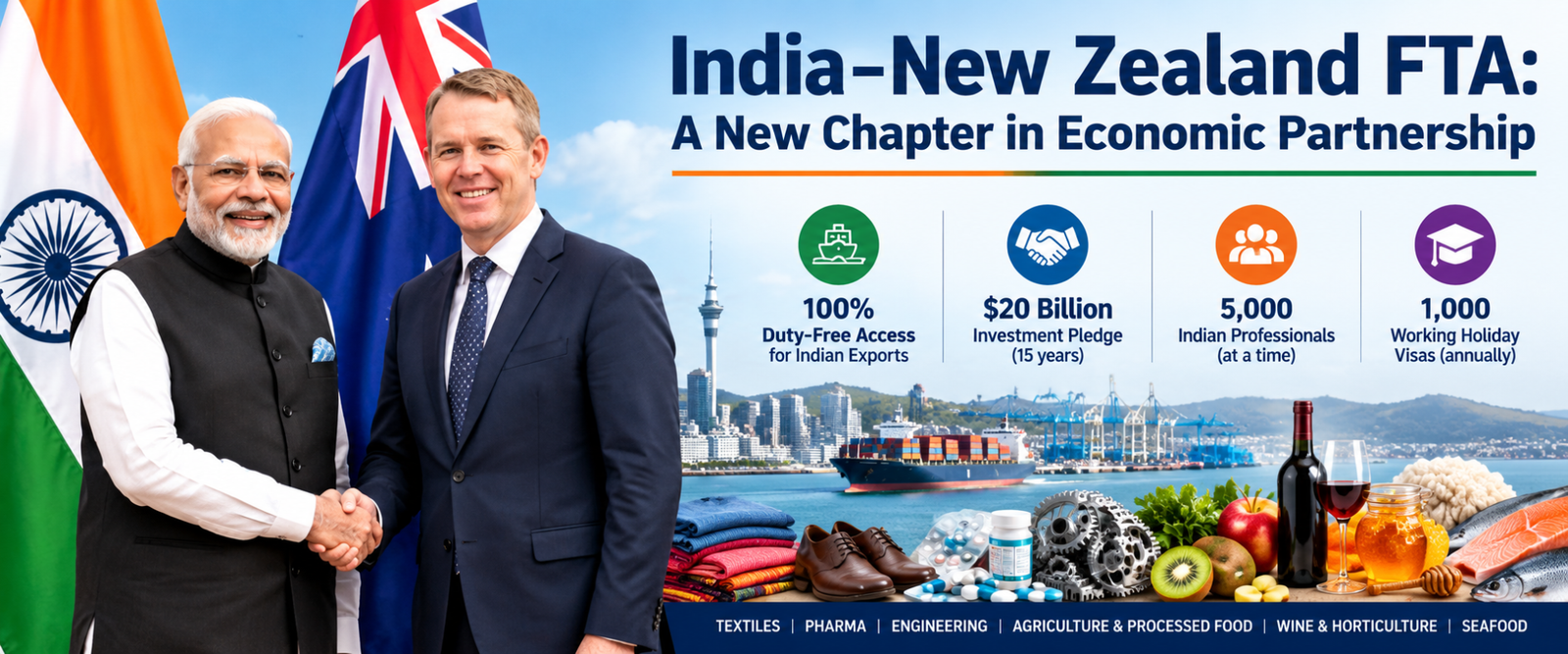
In a historic development, India’s Free Trade Agreement with New Zealand has moved closer to implementation after the New Zealand parliament passed the pact by a vote of 93 to 29 on September 16, following its signing in April this year.
Once domestic procedures are completed, the agreement will mark a new phase in bilateral economic ties. More importantly, it shows how India’s foreign policy is increasingly using economic partnerships to create opportunities for its businesses, workers, students and consumers. The agreement is therefore less about choosing sides in global politics and more about expanding India’s room for economic manoeuvre.
Signed on April 27, 2026, the FTA gives Indian exporters 100% duty-free access to New Zealand’s tariff lines from entry into force. This matters because New Zealand had tariffs of up to 10% on several Indian products. Textiles, apparel, leather, footwear, carpets, pharmaceuticals, engineering goods, automobiles and auto components are among the sectors positioned to benefit. India’s agriculture and processed-food exports also gain wider access.
The scale of the opportunity becomes clearer when compared with the starting point. Bilateral trade remains modest, at about US$1.3 billion in 2024-25 on India’s merchandise-trade measure. The agreement gives Indian companies access to a market where their existing penetration is still limited. In services, India receives commitments across 118 sectors or sub-sectors, alongside most-favoured-nation treatment covering 139 sectors. The agreement also provides a pathway for 5,000 Indian professionals to be in New Zealand at any one time, plus 1,000 Working Holiday visas annually. Students receive expanded work and post-study opportunities.
The investment component could prove even more important. New Zealand has committed to facilitating US$20 billion of private-sector investment into India over 15 years, covering areas such as manufacturing, infrastructure and innovation. The figure should not be confused with a government-to-government transfer. Its real value will depend on how much announced investment becomes actual projects, employment and productive capacity.
New Zealand also gains substantially. It receives preferential access covering 95% of its current exports to India by value. Forestry, sheep meat, wool, seafood, horticulture, wine and mānuka honey receive new concessions. Apple and kiwifruit quotas, in particular, create access that did not previously exist in India’s FTAs. At the same time, India has kept sensitive areas such as core dairy products outside the agreement.
The broader message is important. India’s trade policy is moving towards a network of economic partnerships that can support domestic growth without requiring geopolitical alignment as the sole basis of a relationship. The focus is increasingly on market access, investment, technology, skills and opportunities for Indian citizens.
New Zealand is part of a larger pipeline. India has concluded agreements with the EU, UK and Oman, while negotiations continue with Israel, Canada, Chile, Peru and the Eurasian Economic Union, alongside the review of its ASEAN trade agreement. The EU agreement alone covers a market representing roughly US$24 trillion and provides access for more than 99% of India’s exports by trade value.
The real test of this milestone is the momentum it creates in the real world. Here, India’s strategic trade vision comes alive as seamless tariff access drives vibrant export expansion, investment pledges build world-class factories, and mobility frameworks bring skilled professionals to global opportunities. Ultimately, every new partnership is a powerful engine – expanding global market access, empowering local industries, and creating sustainable, high-value jobs across the country.

