
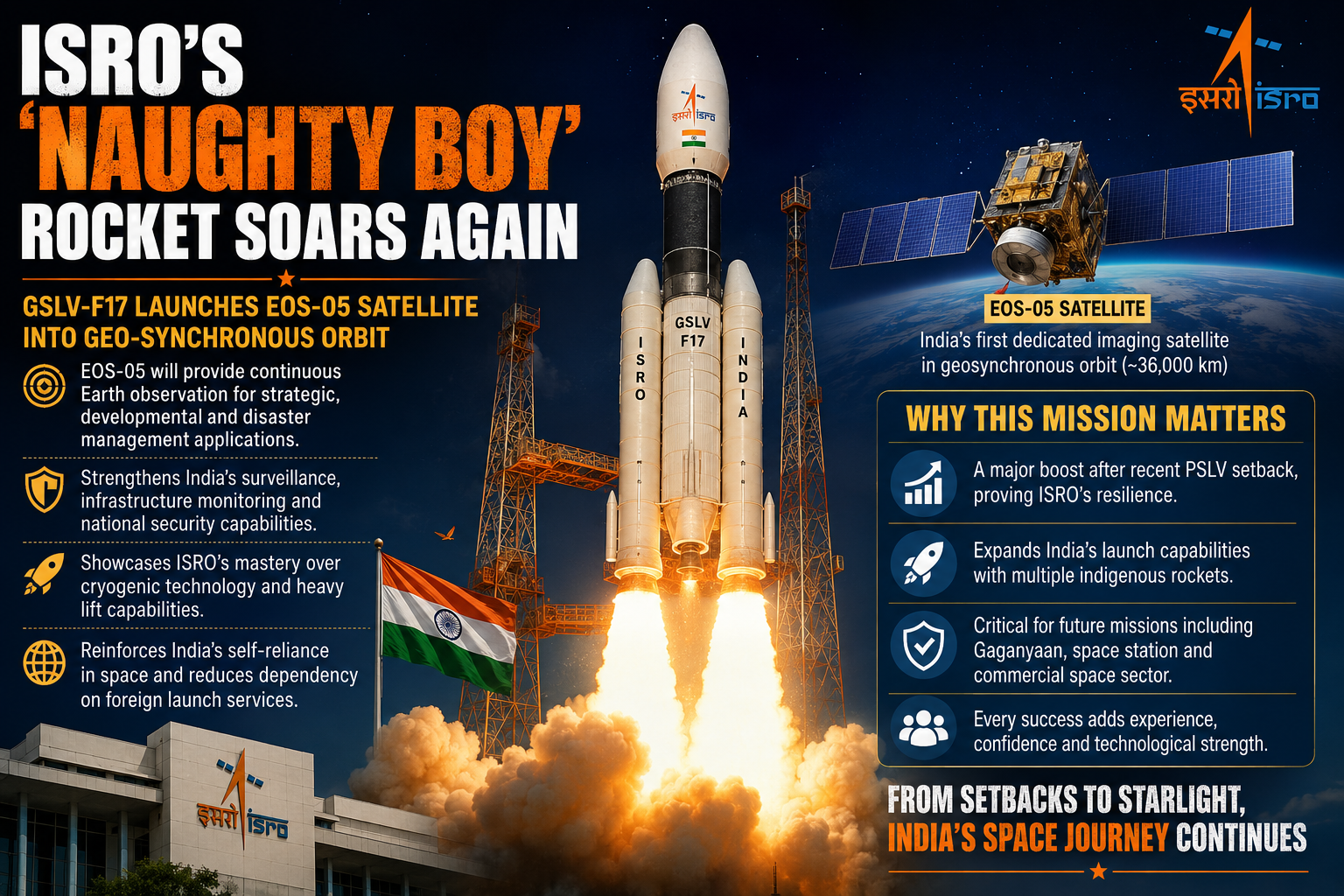
India’s space programme received a major boost on Friday, September 4, as the Indian Space Research Organisation (ISRO) successfully launched the GSLV-F17 carrying the EOS-05 Earth observation satellite. Nicknamed the “Naughty Boy”, the Geosynchronous Satellite Launch Vehicle (GSLV) has earned a reputation over the years for its unpredictable record. Its latest success, therefore, carries significance far beyond a routine satellite launch.
The GSLV-F17 mission is particularly important because EOS-05 is designed to operate from a geosynchronous orbit, around 36,000 kilometres above Earth. It is India’s first dedicated imaging satellite intended for this type of orbit and is expected to provide continuous observation of the country and surrounding regions. Such a capability can have applications ranging from disaster management and infrastructure monitoring to strategic and national-security surveillance.
The success also comes at a crucial moment for ISRO. The agency has faced recent setbacks involving the PSLV, traditionally regarded as its workhorse launch vehicle. The PSLV-C62 mission encountered an anomaly in January 2026, leading to a detailed investigation. Against this backdrop, the successful GSLV-F17 mission demonstrates that India retains multiple indigenous launch capabilities rather than depending on a single rocket family.
The “Naughty Boy” nickname itself reflects the GSLV’s complicated history. The rocket has experienced failures during its development and operational journey, making every successful flight an important demonstration of engineering maturity. Yet its story is also one of perseverance. Developing the cryogenic propulsion technology needed for more demanding missions was a major technological challenge for India. Mastering this technology strengthened the country’s ability to independently launch heavier satellites into higher orbits.
That self-reliance is perhaps the biggest significance of the GSLV-F17 mission. Space technology is closely connected to national capability, communications, Earth observation, navigation, scientific research and strategic security. Having indigenous launch vehicles reduces dependence on foreign providers and gives India greater control over when and how important satellites are placed in orbit.
The mission also fits into a much larger transformation of India’s space programme. In recent years, ISRO has achieved milestones including Chandrayaan-3’s historic lunar landing, the Aditya-L1 solar mission and the SPADEX demonstration of autonomous docking and undocking. India has also operationalised several indigenous launch vehicles, including PSLV, GSLV, LVM3 and SSLV.
The GSLV-F17 success therefore represents more than the revival of one rocket. It reinforces India’s growing ability to build, launch and operate increasingly sophisticated space systems independently.
For a country preparing for human spaceflight through Gaganyaan, developing a national space station and expanding its commercial space sector, reliable launch capability is indispensable. Every successful mission adds experience, confidence and technological know-how.
The “Naughty Boy” may have lived up to its mischievous nickname in the past, but its latest performance sends a different message, the message being that India’s space programme is becoming more resilient, more self-reliant, and increasingly capable of taking on ambitious missions of its own.

